Editorial Calendar Vs Content Calendar: Strategy Vs Schedule
At AI Flow Chat
Contents
0%Most creators and marketers use the terms interchangeably, but an editorial calendar vs content calendar refers to two distinct tools with different jobs. One maps out your big-picture strategy, themes, campaigns, narrative arcs. The other tracks the day-to-day execution, what gets published, where, and when. Mixing them up (or only using one) is a common reason content workflows feel chaotic even when you're technically "organized."
The distinction matters more than it sounds. An editorial calendar answers why you're creating something. A content calendar answers how and when it goes live. When both work together, you get a system where every post, video, and article ties back to a larger goal instead of floating in isolation. Without that connection, you're just filling slots on a schedule and hoping something sticks, which is exactly the kind of inefficiency that burns out solo marketers and small teams.
This article breaks down the real differences between the two, explains when you need one or both, and shows how to connect strategy to execution without overcomplicating your process. If you're using AI Flow Chat to pull insights from viral content, build repeatable workflows, and produce at scale, understanding this distinction will help you structure what you feed into those workflows so the output actually serves a cohesive content strategy rather than a random publishing queue.
What an editorial calendar is
An editorial calendar is a strategic planning document that gives your content a reason to exist. It operates at the campaign or quarter level, mapping out your core themes, content pillars, target audiences, narrative arcs, and how each piece of content ties back to a business objective. Think of it as the why layer of your content operation. When you're comparing an editorial calendar vs content calendar, the editorial calendar is the one that answers whether a piece of content should exist at all, not just when it should go out.
The strategic scope of an editorial calendar
Most editorial calendars span weeks, months, or an entire quarter. They reflect decisions made upstream, like which product launch you're supporting, what seasonal moment you're leaning into, or which audience segment you're trying to reach with a specific message. A marketing team producing content for a product launch might use an editorial calendar to plan a six-week narrative arc: awareness content in week one and two, comparison content in week three and four, and social proof content leading into the launch date. Each piece of content on the schedule connects to that arc.
An editorial calendar without strategic intent is just a list of topics. The strategy is what separates a plan from a pile of ideas.
Your editorial calendar also captures editorial guidelines and voice direction so that anyone producing content, whether that's you, a freelancer, or an AI tool, understands the tone and angle before they start. This is especially useful when you're feeding reference material into an AI workflow. If your editorial calendar specifies that a campaign should take a skeptical, data-driven angle aimed at performance marketers, that context shapes every prompt and output that follows.
What an editorial calendar typically contains
Unlike a day-by-day publishing tracker, an editorial calendar focuses on the big picture. The specific elements will vary by team size and workflow, but a functional editorial calendar generally includes:
- Campaign themes and content pillars: The core topics or narrative threads you're building around for the period
- Business objectives: What each campaign or content block is supposed to achieve, whether that's driving sign-ups, building brand awareness, or supporting a sales cycle
- Target audience per campaign: Which segment you're speaking to and what their specific pain points are during that campaign window
- Content formats and channels: A high-level view of whether a theme will be addressed through video, long-form articles, short-form social, or email, and on which platforms
- Key dates and milestones: Product launches, seasonal events, industry moments, or internal deadlines that anchor the content plan to real-world timing
Keeping these elements inside one document means you always have a reference point when priorities shift or new content requests come in. Instead of asking "should we make this piece of content?" you can check it against your editorial calendar and answer that question in seconds.
What a content calendar is
A content calendar is the execution layer of your content operation. Where an editorial calendar captures themes, goals, and strategic intent, a content calendar tracks the specific details of what actually goes live: the title, platform, publish date, format, status, and who is responsible for delivering it. If your editorial calendar is the plan, your content calendar is the production board. In the context of editorial calendar vs content calendar, this is the tool you check daily, not quarterly.
What a content calendar tracks
A content calendar gets granular in ways that an editorial calendar never needs to. It is the place where a campaign theme turns into a specific Instagram Reel with a working title, a publish date, an assigned creator, and a status of "in review." Every individual piece of content gets its own row or card, and the calendar gives you a real-time snapshot of what is in progress, what is scheduled, and what is overdue.
A content calendar without an editorial calendar behind it produces consistent output with no strategic direction.
A functional content calendar typically includes:
- Title or working title: The specific piece of content, not just a topic category
- Platform and format: Where it is going and what form it takes (video, carousel, article, email)
- Publish date: The exact date and time it goes live
- Owner: Who is responsible for producing and delivering it
- Status: Draft, in review, scheduled, or published
How a content calendar differs from a to-do list
Your content calendar is not just a task list. It gives you a [visual timeline](https://aiflowchat.com/blog/articles/notion-content-calendar-template) showing how your content is distributed across platforms and days, so you can spot gaps or overloads before they become real problems. When you see three pieces going live on Tuesday and nothing on Thursday, you can redistribute the load before you are scrambling to fill a blank slot.
Unlike a task manager, the calendar also shows publishing rhythm and platform balance, which helps you avoid over-indexing on one channel while neglecting another.
Editorial vs content calendar: key differences
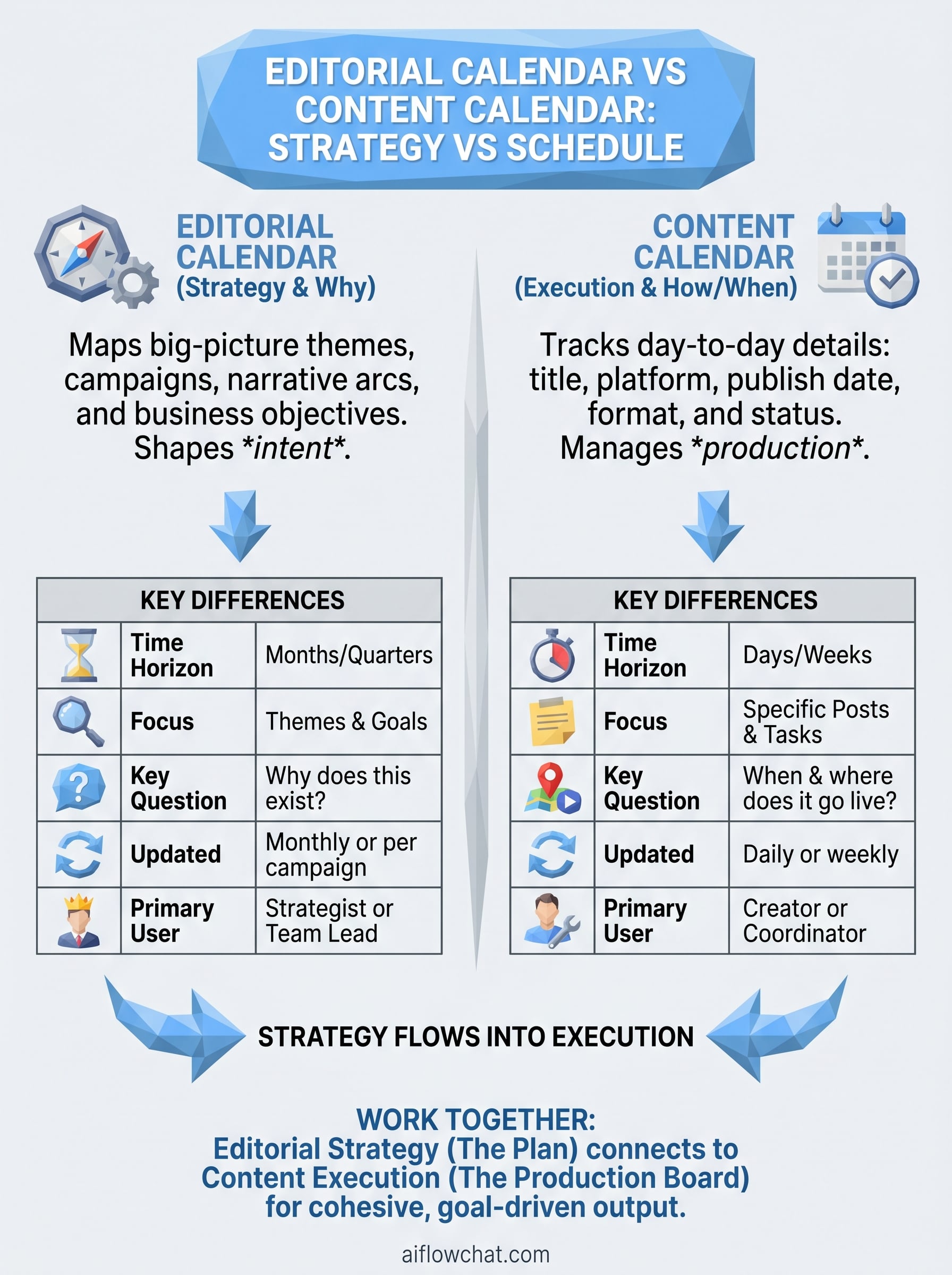
Understanding where one tool ends and the other begins saves you from using the wrong document for the wrong decision. When you're working through the editorial calendar vs content calendar question, the clearest way to separate them is by asking: are you deciding what to create and why, or how and when to ship it? The editorial calendar answers the first question, and the content calendar answers the second. They are not competing tools; they operate at different altitudes.
Scope and time horizon
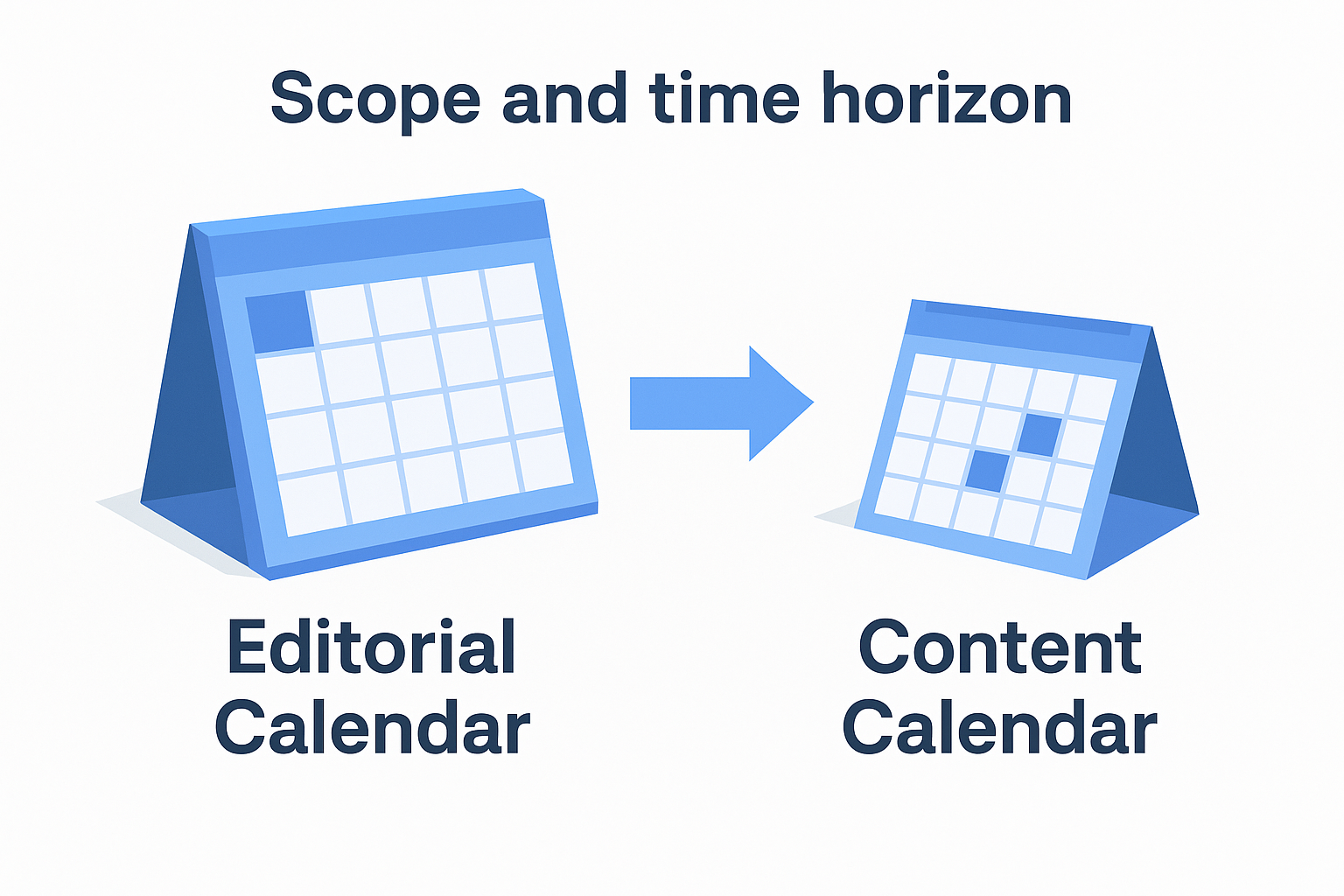
Your editorial calendar runs at a higher level and longer time horizon than your content calendar. It covers quarters, campaigns, and strategic themes. Your content calendar zooms in to weeks and days, tracking individual pieces across specific platforms. Both tools run in parallel, but they serve completely different decisions.
| Factor | Editorial Calendar | Content Calendar |
|---|---|---|
| Time horizon | Months or quarters | Days or weeks |
| Focus | Strategy and themes | Specific posts and tasks |
| Key question | Why does this content exist? | When and where does it go live? |
| Updated | Monthly or per campaign | Daily or weekly |
| Primary user | Strategist or team lead | Creator or coordinator |
The editorial calendar is where you make decisions. The content calendar is where you act on them.
Intent vs. execution
The editorial calendar shapes intent: which audience you are targeting, which narrative arc supports a launch, which content pillar a campaign belongs to. Those decisions then flow into the content calendar as specific titles, formats, and deadlines that your production workflow can act on.
Without the editorial layer, your content calendar fills up with posts that have no connective tissue between them. Without the content calendar, your editorial strategy never leaves the document it lives in. Both tools handle different layers of the same problem, and treating them as interchangeable is what causes publishing plans to feel disconnected from business goals.
How to build an editorial calendar
Building an editorial calendar starts with defining your time horizon and business objectives before you touch any scheduling tool. The most common mistake people make is jumping straight into topic brainstorming without anchoring themes to a real goal. When you understand the editorial calendar vs content calendar distinction, you know that the editorial layer is where strategy lives, so the first thing you place on it is not a post title but a campaign objective and the audience segment it serves.
Start with the goal, not the topic. Topics without goals produce content that fills time rather than drives results.
Define your themes and content pillars
Your content pillars are the three to five core topic areas your brand consistently addresses. Each pillar should map to a specific audience pain point or business priority. Once your pillars are set, use them to group your campaigns. A quarter with three campaigns should have each campaign anchored to one or two pillars so your content output stays coherent rather than scattered across unrelated subjects.
Under each pillar, assign specific campaign themes for the period. A campaign theme is narrower than a pillar and far more useful for directing production. If your pillar is "content workflow efficiency," a campaign theme might be "how solo creators can produce more with fewer tools in Q3." That level of specificity is what makes an editorial calendar actionable when you start generating content at scale.
Map your key dates and review cadence
Once your themes are set, plot your anchor dates first: product launches, seasonal moments, and campaign start and end dates. These fixed points create the structure your editorial calendar works around. Fill in campaign phases between them, noting which weeks are building awareness and which weeks are pushing toward conversion.
Your editorial calendar should get reviewed monthly, not just set at the start of a quarter and left alone. A monthly review lets you shift themes based on performance data, pivot around unexpected opportunities, and keep your content plan connected to what is actually working.
How to build a content calendar
Building a content calendar is faster than building an editorial calendar because you are executing decisions that have already been made, not making new ones. Your editorial calendar tells you what campaigns are running and why. Your content calendar takes that input and breaks it down into individual pieces with specific ownership and deadlines. If you understand the editorial calendar vs content calendar distinction, this step is where strategy finally becomes a publishing schedule.
Choose your format and tool
Your content calendar needs to be simple enough that you will actually update it daily. A spreadsheet, a project management board, or a dedicated content planning tool all work. What matters is that your format gives you a clear view of what is going out, on which platform, and on what date. Avoid overbuilding it with columns you will never fill in. Start with the minimum viable fields and add complexity only when you identify a real gap in your workflow.
A content calendar you actually use is more valuable than a sophisticated one you ignore.
Fill in your content details
Once your format is set, pull each campaign from your editorial calendar and break it into individual content pieces. For each piece, you need a working title, the platform it is going to, the publish date, the owner, and the current status. These five fields give you everything you need to manage production without guessing.
Fill your calendar two to four weeks in advance so your team or workflow has enough lead time to produce content without rushing. Leave buffer slots open for reactive content, since breaking news, platform trends, or unexpected wins from your audience can create opportunities worth acting on quickly. Review the full calendar at least once per week to update statuses, catch anything that has slipped, and confirm that the next seven days are fully loaded and on track.
A simple way to move forward
The editorial calendar vs content calendar distinction comes down to one practical question: are you deciding what to create, or managing how it gets done? Your editorial calendar holds the strategy, your content calendar holds the schedule, and both need each other to produce output that actually serves a real business goal. If you only have one right now, build the other before you add more content to your production queue. The two tools are not redundant; they handle different layers of the same problem.
Once your two-layer system is in place, the next move is making production faster without losing quality. AI Flow Chat lets you pull viral content, competitor ads, and reference materials directly into a visual workflow canvas, so you can generate on-brand content that maps back to your editorial themes without starting from scratch every time. You feed your strategy into the tool, and the tool helps you execute it at scale.
Continue Reading
Discover more insights and updates from our articles
Choose an AI model for scripts, marketing copy, coding, research, long documents, and quick everyday work using a practical quality, speed, and credit-cost framework.
Compare eight current Poppy AI alternatives for visual research, creator workflows, general AI work, grounded synthesis, automation, and reusable delivery.
A practical method for turning a scattered content process into a clear AI-assisted flowchart with source context, review checks, and a reusable output.