Content Strategy Vs Content Marketing Strategy: Explained
At AI Flow Chat
Contents
0%Most people use "content strategy" and "content marketing strategy" interchangeably. They're not the same thing. The difference between them isn't just semantics, it affects how you plan, produce, and distribute every piece of content your brand puts out. If you've ever searched content strategy vs content marketing strategy and walked away more confused, you're not alone. The overlap is real, but the distinction matters if you want either one to actually work.
Here's the short version: content strategy is the big-picture framework that governs all content across your organization, product pages, internal docs, UX copy, help centers, everything. Content marketing strategy is a subset of that. It focuses specifically on creating and distributing content to attract, engage, and convert a defined audience. One is the architecture. The other is a room inside it. Understanding where each starts and stops gives you a clearer execution plan instead of a vague "we should post more" approach.
This matters especially if you're a creator, marketer, or agency owner producing content at scale. When you're using a platform like AI Flow Chat to reverse-engineer viral content, build repeatable workflows, and generate outputs from multiple reference sources, you're operating inside both of these strategies simultaneously. The AI canvas handles execution, but knowing which strategy you're executing against is what separates random output from content that compounds over time.
In this article, we'll break down both concepts with clear definitions, walk through how they overlap and where they diverge, and explain how they work together in practice. By the end, you'll have a framework you can actually use, not just a vocabulary lesson. No jargon walls, no circular definitions. Just a clear picture of what each strategy covers and how to apply both.
Content strategy and content marketing strategy defined
Before you can resolve the content strategy vs content marketing strategy debate in your own business, you need a working definition of each. They share vocabulary and they overlap in goals, but they operate at very different levels of scope. Getting both definitions right gives you something concrete to build from instead of guessing which one applies to the problem in front of you.
Content strategy: the full-picture framework
Content strategy is the high-level plan that governs every piece of content your organization produces, regardless of channel or purpose. That includes your website copy, product descriptions, onboarding emails, internal wikis, support documentation, and your social posts. The goal of content strategy is to make sure all content serves a clear organizational purpose, stays consistent in voice and quality, and connects directly to your broader business objectives.
Content strategy answers the question: "Why does this content exist, and how does it fit into everything else we do?"
Think of content strategy as the architecture of your brand communication. It defines the rules, the structure, the voice guidelines, the governance model, and the systems that determine how content gets created, reviewed, published, and maintained over time. When a product team writes UI copy and a marketing team writes blog posts, content strategy keeps both aligned so your audience gets a coherent experience across every touchpoint rather than a fragmented one.
Content marketing strategy: the audience-facing layer
Content marketing strategy lives inside the content strategy framework. It focuses specifically on producing and distributing content that attracts a defined audience and moves them toward a business outcome, usually a purchase, a signup, or a qualified lead. Where content strategy is broad and organizational, content marketing strategy is targeted, measurable, and conversion-aware.
Your content marketing strategy covers your editorial calendar, your SEO keyword targets, your distribution channels, your content formats, and your performance benchmarks. It asks: who are you trying to reach, what problems do they have, what formats do they prefer, and how do you track whether the content is working? These are audience-first decisions that sit on top of the organizational rules your content strategy sets. Without that broader foundation underneath it, a content marketing strategy tends to drift, producing content that performs in one channel but conflicts with your brand voice everywhere else, creating confusion instead of trust.
What each one owns in a business
When you map content strategy vs content marketing strategy onto actual business operations, the ownership split becomes clearer. Each one covers a distinct set of responsibilities, and knowing which team or individual owns what prevents duplicate work, conflicting messaging, and content that serves no clear purpose.
What content strategy owns
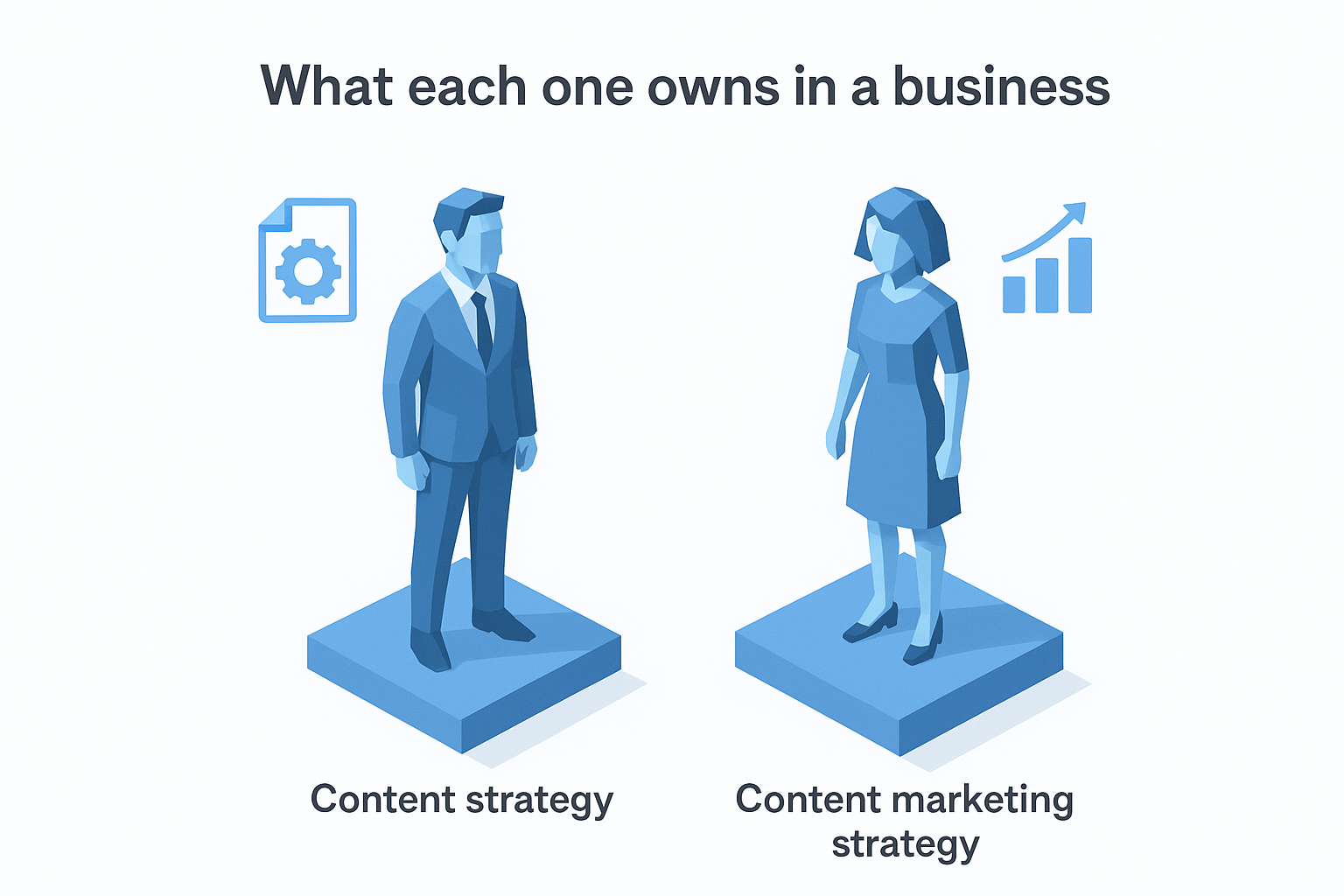
Content strategy owns the rules and infrastructure that govern all content across your organization, not just what your audience finds in a Google search. It sets the standards every team writing under your brand name must follow. That includes:
- Brand voice and tone guidelines
- Content governance and approval workflows
- UX and product copy
- Support documentation and internal wikis
- Editorial standards across all departments
Without this layer, non-marketing content like onboarding emails or help articles will drift from your brand experience and undermine the credibility your marketing content works to build.
What content marketing strategy owns
Content marketing strategy owns the audience-facing execution plan: your blog, social channels, email campaigns, lead magnets, and video content. It controls your editorial calendar, keyword targets, distribution plan, and the performance metrics you use to determine whether the content earns its place. This is where conversion intent lives.
If content strategy sets the standards, content marketing strategy is where you put those standards to work in front of real people.
Your format, frequency, and platform decisions all live here, tied directly to what your audience engages with and what moves them toward a specific action.
How they work together in one funnel
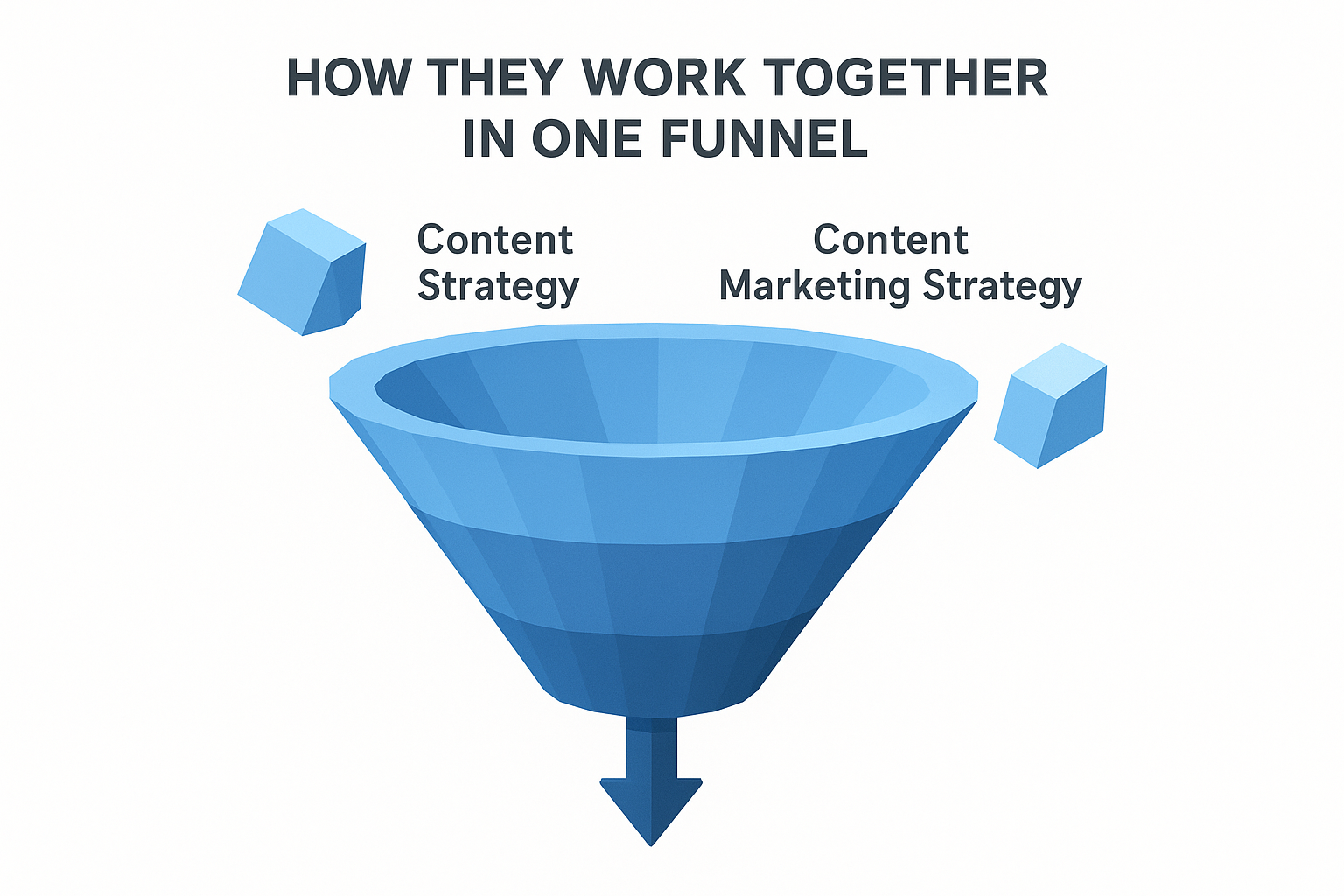
Understanding content strategy vs content marketing strategy as two separate layers is useful, but you also need to see how they connect inside a single funnel. The two strategies aren't competing priorities. They're complementary, and the funnel is where that relationship becomes visible and measurable. One sets the rules the other plays by.
Content strategy sets the guardrails
Content strategy defines the constraints your marketing content operates within, including voice guidelines, editorial standards, and governance rules. These guardrails apply at every stage of the funnel, not just the top.
When a blog post brings someone to your site, your UX copy, product pages, and support documentation need to deliver the same brand experience that drew them in. If those layers conflict, the funnel leaks trust at every transition point. A visitor who lands on a polished, conversational blog post and then hits a cold, technical product page will disengage before converting.
A funnel built on aligned content strategy converts better because every touchpoint reinforces the same message and voice, not just the entry point.
Content marketing strategy drives movement through it
Content marketing strategy is what actively pulls people into the funnel and moves them from one stage to the next. Your blog earns the click. Your email nurture sequence builds familiarity and intent. Your case study or comparison page closes the gap between consideration and conversion.
Each piece of marketing content carries a defined role, a specific audience segment, and a measurable outcome tied to funnel position. Without that structure underneath, content gets produced but doesn't move anyone toward a decision. When both strategies operate in sync, every asset earns its place instead of just filling a calendar slot.
How to build both without extra headcount
The content strategy vs content marketing strategy split can sound like a two-team problem, but most creators and solo marketers run both from a single seat. The key is building lightweight, reusable systems instead of separate documents that nobody updates. You don't need an agency structure to get this right. You need clear ownership and a repeatable process.
Start with a one-page content strategy document
Your content strategy doesn't need to be a 40-page brand bible. A single reference document covering your voice guidelines, content principles, and governance rules is enough to keep every asset you produce aligned. Write it once, share it with anyone who creates content under your name, and update it when your brand evolves.
A one-page content strategy document you actually use beats a detailed one that stays in a folder.
Include your audience definition, core topics you cover, and a short list of what your brand never says. That's your guardrail layer. Every piece of marketing content you produce checks against this before it goes out.
Turn your content marketing strategy into a repeatable system
Once your guardrails exist, your content marketing strategy becomes a workflow problem, not a planning problem. Build a repeatable system: a fixed set of content formats, a weekly or monthly publishing rhythm, and a short checklist that maps each piece to a funnel stage and a measurable outcome.
Tools that let you template prompts, analyze reference content, and schedule outputs cut the manual work significantly. You stop rebuilding your strategy every month and start executing against a system that compounds results over time.
Common mistakes and how to fix them
Most problems in content strategy vs content marketing strategy come down to one root cause: people collapse both into a single vague plan, then wonder why their content feels scattered. Knowing the common failure points helps you catch them before they cost you time and traffic.
Treating both strategies as identical
When you treat your content marketing strategy as your entire content strategy, non-marketing content gets ignored. Your help docs, onboarding copy, and product pages drift away from your brand voice because no one owns the rules that govern them. The fix is simple: write a separate one-page document that covers brand voice, editorial standards, and what your content never says. That document becomes the foundation every other content decision sits on.
Your content marketing strategy can only be as strong as the content strategy framework underneath it.
Building campaigns without a defined audience
A common failure in content marketing strategy is producing content around topics without tying each piece to a specific audience segment and funnel stage. You end up with a full calendar and low conversions because the content doesn't pull anyone toward a decision. Fix this by mapping every asset you plan to produce against a defined reader, a problem they have, and a next step you want them to take after reading.
Skipping performance review
Many creators set up a content plan and never look back at the data. Without regular performance reviews, you keep producing formats and topics that don't move the needle while cutting the ones that actually do. Schedule a monthly review of your top and bottom performers. Drop what isn't working and double down on what converts.
Key takeaways
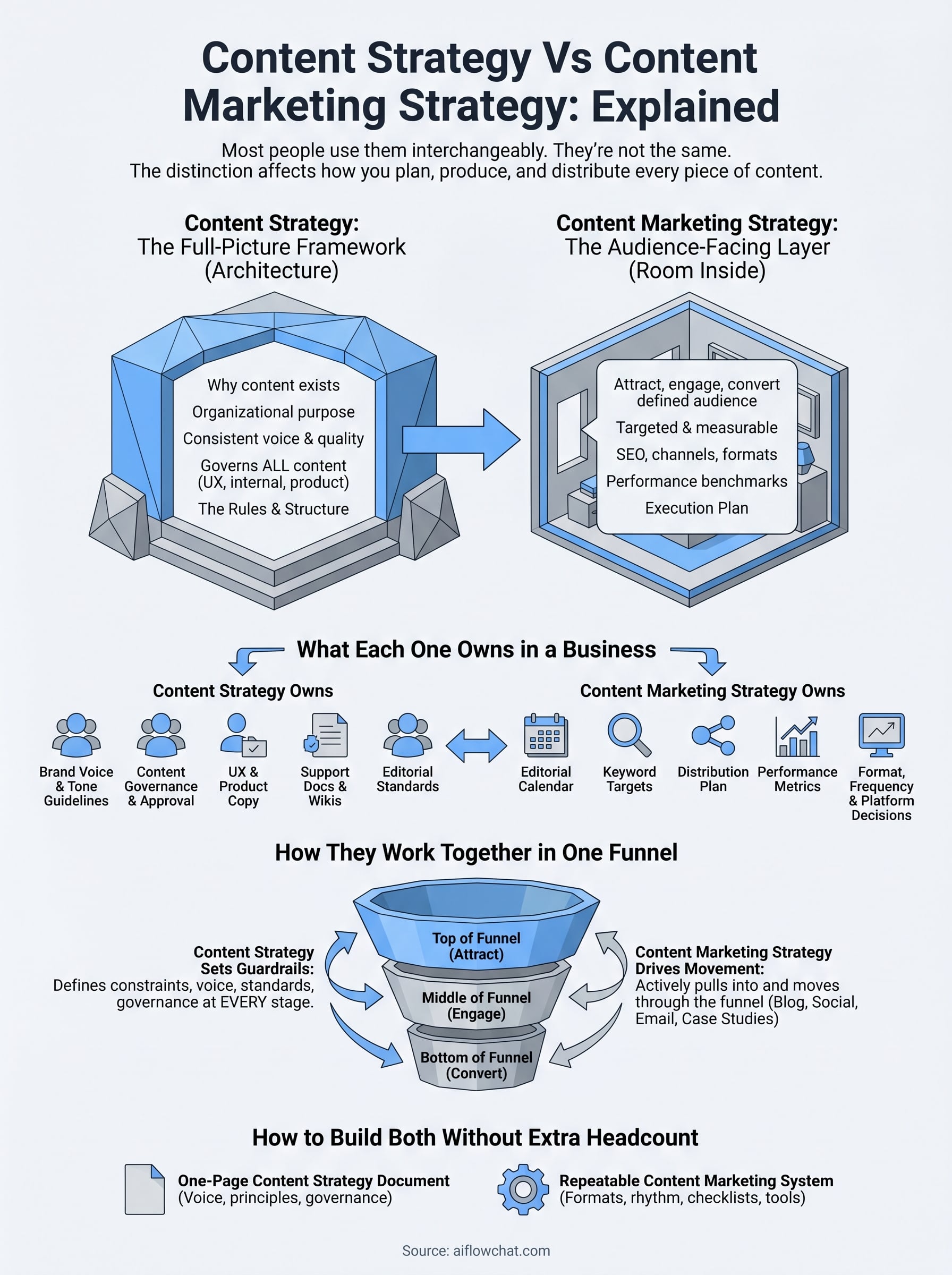
The content strategy vs content marketing strategy distinction comes down to scope. Content strategy governs every piece of content your organization produces, including UX copy, help docs, and internal guidelines. Content marketing strategy sits inside that framework and drives audience-facing execution, your blog, social content, email campaigns, and conversion assets.
Both layers need to exist for your content to compound. When your content strategy sets clear voice and governance rules, your marketing content earns more trust at every funnel stage. When your content marketing strategy maps every asset to a defined audience and funnel position, you stop filling calendars and start driving decisions.
You don't need a large team to run both. You need repeatable systems, a one-page strategy document, and a workflow that connects reference material to output. If you want to build that workflow without starting from scratch, try AI Flow Chat to turn your content process into something you can actually scale.
Continue Reading
Discover more insights and updates from our articles
Choose an AI model for scripts, marketing copy, coding, research, long documents, and quick everyday work using a practical quality, speed, and credit-cost framework.
Compare eight current Poppy AI alternatives for visual research, creator workflows, general AI work, grounded synthesis, automation, and reusable delivery.
A practical method for turning a scattered content process into a clear AI-assisted flowchart with source context, review checks, and a reusable output.