Content Strategy for Social Media Marketing: Step-by-Step
At AI Flow Chat
Contents
0%Most social media accounts fail not because the content is bad, but because there's no strategy behind it. Posting without a plan is like throwing darts blindfolded, you might hit something, but you'll waste a lot of effort getting there. A solid content strategy for social media marketing is what separates accounts that grow consistently from those that stall out after a few weeks.
The problem? Building that strategy from scratch feels overwhelming. You need to define goals, figure out who you're actually talking to, pick the right platforms, decide on content formats, and then somehow keep the whole machine running week after week. Most guides either oversimplify this or bury you in theory with zero actionable steps.
This guide breaks the entire process down into clear, repeatable steps you can start using today. You'll learn how to set goals that actually drive decisions, choose platforms based on your audience (not trends), and build a content system that scales. We also built AI Flow Chat specifically for this kind of work, it lets you reference viral content, competitor ads, and existing materials on a visual canvas so you can reverse-engineer what's already working and turn it into a repeatable strategy instead of starting from zero every time.
What a social content strategy includes
A content strategy for social media marketing is more than a posting schedule. It's a documented system that connects your business objectives to the specific content you create, publish, and measure. Without this document, every content decision becomes a guess, and your team (or just you) wastes time on questions that should already have clear answers.
The core components
Every solid social content strategy covers the same fundamental building blocks, regardless of your industry or platform mix. Think of these as the non-negotiable layers you need to define before you can make a single smart decision about what to post.
A strategy without defined goals and audience research is just a content calendar, not a real strategy.
| Component | What it defines |
|---|---|
| Goals and KPIs | What success looks like and how you measure it |
| Audience profile | Who you're talking to and what they care about |
| Platform selection | Where your audience actually spends time |
| Content pillars | The core topics your account owns |
| Production workflow | How content gets made and approved |
| Publishing cadence | How often and when you post |
| Measurement cycle | How often you review and adjust |
How the pieces connect
Each component feeds the next. Your goals shape your audience research, your audience research informs platform selection, and your platform selection drives your content pillars. Skipping any layer forces you to make decisions without the right context, which is why strategies built backwards from tactics rarely hold up past the first month.
Step 1. Set goals, KPIs, and guardrails
Before you create a single piece of content, you need to know what you're optimizing for. Vague goals like "grow our audience" lead to scattered content decisions. Every goal in your content strategy for social media marketing needs a specific number attached to it and a clear deadline so you know when you've actually hit it.
Goals without metrics are just intentions.
Tie each goal to a measurable KPI
Set one primary goal per quarter and assign it a single KPI you track weekly. Below are common goal-KPI pairings to get you started:
| Goal | KPI |
|---|---|
| Build brand awareness | Reach and impressions per post |
| Drive traffic | Link clicks per week |
| Generate leads | DM inquiries or form fills |
| Grow community | Net new followers per month |
Beyond KPIs, define guardrails upfront: limits on posting frequency, brand tone, and content types you won't produce. These boundaries prevent scope creep and keep every future content decision anchored to something concrete rather than whatever feels right in the moment.
Step 2. Map your audience and competitors
Your goals tell you what you want. Your audience profile tells you who you're talking to, and your competitor analysis reveals what content already resonates in your space. Skipping either one means every content decision is based on guesswork rather than actual evidence.
Build your audience profile
Start with three to five core attributes: age range, primary pain points, content formats they engage with, and the platforms they use daily. Document these in a simple reference template you pull out every time you plan new content for your social media marketing strategy.
The sharper your audience profile, the easier every content decision becomes.
| Attribute | Example |
|---|---|
| Age range | 28-42 |
| Primary pain point | Not enough time to create content |
| Preferred format | Short-form video and carousels |
| Active platforms | Instagram, TikTok |
Analyze your competitors
Pick three to five direct competitors and study their top-performing posts over the last 90 days. Note which topics and formats drive the most engagement, what hooks they repeat, and where their audience comments asking for more. Those gaps signal your content opportunities.
Step 3. Choose platforms and content pillars
Your audience profile from Step 2 already tells you where your audience spends time. Use that data, not personal preference, to narrow your platform selection. Starting on two platforms and doing them well beats spreading yourself thin across five with mediocre results.
Picking the wrong platform wastes every other resource you put into your content strategy for social media marketing.
Match platforms to your format strengths
Each platform rewards specific content formats. Short-form video dominates TikTok and Instagram Reels. LinkedIn favors text-based posts and carousels. YouTube rewards long-form tutorials. Pick platforms where your natural production strengths align with what the algorithm already distributes.
Define your content pillars
Content pillars are the three to five core topics your account consistently covers. They keep your posting focused and train your audience on what to expect from you. Use this simple template to lock yours in:
| Pillar | Topic | Example post angle |
|---|---|---|
| Pillar 1 | Education | How-to tutorials |
| Pillar 2 | Social proof | Customer results |
| Pillar 3 | Behind-the-scenes | Process breakdowns |
Step 4. Build your calendar and production flow
With your pillars defined, you need a content calendar and a repeatable production workflow to keep publishing consistent. These two systems work together: the calendar tells you what to post and when, while the workflow defines exactly how each piece gets made so you're never scrambling the night before.
A calendar without a production workflow just creates a list of deadlines you'll miss.
Map your publishing cadence
Start by deciding how many posts per week each platform gets. Two to three posts per week on Instagram and one to two on LinkedIn is a realistic starting point for most solo creators. Lock these numbers into a simple weekly template:
| Platform | Posts/week | Format | Pillar focus |
|---|---|---|---|
| 3 | Reels + carousels | Pillars 1, 2 | |
| 2 | Text + carousels | Pillar 3 | |
| TikTok | 3 | Short-form video | Pillar 1 |
Define your production stages
Break every piece of content into fixed production stages: research, draft, design, review, and schedule. Assign a dedicated time block to each stage so your content strategy for social media marketing runs on a predictable rhythm rather than on motivation alone.

Step 5. Publish, engage, and iterate
Publishing consistently is only half the job. Your content strategy for social media marketing doesn't do anything useful if you set it and forget it. The moment content goes live, your focus shifts to engaging with your audience and using performance data to sharpen what you do next.
Track what performs and cut what doesn't
Review your metrics every two weeks using a simple performance log. Track reach, engagement rate, and link clicks for each post. If a specific pillar or format consistently underperforms after four weeks, replace it, not the entire strategy.
| Metric | What it tells you |
|---|---|
| Reach | How far your content spreads |
| Engagement rate | How relevant it is to your audience |
| Link clicks | Whether it drives action |
The data from your last 30 posts tells you more than any best practices guide ever will.
Build a feedback loop into your workflow
After each monthly review, update your content calendar based on what worked. Note your top three posts by engagement, identify the common thread, and produce more content along that angle the following month.
Wrap-up and what to do next
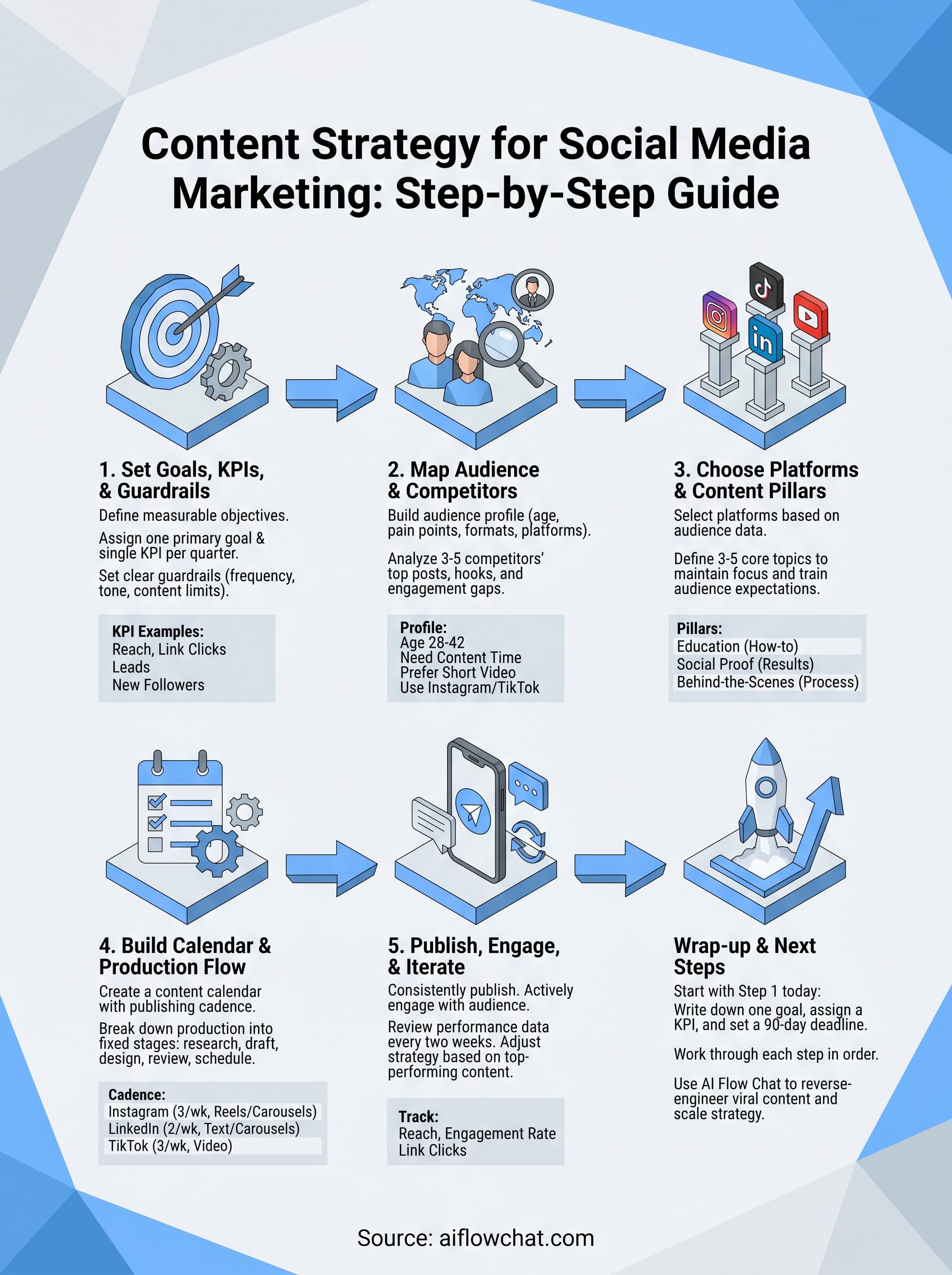
A strong content strategy for social media marketing comes down to six connected steps: set measurable goals, map your audience and competitors, pick platforms intentionally, define content pillars, build a repeatable production system, and review your data on a fixed cycle. Skip any one of these, and the rest of the strategy loses its footing.
The fastest way to apply what you've read here is to start with Step 1 today. Write down one goal, assign it a KPI, and set a 90-day deadline. From there, work through each step in order before you touch your posting schedule.
If you want to move faster, AI Flow Chat lets you pull viral content, competitor ads, and reference materials directly into a visual canvas so you can reverse-engineer what's already working in your niche and build your strategy around real evidence instead of guesswork. Start building your content strategy on AI Flow Chat and cut the time it takes to go from idea to published content.
Continue Reading
Discover more insights and updates from our articles
Choose an AI model for scripts, marketing copy, coding, research, long documents, and quick everyday work using a practical quality, speed, and credit-cost framework.
Compare eight current Poppy AI alternatives for visual research, creator workflows, general AI work, grounded synthesis, automation, and reusable delivery.
A practical method for turning a scattered content process into a clear AI-assisted flowchart with source context, review checks, and a reusable output.