11 Content Marketing Frameworks to Plan, Create, Scale Fast
At AI Flow Chat
Contents
0%Most content teams don't have a strategy problem. They have a structure problem. They know what topics to cover and which platforms matter, but the actual process of going from idea to published piece is held together by scattered docs, half-remembered templates, and whatever worked last time. That's exactly where content marketing frameworks come in, they give you a repeatable system for planning, creating, and distributing content so you're not reinventing the wheel every Monday morning.
The right framework does more than organize your workflow. It forces you to think about why a piece of content exists, who it serves, and how it moves someone closer to a decision. Without that structure, you end up publishing content that feels productive but doesn't actually drive traffic, leads, or revenue. With it, you can spot gaps, prioritize what matters, and scale output without burning out your team (or yourself).
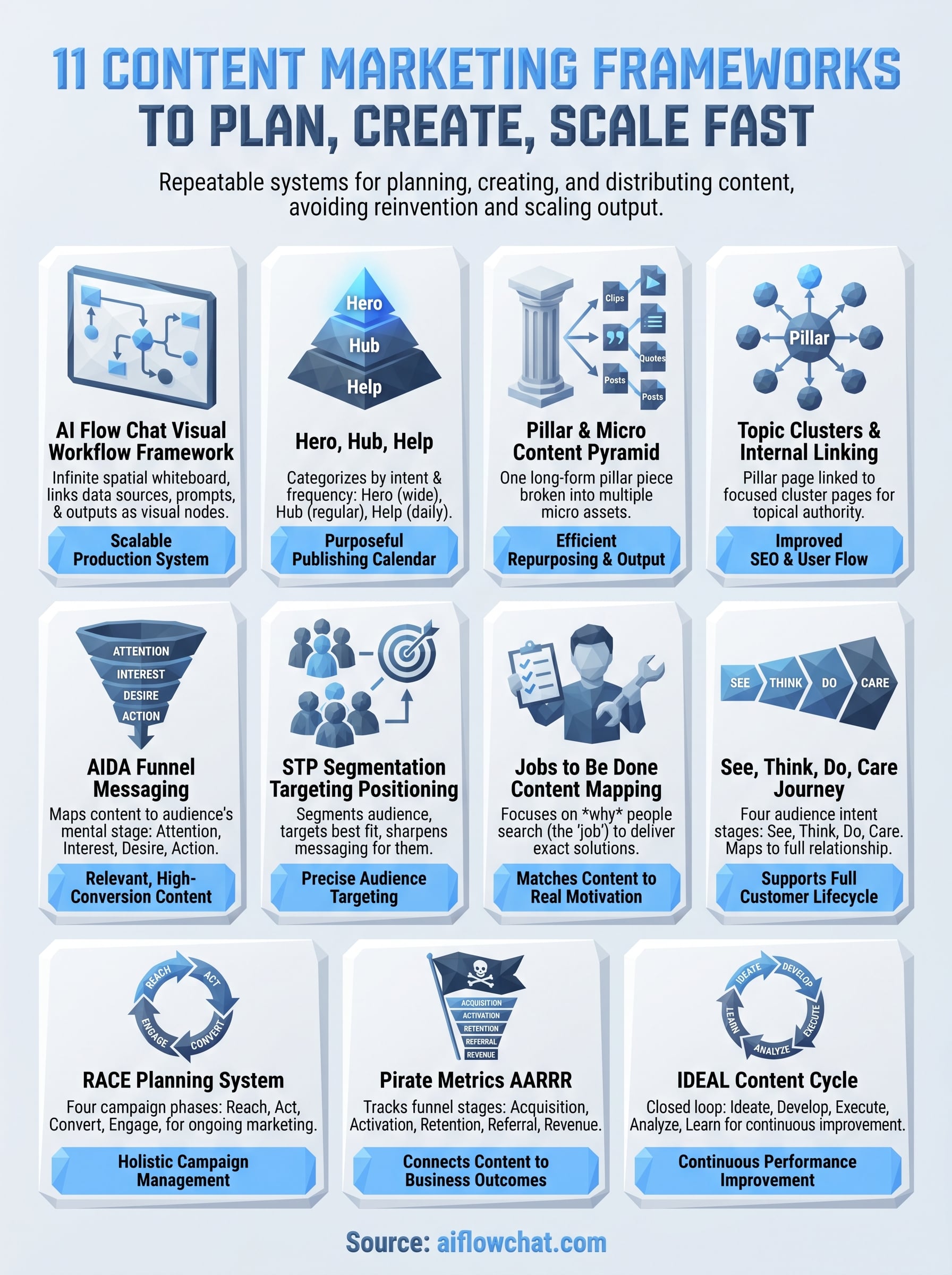
This guide breaks down 11 frameworks that cover the full content marketing lifecycle, from audience research and ideation to production and distribution. Some are classic models you've seen referenced elsewhere; others are tactical systems built for the way creators and marketers actually work right now. For each one, you'll get a clear explanation of how it works, when to use it, and how to put it into practice. And if you're looking to operationalize these frameworks faster, tools like AI Flow Chat let you build visual, repeatable workflows that turn any framework into an automated content engine, pulling from reference material, viral content, and your own SOPs to produce consistent output at scale.
1. AI Flow Chat visual workflow framework
AI Flow Chat replaces the standard linear chat interface with an infinite spatial whiteboard where you connect data sources, prompts, and outputs as visual nodes. Instead of scrolling through a single thread, you see exactly how your inputs generate your results. That spatial clarity makes it one of the most practical content marketing frameworks for solo creators and marketing teams that need to produce high volumes of content without losing consistency.
What it is and why it works
The framework centers on building visual AI flowcharts that link reference materials directly to content outputs. You pull in YouTube videos, competitor ads, PDFs, or Notion pages, and AI Flow Chat extracts what matters before feeding it into prompts that generate content in your voice. Because every output ties back to a real source, your content stays grounded in what already resonates with an audience rather than drifting into generic AI filler.
When your AI outputs are anchored to proven reference material, you stop generating generic content and start producing work that mirrors what already drives results.
How to set it up step by step
Your first working flow takes about 20 minutes to build. Drop a source node onto the canvas, connect it to an extraction prompt, then connect that to an output node with your format and tone instructions.
Basic setup sequence:
- Open a blank canvas in AI Flow Chat
- Add a source node (video link, PDF, or website URL)
- Connect it to an extraction prompt node
- Add an output node specifying your format and tone
- Run the flow, review the result, and save it as a reusable template
How to turn one idea into a repeatable flow
Once you have a working flow, save it as a flowchart template so you never rebuild it from scratch. The next time you need the same content type, swap the source node and run the flow again. This converts a one-time task into a scalable production system.
Your team can then share saved flows through the reusable prompt library or package them into an AI app that anyone can run with one click, keeping output quality consistent regardless of individual AI skill level.
Example workflow for planning and production
A practical planning flow takes a competitor's top-performing video, extracts the hook structure, and generates variations for your brand.
| Node | Input | Output |
|---|---|---|
| Source | YouTube video URL | Transcript and engagement signals |
| Extraction | "Extract hook formula and tone" | Hook pattern summary |
| Repurpose | "Write 3 hooks in [brand voice]" | Ready-to-publish hooks |
| Distribution | "Turn hook into full LinkedIn post" | Draft post |
Metrics to track to prove it works
Track output volume per hour and compare your first month using the visual workflow against the prior month without it. That gap tells you whether the framework is actually accelerating your production.
Also monitor engagement rate on AI-assisted content versus content created without reference material. If your flows pull from proven sources, your outputs should reflect those patterns and outperform generic drafts consistently.
Common mistakes and how to avoid them
The most common mistake is building one giant single-use prompt instead of modular connected nodes. That kills repeatability. Keep each node focused on a single task so you can swap components without rebuilding the entire flow.
A second mistake is ignoring source quality. The framework only performs as well as what you feed it, so pull only from high-engagement videos, top-ranking posts, or proven ad creatives before you build your extraction flows.
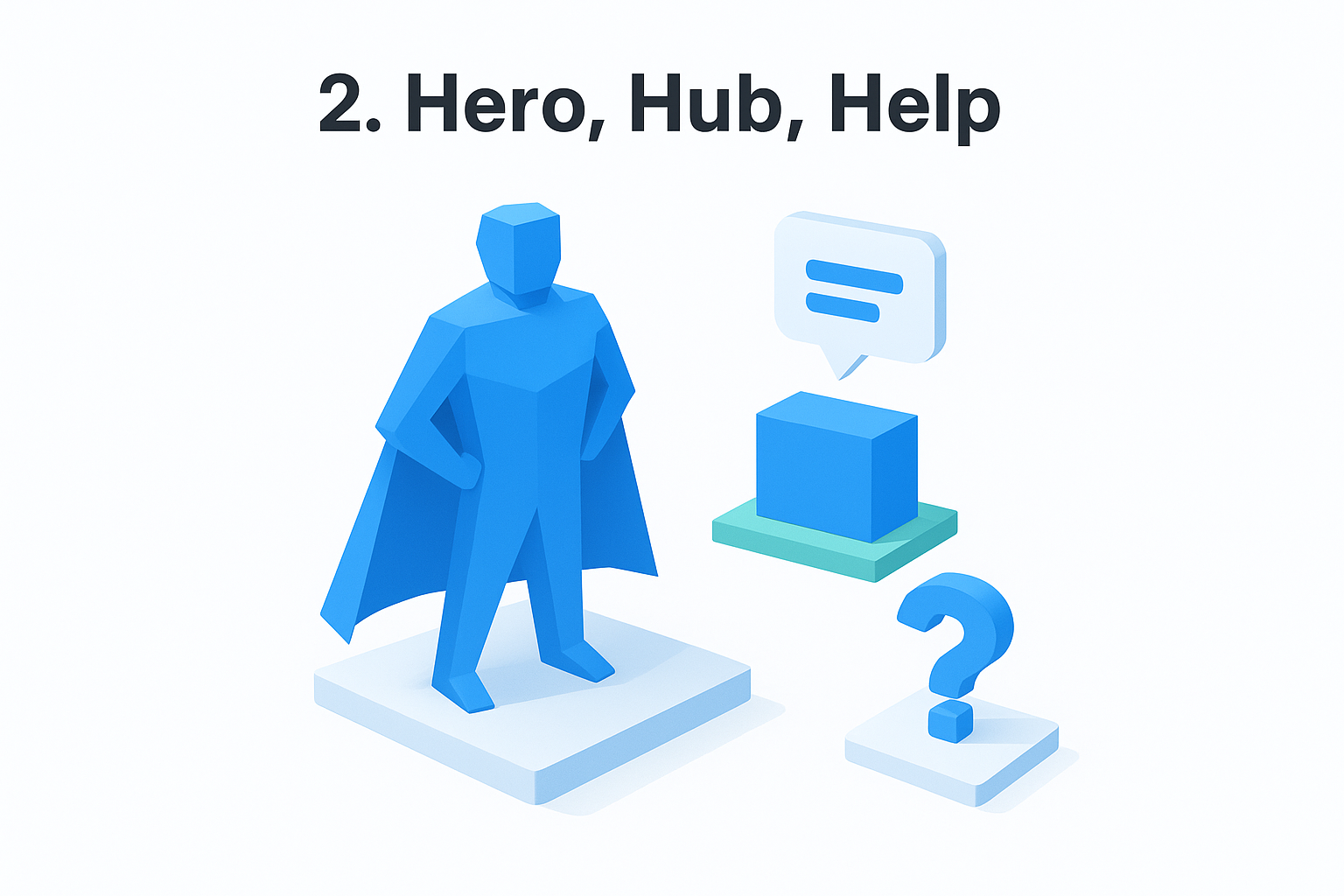
2. Hero, Hub, Help
The hero, hub, help model is one of the most durable content marketing frameworks in circulation. Originally developed by Google, it gives you a simple way to categorize every piece of content you produce by audience intent and production frequency, so your calendar stays balanced instead of tilting too far into any single content type.
What it is and why it works
The framework divides your content into three distinct buckets. Hero content targets wide audiences with high-production pieces you publish a few times a year. Hub content serves your regular audience on a consistent schedule, and help content answers the specific questions your audience searches for daily. Together, the three layers cover the full range of what your audience needs, from discovery to decision.
Matching your content type to your audience's intent at each layer is what keeps your publishing calendar purposeful rather than random.
How to plan your hero, hub, and help mix
Start by looking at your current content backlog and assigning each piece to one of the three layers. Most teams discover they have too much help content and almost no hero pieces. A balanced mix typically runs 70% help, 20% hub, and 10% hero, though your ratio shifts depending on your stage of growth and available resources.
How to choose topics for each layer
Your help topics come from keyword research and support ticket data, the questions your audience already asks. Hub topics come from your core content themes and brand positioning. Hero topics come from cultural moments, product launches, or original research that earns attention beyond your existing audience.
Example content calendar using the model
| Layer | Frequency | Example |
|---|---|---|
| Hero | 2-4x per year | Original industry report |
| Hub | Weekly | YouTube series episode |
| Help | Daily or near-daily | SEO blog answering a specific question |
Metrics to track at each layer
Track reach and shares for hero content, subscriber growth and return visits for hub content, and organic search traffic for help content. Each layer has a different success signal, so resist the urge to measure all three with the same metric.
Common mistakes and how to avoid them
The most common mistake is treating the model as a production quota rather than a strategic lens. Publishing more hero content does not automatically improve results. Each piece you create should earn its place in the layer you assign it to based on audience fit and intent, not on how ambitious the format feels.
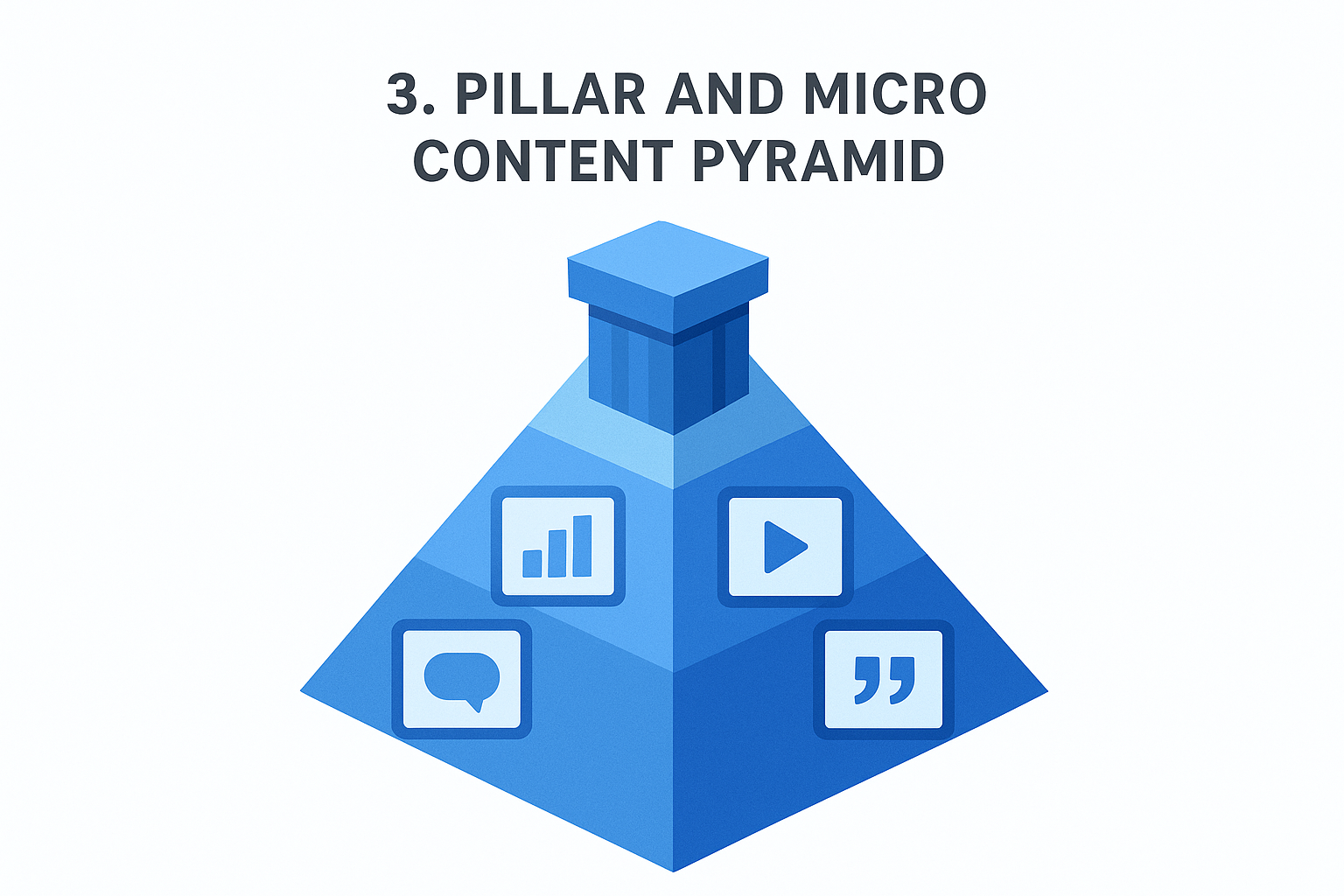
3. Pillar and Micro Content Pyramid
The pillar and micro content pyramid is one of the most efficient content marketing frameworks for maximizing output from a single idea. You create one long-form pillar piece and then break it into multiple smaller assets that work across different platforms and formats.
What it is and why it works
This framework positions a comprehensive pillar asset at the top of the pyramid, such as a long-form article, webinar, or detailed video. Below it sit micro content pieces derived from that single source: short clips, quotes, social posts, and email snippets. Every hour you invest in research multiplies into dozens of distribution-ready assets.
One strong pillar piece can generate weeks of micro content without requiring you to generate fresh ideas from scratch.
How to build your pillar content backlog
Start by listing your core topics and identifying one high-value question your audience consistently asks about each. For each topic, produce one thorough, well-researched piece that fully answers the question. Prioritize pillar topics that align with your strongest conversion goals so your micro content feeds the audience segments most likely to take action.
How to repurpose into micro content fast
Pull your pillar content into a workflow tool, then identify five to ten discrete insights or sections you can isolate. Each becomes its own micro asset. You don't rewrite from scratch; you extract and reformat with platform-specific framing applied to each piece.
Example repurposing map across channels
| Pillar Asset | Micro Content | Platform |
|---|---|---|
| Long-form blog post | Key stat graphic | |
| Webinar recording | 60-second clip | TikTok, YouTube Shorts |
| Research report | Bullet summary thread | X (Twitter) |
| Podcast episode | Pull quote card |
Metrics to track for reach and efficiency
Track total content pieces published per pillar asset to measure repurposing efficiency. Compare organic reach across micro assets to identify which formats and platforms deliver the most distribution per hour of work.
Common mistakes and how to avoid them
The biggest mistake is repurposing without adapting. Copying text verbatim across platforms ignores how different audiences consume content in different contexts. Always reframe each micro piece for its specific platform format and audience expectation before publishing.
4. Topic Clusters and Internal Linking
Topic clusters pair a broad pillar page with a set of tightly focused supporting pages that all link back to it. This structure signals to search engines that your site covers a subject in depth, and it gives readers a natural path to explore related content without bouncing back to Google for another search.
What it is and why it works
A cluster groups one core topic with multiple subtopic pages, all connected through deliberate internal links. The pillar page targets a broad keyword and provides a high-level overview, while each cluster page dives into a specific angle. Search engines reward this architecture because it demonstrates topical authority across an entire subject area rather than isolated coverage of disconnected keywords.
How to pick a cluster topic and subtopics
Start with a core keyword that represents a high-value subject for your business. Then brainstorm the specific questions your audience asks around that topic. Each question becomes a subtopic page. Google Search Console shows you which existing queries you already rank for, giving you a head start on subtopics worth building out first.
How to structure links and on-page UX
Every cluster page needs a contextual link back to the pillar page, placed where it fits naturally in the body copy. The pillar page should also link out to each cluster page. Keep your anchor text descriptive rather than generic so both readers and search engines understand what they'll find on the linked page.
Consistent, well-placed internal links do more for your SEO than any single on-page optimization tactic.
Example cluster outline for a SaaS site
| Page Type | Topic | Target Keyword |
|---|---|---|
| Pillar | Content marketing overview | content marketing frameworks |
| Cluster | SEO writing guide | how to write for SEO |
| Cluster | Content calendar templates | content calendar template |
| Cluster | Distribution strategies | content distribution channels |
Metrics to track for SEO and conversions
Track organic impressions and rankings for both your pillar and cluster pages over 90-day windows. Also watch pages per session to confirm readers actually follow internal links rather than exiting after a single page.
Common mistakes and how to avoid them
The most common mistake is building cluster pages that are too shallow to satisfy search intent. A thin page won't support your pillar. Each cluster page needs to fully answer its subtopic question with enough depth that a reader has no reason to return to Google for more information.
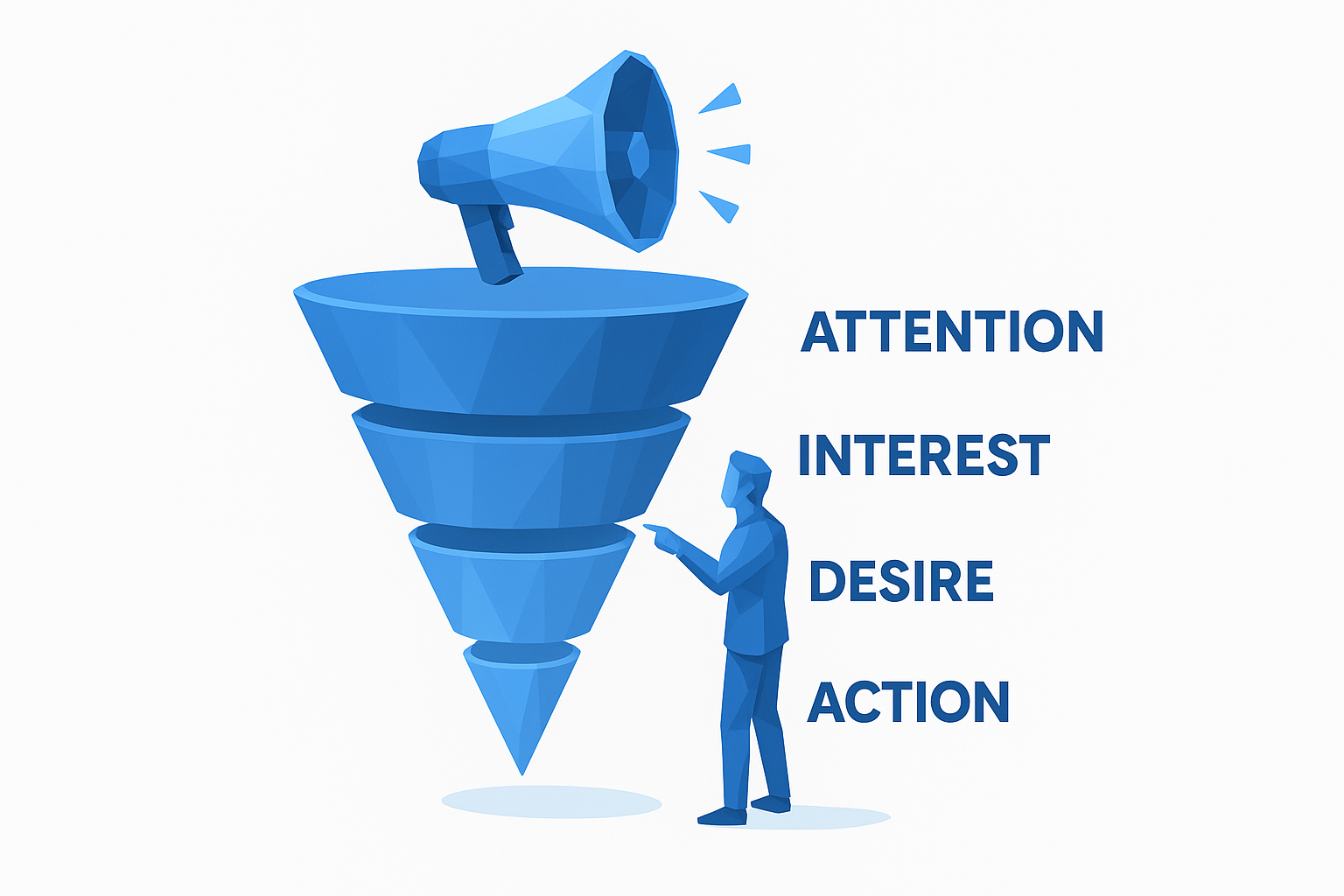
5. AIDA Funnel Messaging
AIDA is one of the oldest content marketing frameworks still in active use, and it holds up because it mirrors how people actually make decisions. The model walks your audience through four stages: Attention, Interest, Desire, and Action, giving you a clear blueprint for what each piece of content needs to accomplish at each point in the buying process.
What it is and why it works
AIDA works because it forces you to think about where your reader is mentally before you write a single word. Most content fails not because it lacks quality but because it assumes the reader is ready to buy when they're still in discovery mode. Matching your message to the right stage eliminates that mismatch and makes your content feel relevant rather than pushy.
Writing content that assumes too much from your reader is one of the fastest ways to lose them before they convert.
How to write content for each AIDA stage
Each stage demands a different job from your content. Attention content interrupts the scroll with a bold hook or surprising insight. Interest content deepens engagement by connecting your topic to a problem your audience cares about. Desire content builds a case for why your solution fits, and action content removes friction and gives a clear next step.
How to match formats to attention spans
Short, punchy formats like social posts and short-form video handle the Attention stage well. Long-form articles, case studies, and comparison pages work best for Interest and Desire. Reserve direct CTAs, free trials, and limited-time offers for the Action stage where intent is highest.
Example AIDA sequence for one offer
| Stage | Format | Goal |
|---|---|---|
| Attention | Short-form video hook | Stop the scroll |
| Interest | Blog post or newsletter | Educate and engage |
| Desire | Case study or testimonial | Build conviction |
| Action | Landing page with CTA | Drive conversion |
Metrics to track for conversion lift
Track click-through rate at the Attention stage and time on page at the Interest and Desire stages. At the Action stage, your primary metric is conversion rate on the specific offer you're promoting.
Common mistakes and how to avoid them
The most common mistake is skipping straight to Action content without building the earlier stages first. Cold audiences need context before they trust you enough to act. Build each stage deliberately so your audience moves through the funnel with momentum rather than dropping off at the first ask.
6. STP Segmentation Targeting Positioning
STP stands for Segmentation, Targeting, and Positioning. It's one of the more disciplined content marketing frameworks borrowed from traditional marketing, and it forces you to get precise about who your content actually serves before you write a single word.
What it is and why it works
STP breaks your audience into distinct groups, selects the most valuable group to focus on, and then shapes your messaging to resonate specifically with that group. The discipline this creates prevents you from writing vague content that tries to appeal to everyone and ends up connecting with no one.
Trying to reach everyone with the same message is a reliable way to reach no one effectively.
How to segment your audience in a practical way
Start by grouping your audience around shared characteristics like role, goal, or pain point rather than broad demographics. A solo creator building social content faces completely different challenges than an agency owner billing clients, even if both use the same tool. Each segment deserves its own dedicated content angle and messaging approach.
How to pick a target and sharpen positioning
Once you have your segments mapped, choose the one that offers the best fit between your solution and their specific problem. Then build a positioning statement that names the segment, states the problem, and explains why your approach solves it better than the alternatives they are already using. Keep it specific and grounded in language your target segment actually uses.
Example messaging matrix by segment
| Segment | Core Pain | Positioning Angle |
|---|---|---|
| Solo creator | Too slow to produce content | Speed and automation |
| Agency owner | Inconsistent client output | Repeatable workflows |
| SEO specialist | Thin content at scale | Depth with AI referencing |
Metrics to track for relevance and ROI
Track engagement rate and conversion rate by audience segment rather than averaging across your full audience. A drop in one segment often signals a messaging mismatch you can fix before it costs you leads or subscribers.
Common mistakes and how to avoid them
The most common mistake is skipping the targeting step and writing for all segments simultaneously. That approach produces unfocused content that reads as generic. Pick one segment per campaign and write directly to their specific situation.
7. Jobs to Be Done Content Mapping
Jobs to be done (JTBD) content mapping shifts your focus from what people search to why they search it. Instead of organizing your content around keywords alone, you organize it around the real motivation sitting behind each query. This reframe turns generic content into work that speaks directly to what your audience is actually trying to accomplish.
What it is and why it works
The JTBD framework, originally developed for product design, applies just as well to content. Every search is a "hire." Your reader is hiring a piece of content to help them complete a specific task or resolve a specific problem. When your content matches that job precisely, it performs better than content built around keyword volume alone because it delivers exactly what the reader came looking for.
Content that matches the real job gets read, shared, and converted on. Content that matches only the keyword often gets bounced.
How to find the real job behind the keyword
Pull your top-traffic keywords and ask what the reader is actually trying to do, not just what they typed. A search for "content calendar template" is a job: the reader needs to organize their publishing schedule this week. That job is more specific than the keyword implies, and your content should reflect it.
How to map jobs to content angles and CTAs
Once you identify the job, match it to a content format and CTA that completes it. A reader hiring content to compare options needs a detailed comparison. A reader hiring content to take action needs a clear next step with minimal friction between reading and doing.
Example job map for a creator or SaaS tool
| Job Statement | Content Angle | CTA |
|---|---|---|
| Organize my content calendar | Template with instructions | Download template |
| Understand which AI tool fits me | Side-by-side comparison | Start free trial |
| Repurpose one video into ten posts | Step-by-step workflow guide | Try the workflow |
Metrics to track for intent match
Track task completion rate on pages tied to specific jobs. If someone lands on your template page but never downloads the template, your content identified the job but failed to complete it for the reader.
Common mistakes and how to avoid them
The most common mistake teams make when applying this to content marketing frameworks is mapping jobs at too high a level. "Learn about content marketing" is not a job. "Build a repeatable publishing system before next month's product launch" is. Specificity is what makes the framework useful, so push your job statements until they describe a real situation your reader recognizes immediately.
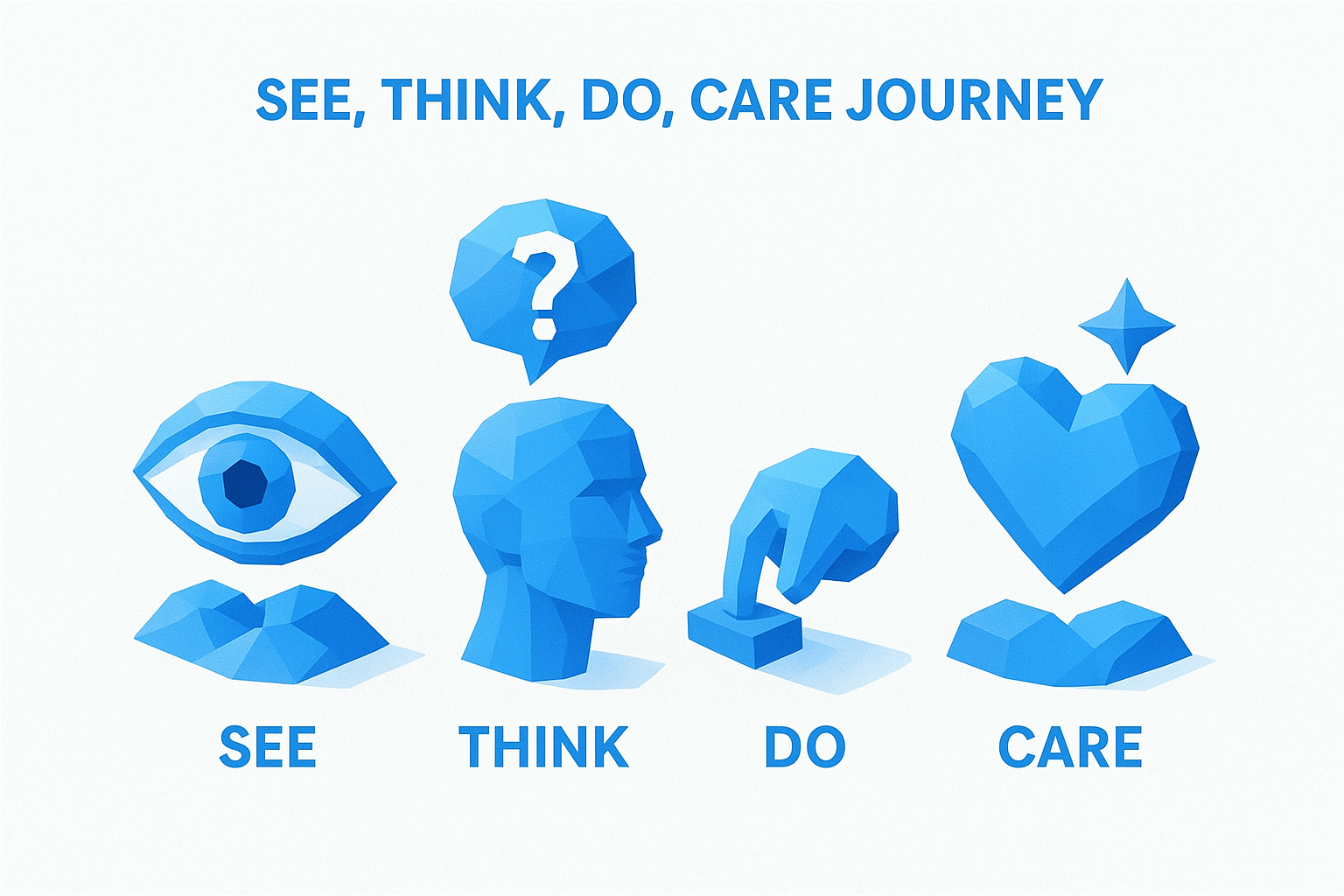
8. See, Think, Do, Care Journey
The see, think, do, care framework, developed by Google's Avinash Kaushik, organizes your content around four distinct audience intent stages rather than a traditional funnel. It's one of the more practical content marketing frameworks for teams that serve audiences at very different points in their decision process and need content that feels relevant at each stage.
What it is and why it works
The four stages map to real audience mindsets. See captures the largest addressable audience: people who aren't actively looking to buy but fit your target profile. Think reaches people beginning to consider their options. Do targets those ready to act, and Care focuses on retaining customers you've already won. Covering all four stages means your content works across the full relationship, not just at the moment of conversion.
Most content teams over-invest in the Do stage and neglect See and Care, which is where long-term audience growth actually happens.
How to map content to each intent stage
Match each stage to the primary question your audience has at that moment. See-stage readers ask broad questions with no purchase goal. Think-stage readers compare options and want specific answers. Do-stage readers need minimal friction between reading and acting. Care-stage readers want to get more value from what they already have.
How to move people forward without forcing it
Avoid placing hard conversion CTAs on See and Think stage content. Instead, use soft next steps like related articles, newsletter sign-ups, or free resources that pull readers deeper into your content without asking for a purchase decision before they are ready.
Example journey map across channels
| Stage | Format | Example |
|---|---|---|
| See | Short-form video | Awareness reel on TikTok |
| Think | Blog comparison post | Best tools for a specific job |
| Do | Landing page | Free trial or demo |
| Care | Email sequence | Onboarding tips |
Metrics to track by stage
Track reach and new audience growth at the See stage, engagement and return visits at Think, conversion rate at Do, and retention or repeat purchase rate at Care.
Common mistakes and how to avoid them
The most common mistake is conflating the See and Think stages into one bucket and producing content that tries to educate and convert simultaneously. That creates awkward messaging that feels pushy to early-stage readers and too vague for readers already close to a decision. Keep each stage distinct and assign a clear job to every piece you publish.
9. RACE Planning System
RACE is a structured digital marketing framework that breaks your entire marketing operation into four phases: Reach, Act, Convert, and Engage. As one of the more practical content marketing frameworks for teams running ongoing campaigns, it gives you a clear way to plan, execute, and measure work across the full customer lifecycle rather than focusing only on acquisition or retention in isolation.
What it is and why it works
Each phase covers a distinct stage of the customer relationship. Reach focuses on building awareness and driving traffic. Act encourages first interactions, Convert turns those interactions into sales or leads, and Engage retains customers and builds loyalty over time. The framework works because it forces you to allocate content resources across all four stages rather than defaulting to whatever feels most urgent this week.
When you plan content across all four RACE phases, you stop treating acquisition and retention as separate problems and start building a system that handles both simultaneously.
How to plan campaigns using RACE
Start each campaign by mapping your content goals to the specific phase they serve. A blog post targeting new keywords lives in Reach. An interactive quiz or lead magnet belongs in Act. A case study or demo page serves Convert, and a post-purchase email sequence supports Engage. This mapping prevents you from creating content without a defined role in your broader campaign.
How to assign owners, cadence, and assets
Assign a dedicated point person and publishing cadence to each RACE phase at the start of every planning period. Without clear ownership, Engage content gets deprioritized when deadlines pile up because it feels less urgent than acquisition work, even though retention drives long-term revenue.
Example monthly plan using RACE
| Phase | Content Type | Cadence |
|---|---|---|
| Reach | SEO blog posts | 4x per month |
| Act | Lead magnet or quiz | 1x per month |
| Convert | Case study or comparison page | 1x per month |
| Engage | Email nurture sequence | Weekly |
Metrics to track for each phase
Track organic traffic and new visitors for Reach, email signups or content downloads for Act, conversion rate for Convert, and repeat visit rate or churn for Engage. Each phase has a distinct success signal, so avoid averaging them into a single number.
Common mistakes and how to avoid them
The most common mistake is treating RACE as a linear funnel rather than a parallel system. All four phases need active content at all times. Letting any single phase go dark while you focus on another creates gaps your audience notices immediately, even if your analytics take a few weeks to show it.
10. Pirate Metrics AARRR
Pirate metrics, named for what the acronym sounds like when said aloud, is one of the most direct content marketing frameworks for connecting your publishing activity to actual business outcomes. Each letter maps to a stage in your growth engine: Acquisition, Activation, Retention, Referral, and Revenue.
What it is and why it works
The AARRR model, popularized by venture capitalist Dave McClure, gives you a structured way to evaluate where your content is helping and where it is losing people. Rather than tracking vanity metrics like total page views, you measure how audiences move through each stage of your funnel. That movement tells you which content is doing real work and which is just filling a calendar.
Tracking stage-by-stage movement turns your content analytics from a report card into a decision-making tool.
How to connect content to each metric
Each AARRR stage needs a dedicated content type tied to a specific outcome. Acquisition content drives first visits through SEO, social, or paid channels. Activation content converts those visitors into subscribers or trial users. Retention content keeps existing users engaged, referral content motivates sharing, and revenue content drives upgrades or purchases.
How to fix the leakiest stage first
Pull your funnel data by stage and identify where you lose the highest percentage of people. That stage is your priority. If visitors arrive but never activate, your onboarding or lead magnet content needs work before you invest more in Acquisition.
Example content ideas for each stage
| Stage | Content Type |
|---|---|
| Acquisition | SEO blog, short-form video |
| Activation | Free template, lead magnet |
| Retention | Weekly newsletter, tutorial |
| Referral | Case study, shareable tool |
| Revenue | Comparison page, demo |
Metrics to track and how to define them
Define one primary metric per stage before you start producing content. Acquisition tracks new sessions, Activation tracks email signups or trial starts, and Retention tracks return visit rate or active days per user per month.
Common mistakes and how to avoid them
The most common mistake is measuring all five stages with engagement-only metrics like clicks and shares. Revenue and Retention need outcome-based definitions, not just activity signals. Assign clear numeric targets to each stage so your content decisions stay grounded in results rather than reach.
11. IDEAL Content Cycle
The IDEAL content cycle is one of the more underused content marketing frameworks for teams that want to build continuous improvement into their production process. It stands for Ideate, Develop, Execute, Analyze, and Learn, and it treats content production as a closed loop rather than a one-way pipeline.
What it is and why it works
Each phase of the cycle feeds the next. You generate ideas, develop them into assets, publish them, measure results, and then use what you learn to sharpen your next round of ideation. That feedback loop is what separates teams that improve steadily from those that repeat the same content mistakes every quarter without understanding why their results plateau.
How to run the cycle step by step
Start every cycle by documenting your ideation sources before you write a single piece. Whether you pull from audience questions, keyword gaps, or competitor analysis, every idea should have a traceable origin. Move through Development and Execution with defined checkpoints, then treat the Analyze and Learn phases as required steps, not optional reviews you schedule when time allows.
How to build feedback loops into production
Build your feedback loop directly into your publishing calendar so the Learn phase happens before the next Ideate phase begins. Set a standing weekly or biweekly review where you pull performance data from your last batch of content and convert findings into specific adjustments for your next cycle.
Skipping the Analyze and Learn phases turns your content operation into a guess repeated at scale rather than a system that compounds over time.
Example weekly operating rhythm
| Day | Activity |
|---|---|
| Monday | Review last week's content metrics |
| Tuesday | Ideate new topics based on findings |
| Wednesday to Thursday | Develop and draft new assets |
| Friday | Publish and schedule distribution |
Metrics to track to keep improving
Track cycle completion rate to confirm your team actually finishes all five phases each week. Also monitor week-over-week engagement trends on new content to confirm your Learn phase insights translate into measurable performance gains.
Common mistakes and how to avoid them
The most common mistake is treating the cycle as a production checklist rather than a learning engine. Teams rush through Analyze and Learn to get back to creating, which breaks the feedback loop entirely. Protect those phases by blocking dedicated time for them in your calendar before the next cycle begins.
Next Steps
The 11 content marketing frameworks in this guide each solve a different production problem, from mapping audience intent to building repeatable workflows and closing feedback loops. You don't need to implement all of them at once. Pick the one that addresses your most pressing gap right now and build from there.
Once you've chosen a starting framework, your next priority is turning it into a system you can run consistently without rebuilding it from scratch each week. That's where tooling matters. AI Flow Chat lets you build visual, repeatable workflows on an infinite canvas, pulling in reference material from videos, PDFs, and competitor content so your outputs stay grounded in proven, high-performing sources. You can save every flow as a reusable template, schedule content to run automatically, and scale output without scaling your workload. Start with one flow, validate it, and expand from there.
Continue Reading
Discover more insights and updates from our articles
Choose an AI model for scripts, marketing copy, coding, research, long documents, and quick everyday work using a practical quality, speed, and credit-cost framework.
Compare eight current Poppy AI alternatives for visual research, creator workflows, general AI work, grounded synthesis, automation, and reusable delivery.
A practical method for turning a scattered content process into a clear AI-assisted flowchart with source context, review checks, and a reusable output.