7 Hook Writing Examples for Essays, Blogs, and Social Posts
At AI Flow Chat
Contents
0%The first sentence of anything you write is doing the heaviest lifting. It's the difference between someone reading your entire post or scrolling past it, between a professor leaning in or zoning out. Yet most writers treat their opening line as an afterthought, a throat-clearing warm-up before the "real" content starts. If you've been searching for hook writing examples that actually work, you're already ahead of the game. You know the opening matters. Now you need a concrete toolkit to nail it every time.
A great hook isn't random. It follows a pattern, a structure you can study, break down, and repeat across formats. The same psychological triggers that make an essay introduction compelling also make a social media caption stop the scroll. Understanding these patterns is what separates writers who consistently grab attention from those who hope for the best. And once you see the formulas behind strong hooks, you start spotting them everywhere: in viral TikToks, high-performing blog posts, and even competitor ads.
That's exactly why we built AI Flow Chat, to help creators and marketers reverse-engineer what's already working and turn those patterns into their own content. Below, you'll find seven hook writing examples organized by type, with breakdowns of why each one works and where to use it. Whether you're writing an academic essay, a blog post, or a caption that needs to perform, these examples give you a starting framework you can adapt right now.
1. Build hooks fast with AI Flow Chat
Writing a strong hook from scratch takes longer than most people expect. AI Flow Chat gives you a structured way to speed that process up without sacrificing quality. Instead of staring at a blank page, you feed the tool your topic, target format, and a few reference examples, then generate multiple hook variations you can compare, edit, and use right away.
What this hook workflow does
AI Flow Chat pulls from your reference materials and uses them to generate hooks that match proven patterns. You get outputs grounded in what's already working in your specific niche, not generic openers with no context behind them. The platform accepts inputs from:
- Viral social posts and YouTube videos for engagement-tested language
- Uploaded PDFs or Notion pages for topic-specific framing
- Competitor ads for persuasion-driven openers
When this approach works best
This workflow shines when you need multiple hook variations fast, like when A/B testing subject lines or writing a batch of essay intros for clients. If you already have a few strong hook writing examples you want to replicate in your own voice, AI Flow Chat outperforms a blank chat window because it gives the model something real to work from.
The fastest way to write better hooks is to study the ones already working in your niche, then use AI to adapt those patterns to your own content.
Example hook outputs for essays, blogs, and social
Here are three outputs generated from the same topic, "remote work productivity," across different formats:
- Essay: "Most remote workers are not struggling with distractions. They're struggling with decisions."
- Blog: "The productivity advice you've been following was designed for offices, not your kitchen table."
- Social: "You don't have a focus problem. You have a setup problem."
Simple hook-building flow on a visual canvas
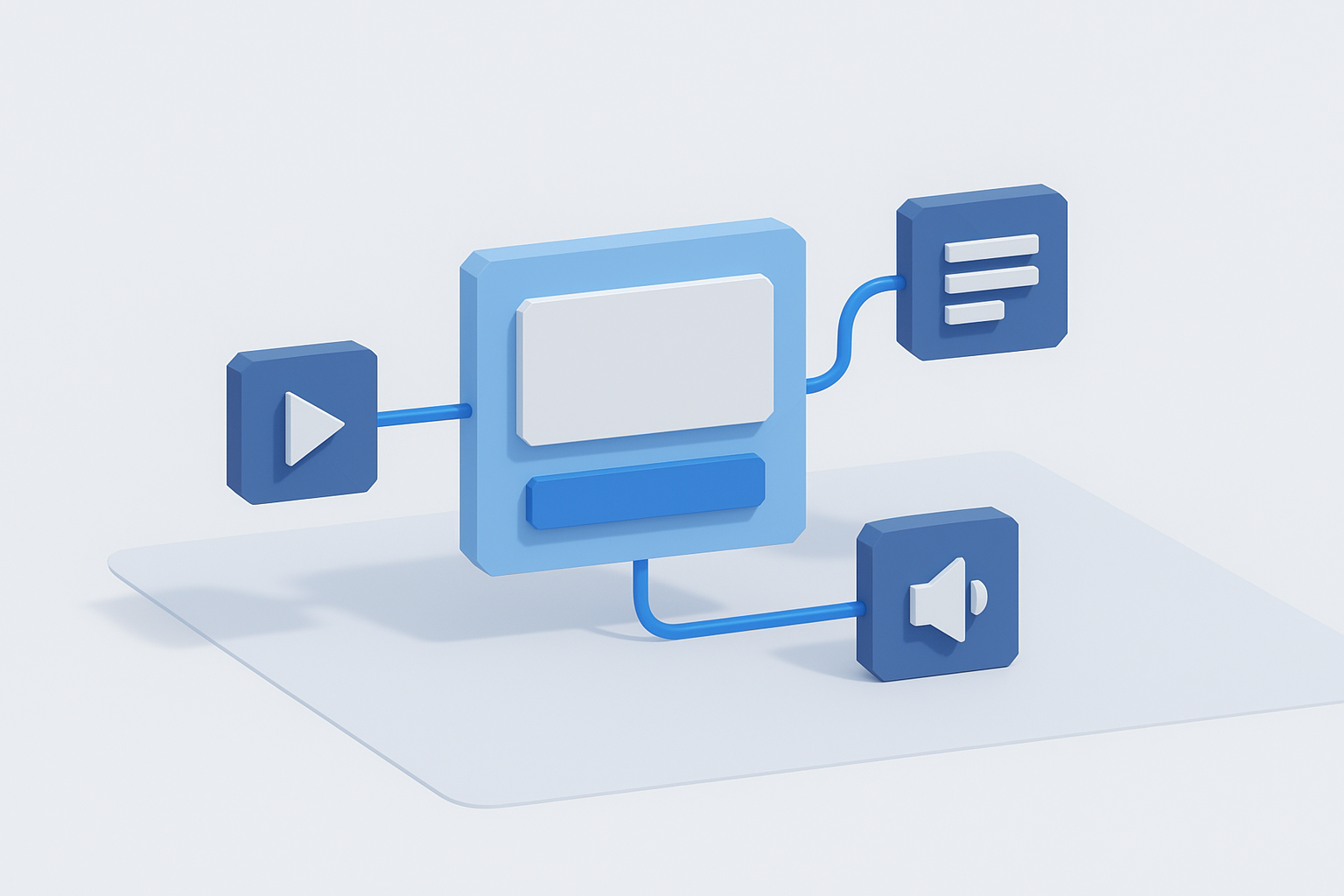
On AI Flow Chat's visual canvas, you drag in your reference content, add a prompt node specifying your format and tone, and connect them to an output block. This spatial layout lets you see exactly how each input shapes your hook, rather than guessing what the model is working from behind a chat window.
Common mistakes to avoid when using AI for hooks
The biggest mistake is giving the AI no reference material and expecting a strong result. Vague inputs produce vague hooks every time.
Always specify your target format, audience, and tone before generating. Treat the first output as a draft you refine, not a finished hook ready to post.
2. Ask a sharp question hook
A well-aimed question pulls readers in because it creates an instant knowledge gap they want to close. Questions feel personal and direct, putting your reader in an active mental state rather than a passive one.
Why question hooks stop the scroll
Questions trigger an automatic cognitive response; people begin forming answers before they consciously decide to keep reading. That split-second engagement is why question-based hook writing examples consistently appear in top-performing essays and social content alike.
When to use it in essays vs social posts
In essays, question hooks work best when your argument directly answers the question you open with. On social, keep your question short and pointed so it lands before the reader scrolls past.
Question hook writing examples
Here are three question hooks across different formats:
- "What if the habits holding you back are the ones you built on purpose?"
- "Are you solving the right problem, or just the most obvious one?"
- "Who told you that getting started required a perfect plan?"
Quick formula for stronger questions
Start with a specific belief your audience holds, then flip or challenge it inside the question. Avoid yes/no questions because they let readers disengage the moment they answer mentally.
The strongest question hooks don't ask for information; they challenge a belief the reader didn't know they had.
How to connect the question to your thesis or main point
Your very next sentence after the question must bridge toward your argument. Answer it or reframe it immediately so the reader knows exactly where you're taking them.
Template: [Challenging question] + [one sentence that pivots directly to your main point].
3. Use a surprising statistic hook
A well-chosen statistic stops readers cold because it forces them to reckon with a fact they didn't expect. Numbers give your opening instant credibility before you've made a single argument, which is why stat-based hooks are a reliable move across essays, blog posts, and social content.
What makes a stat feel credible and relevant
The stat must connect directly to your reader's situation rather than feel abstract or distant. Always pair your figure with a named source your audience already respects so they accept the data before you've even made your argument.
Best places to find usable stats fast
Stick to primary research sources to give your hook real weight:
- Pew Research Center
- Government databases (.gov domains)
- Published academic studies with clear methodology
Statistic hook writing examples
These hook writing examples show how a single number can reframe an entire topic:
- "Only 8% of people achieve the goals they set at the start of the year."
- "The average person checks their phone 96 times a day, once every 10 minutes."
- "Businesses that blog consistently generate 67% more leads than those that don't."
A stat hook works best when it directly contradicts what your reader assumed was true.
How to explain the stat without killing momentum
Follow your stat with one tight sentence that clarifies what it means for your reader. Avoid multi-sentence explanations that stall momentum before the reader has committed to your piece.
Red flags that make a stat hook feel fake
Unverified numbers and vague attributions like "studies show" erode trust immediately. If you cannot name the source in one clean phrase, find a different stat before you publish.
4. Start with a bold claim hook
A bold claim hook opens with a flat-out assertion that most readers wouldn't say out loud. It forces the reader to take a position immediately, either agreeing or wanting to push back. Both reactions keep them reading, which is the only job your first sentence needs to do.
What counts as bold without becoming clickbait
Bold means specific and defensible. Clickbait makes a promise it never keeps. Your claim should feel surprising but grounded, something your argument can actually back up in the very next paragraph. If you can't support it in three sentences, the claim is too far out.
How to support the claim in the next 3 sentences
Follow your bold opener with one concrete reason, one specific example, and one sentence that connects both back to your reader's situation. That sequence converts a provocative line into a credible argument before skepticism sets in.
The fastest way to lose a reader after a bold hook is to spend the next three sentences building up to a point instead of making one.
Bold claim hook writing examples
These hook writing examples show how a direct assertion anchors different formats:
- "Most content strategies fail before the first post goes live."
- "Productivity systems don't save time. They reveal how you actually work."
- "The best essay you'll ever write won't come from an outline."
Strong verb list to tighten the opener
Replace weak linking verbs with action-driven alternatives. Strong options include: destroys, reveals, forces, breaks, proves, kills, drives, and strips.
How to tailor bold claims for different audiences
Academic readers expect a claim backed by evidence, so follow your opener with a cited source immediately. Social audiences respond to personal and specific language, so aim the claim at one person rather than a broad crowd.
5. Open with a mini story hook
A mini story hook drops your reader into a specific moment rather than explaining what you're about to cover. The story doesn't need a full arc; it just needs to create enough tension or curiosity to make the next sentence feel necessary.
Why micro-stories work
Micro-stories bypass your reader's resistance to being persuaded. When you open with a specific scene, readers lean in because their brain processes narrative differently than argument.
Stories signal that something happened, and people want to know what comes next. That forward pull is exactly what you need before you introduce your main point.
How to keep the story short and purposeful
Your mini story hook should run two to three sentences maximum. Every word must push toward the point you're making. If a detail doesn't connect directly to your core argument, cut it before you publish.
The shortest story that sets up your argument is always stronger than a longer one that entertains but never connects.
Mini story hook writing examples
These hook writing examples show how a small narrative sets up a larger point:
- "I sent 47 cold emails before I figured out every single one opened wrong."
- "She read the essay twice, set it down, and said: 'I don't know what this is about.'"
- "The ad ran three days and spent $800 before anyone clicked."
A simple story structure for hooks
Use this three-part structure: a specific moment, an unexpected outcome, then one sentence that signals what comes next. This keeps your story focused and directly tied to your argument rather than drifting into background detail.

How to pivot from story to argument or lesson
After your mini story, your very next sentence should name what the story reveals. Skip transition filler and make a direct statement that connects the scene to your main point.
6. Use a quote hook with context
A quote hook borrows authority from someone your reader already respects. The key is that the quote must connect directly to your argument, and you need to add at least one sentence of context right after, otherwise the reader has no reason to care about what you just shared.
How to choose a quote that earns attention
Pick a quote that challenges a common assumption or makes a counterintuitive point. Avoid anything your reader has seen on a motivational poster. The more specific and unexpected the source, the more your opener stands out from every other piece covering the same topic.
How much context to add right away
One sentence is usually enough. State who said it and why it matters to your reader's situation right away. Resist the urge to over-explain the quote before you've even made your argument.
A quote only earns its spot in your hook if it does work your own words can't do better.
Quote hook writing examples
These hook writing examples show how a quote sets up a larger point:
- "Richard Feynman once said, 'The first principle is that you must not fool yourself.' Most content strategies skip that step entirely."
- "'People don't buy what you do; they buy why you do it.' That sentence changed how I write every opening line."
How to avoid the overused quote problem
Skip Einstein, Gandhi, and Churchill. Your reader has seen those quotes too many times to feel anything. Search for quotes from practitioners in your specific field instead, people your audience already follows or respects.
When to skip quotes entirely
If the quote doesn't sharpen your argument, replace it with a bold claim or a stat. A quote that just sounds good wastes your most valuable real estate, the one sentence your reader will always read.
7. Paint a vivid scene hook
A vivid scene hook drops your reader into a specific moment before you explain anything. Instead of telling them what your piece is about, you show them a slice of it in motion. That sensory pull creates immediate engagement because the reader's brain starts filling in details automatically.
What makes a scene feel immediate
Present tense and specific physical details make a scene land in the reader's body rather than their head. Vague settings feel distant; a named location, a specific action, or a single concrete object gives the reader something to hold onto from your very first word.
Sensory details that actually help
Sound, temperature, and movement tend to create faster immersion than visual description alone. Choose one or two sharp sensory details rather than stacking several, and make sure each detail connects to the emotional tone you want your reader to feel.
Specific sensory details do more work in one sentence than a full paragraph of general description.
Vivid scene hook writing examples
These hook writing examples show how a scene sets up a larger argument:
- "The cursor blinked for eleven minutes before she typed the first word."
- "Three tabs open. No words written. The deadline was in four hours."
- "He read the headline aloud, set his phone face-down, and went back to scrolling."
How to match tone to topic
A heavy topic needs restrained, grounded language while a lighter subject can carry more energy. Match your word choices to the emotional register your reader should feel before your argument begins.
How to transition from scene to your point fast
Your scene ends the moment you name what it reveals. Write one direct sentence immediately after the scene that states your point plainly, with no transition filler between the image and the idea.
Quick recap and next step
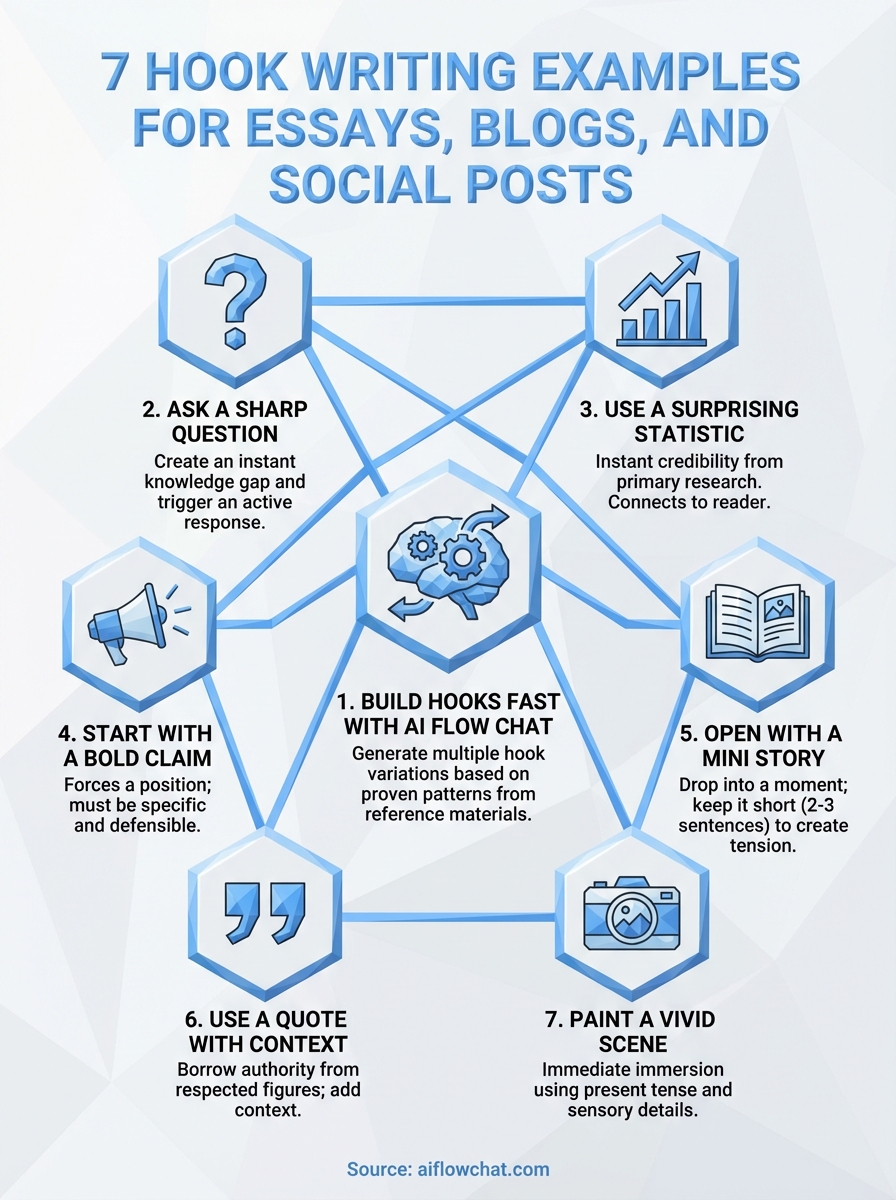
You now have seven distinct hook writing examples to pull from across essays, blogs, and social posts. Each type works by triggering a specific reader response: questions create knowledge gaps, stats force a mental recalculation, bold claims demand a reaction, mini stories create forward pull, quotes borrow authority, and vivid scenes drop readers directly into the moment. Knowing which hook fits your format is the difference between an opener that performs and one that gets skipped.
Studying these patterns is a strong start, but applying them at scale is where most writers slow down. AI Flow Chat gives you a visual workspace to feed your reference content directly into the generation process, so every hook you produce is grounded in what's already working in your niche. Instead of starting from scratch each time, you build from proven patterns and adapt them to your own voice. Try AI Flow Chat and write your next hook in minutes.
Continue Reading
Discover more insights and updates from our articles
Choose an AI model for scripts, marketing copy, coding, research, long documents, and quick everyday work using a practical quality, speed, and credit-cost framework.
Compare eight current Poppy AI alternatives for visual research, creator workflows, general AI work, grounded synthesis, automation, and reusable delivery.
A practical method for turning a scattered content process into a clear AI-assisted flowchart with source context, review checks, and a reusable output.