Competitor Content Analysis: Steps, Tools, And Templates
At AI Flow Chat

Contents
0%Your competitors are publishing content that ranks, gets shared, and drives revenue. Some of it works brilliantly, some of it flops. A structured competitor content analysis tells you exactly which is which, so you can skip the guesswork and build a content strategy based on evidence, not assumptions.
Most marketers know they should be studying what their competitors publish. Few actually do it systematically. They'll glance at a rival's blog or scroll through their social feed, make a few mental notes, and move on. That's not analysis, that's browsing. Real competitor content analysis follows a repeatable process: auditing what competitors create, identifying gaps they've missed, and extracting the patterns behind their best-performing pieces. When done right, it becomes your fastest shortcut to content that actually performs.
This guide breaks down the entire process into clear, actionable steps. You'll learn how to select the right competitors, audit their content across channels, spot opportunities they're leaving on the table, and build templates to repeat the process at scale. We also cover how tools like AI Flow Chat can accelerate the heavy lifting, particularly when you need to pull insights from competitor videos, ads, and web pages and turn that analysis into your own content without starting from a blank screen. Whether you're a solo creator or running an agency, this framework gives you a structured way to turn competitor intelligence into a real content advantage.
What competitor content analysis is
Competitor content analysis is the systematic process of researching, auditing, and evaluating the content your competitors publish across every channel they use, including their blog, social media, YouTube, and paid ads. The goal isn't to copy what rivals are doing. The goal is to understand the patterns behind their performance: which topics drive traffic, which formats earn engagement, which keywords they target, and where their strategy leaves gaps you can fill. When you approach it this way, the process stops being reactive and becomes one of the most reliable inputs you have for planning your own content.
A competitor content analysis turns scattered observations into structured intelligence you can act on immediately.
Unlike a quick Google search to see what ranks, a proper analysis maps each competitor's full content footprint, identifies the signals that separate their high-performing pieces from their weak ones, and surfaces topics your audience is actively searching for but no one in your space addresses well. That combination of depth and specificity is what makes it useful rather than just interesting.
The core elements it covers
A thorough competitor content analysis examines several distinct layers of a rival's strategy. Knowing each layer helps you build a complete picture rather than a fragmented one that leads to incomplete conclusions.
| Layer | What you examine |
|---|---|
| Topics and themes | Which subjects they cover repeatedly and which they avoid |
| Keyword targeting | What search terms they rank for, including long-tail queries |
| Content formats | Blog posts, videos, podcasts, short-form social posts |
| Publishing cadence | How often they publish and on which channels |
| Engagement signals | Shares, comments, backlinks, and video view counts |
| Paid content | Ad copy patterns, promoted posts, and landing page hooks |
Each layer reveals a different dimension of how your competitors attract and hold their audience's attention. Skipping even one layer can create a blind spot in your strategy, so treating the process as a full audit rather than a surface scan will pay off over time.
How it differs from a standard content audit
Many marketers confuse a content audit with a competitor content analysis, but they answer entirely different questions. A content audit looks inward: it evaluates the content you've already produced to find what's performing, what's outdated, and what needs updating. A competitor content analysis looks outward, studying what others in your market publish so you can benchmark your strategy against the field.
Both practices have value, but they serve different purposes. Running a content audit without competitor context means you're optimizing in isolation. You might improve a blog post's structure while missing the fact that a competitor is capturing all the search traffic for that topic with a video series. Combining both approaches gives you a full picture of where you stand and where the real opportunities exist.
Why timing and frequency matter
Competitor content analysis isn't a one-time exercise. Markets shift, competitors pivot, and new formats emerge faster than most content calendars account for. Running a full analysis at the start of a new campaign or quarter is good practice, but building a lightweight version of the process into your regular workflow is what actually compounds over time.
A practical cadence for most teams is a deep analysis every quarter combined with a lighter monthly check on top-performing competitor pieces. The monthly check doesn't need to be exhaustive; it just needs to flag new topics, formats, or keywords that are gaining traction before your competitors fully capitalize on them.
Step 1. Choose competitors and goals
Before you pull a single piece of data, you need to know who you're studying and what you want to find out. Jumping straight into analysis without defining both of these upfront leads to hours of research that produces results you can't act on. A focused competitor content analysis starts with a deliberate selection process, not a list of brands you vaguely recognize from your industry.
Map your competitor types
Not every competitor belongs in the same category, and mixing them without distinction will distort your findings. Three distinct types appear in most markets, and each one tells you something different about where your content strategy has room to grow.
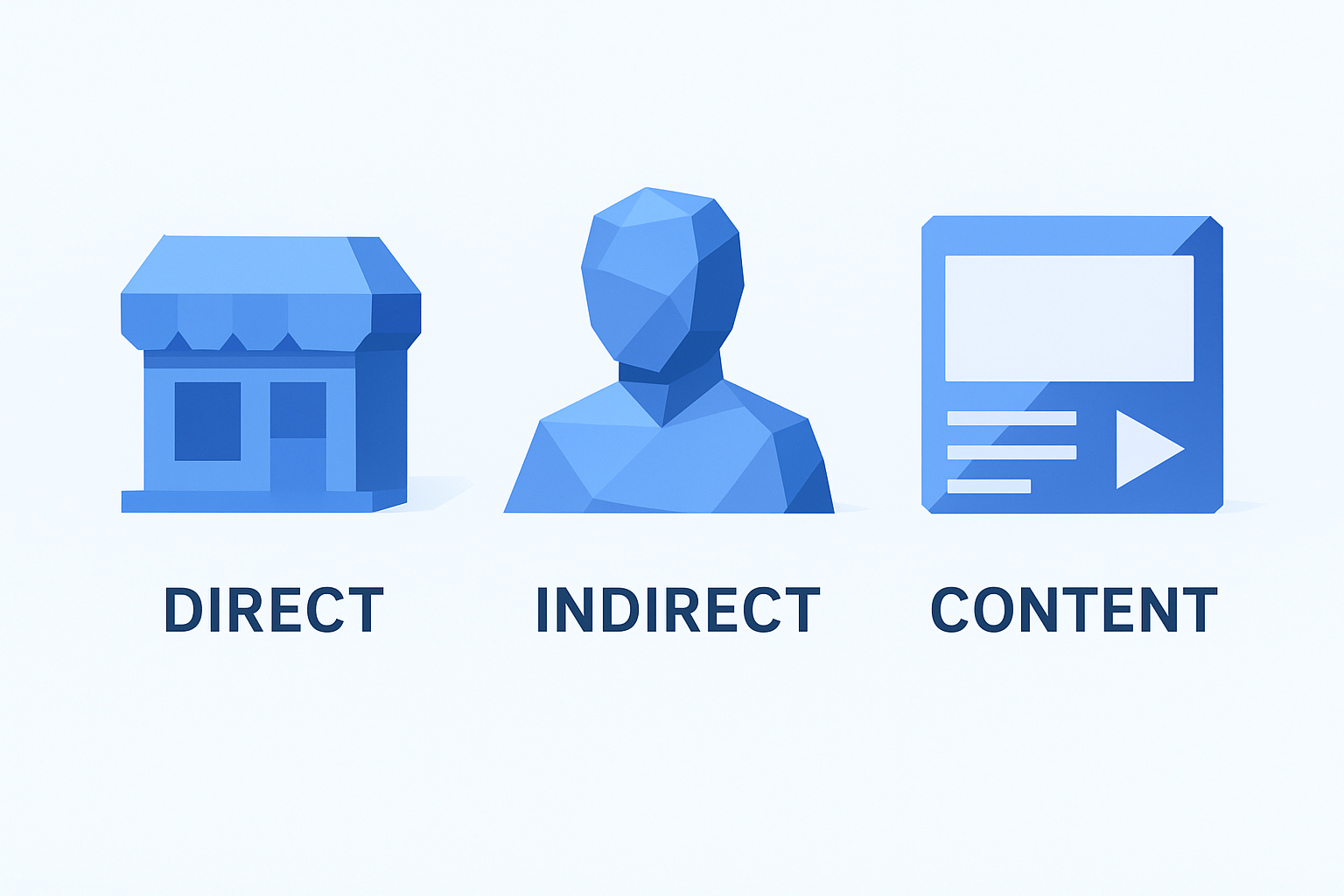
Direct competitors sell the same product or service to the same audience you target. Indirect competitors solve the same underlying problem but with a different solution or approach. Content competitors don't overlap with you commercially at all, but they rank for the same keywords and capture your audience's attention before those readers ever find you. Content competitors are the most commonly ignored, and skipping them leaves real blind spots in your research.
A practical starting list includes three to five direct competitors and two to three content competitors. Keeping the list tight means you can analyze each one thoroughly rather than spreading your attention too thin across a dozen brands and ending up with shallow data on all of them.
More competitors on your list rarely means better analysis. It usually means shallower analysis.
Set specific goals before you start
Your goals determine which data you collect and how you interpret it. Without a defined goal, every data point looks equally important, which makes it nearly impossible to prioritize what to act on first. Clarity here saves hours of work later.
Use this goal sheet template before you open any tool:
Competitor Analysis Goal Sheet
--------------------------------
Goal type:      [Traffic growth / Gap discovery / Format research / Ad strategy]
Core question:  What specific question are you trying to answer?
Competitor list:[List 3-5 competitors here]
Channels:       [Blog / YouTube / Social / Paid ads]
Time period:    [Last 3 months / 6 months / 12 months]
Success metric: How will you measure if this analysis improved your content?
Fill out every field before you begin. If you struggle to write a clear answer in the "Core question" row, narrow your focus further until the question fits in one sentence. A sharp question produces insights you can act on directly. A vague one produces a report that no one reads twice.
Step 2. Pull content, keywords, and channels
Once your competitor list and goals are locked, the next task is systematic data collection. This step is where most people either over-collect (pulling everything and drowning in data) or under-collect (grabbing only what's easy to find). A structured approach keeps you focused on the signals that actually feed your competitor content analysis and produce decisions you can act on immediately.
Collect their content inventory
Start by auditing each competitor's primary content channels: their blog, YouTube channel, social media profiles, and any podcast or newsletter they run. For each channel, record the topics they cover, the formats they use, and their publishing frequency. A simple spreadsheet works well here, but using a consistent template across every competitor is what makes the data comparable later.
Use this collection template for each competitor:
Competitor Content Inventory
------------------------------
Competitor name:    [Brand name]
Blog URL:           [URL]
Top blog topics:    [List 5-10 recurring themes]
Publishing cadence: [e.g., 3x per week]
YouTube channel:    [URL or N/A]
Top video topics:   [List 5 recurring themes]
Social channels:    [Platform names]
Content formats:    [Video / Long-form / Short-form / Infographic]
Paid ads active:    [Yes / No]
Notes:              [Anything unusual about their strategy]
Fill this out for every competitor on your list before moving to keyword research. Jumping straight to keyword tools without completing the inventory means you'll miss format patterns and topic clusters that search data alone won't surface.
Extract keywords and engagement signals
With the inventory complete, keyword extraction is your next move. Tools like Ahrefs, Semrush, or Google Search Console (for your own domain as a comparison baseline) let you pull the specific search terms each competitor ranks for. Focus on keywords where they appear in positions one through ten, since those represent the topics where their content is actively winning traffic right now.
The keywords your competitors rank for in the top ten are a direct map of proven demand in your market.
Alongside keywords, collect engagement signals for their top-performing pieces: backlink counts, comment volume on social posts, and view counts on videos. You don't need exact numbers; you need a relative picture of which topics and formats generate the most response. Pull the top five to ten performing pieces per competitor and note what they share. That pattern is the raw material you'll use in Step 3.
Step 3. Find gaps and winning patterns
With your inventory and keyword data collected, the next task is pattern recognition: turning raw competitor data into two distinct lists. The first captures topics and formats your competitors have ignored or underserved, which represents your gap opportunities. The second captures the structural elements that appear repeatedly in their highest-performing content, which tells you what's already working in your market.
Identify content gaps
A content gap is any topic, question, or keyword your target audience searches for but no competitor addresses well. Run each competitor's top-ranking keywords through a comparison matrix and flag every query where rankings are weak, absent, or filled only with thin content. Those are your clearest entry points.
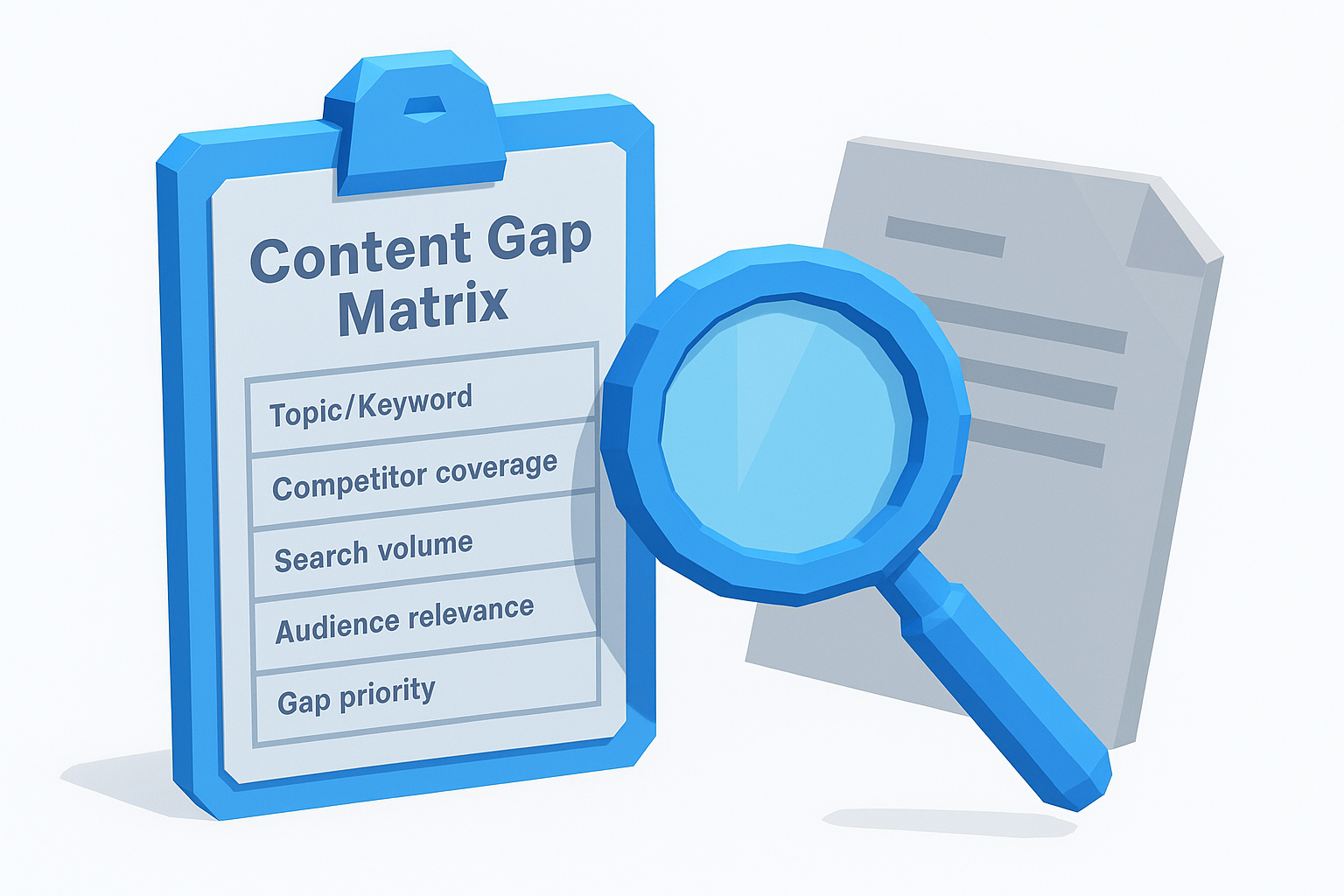
Content Gap Matrix
-------------------
Topic/Keyword:       [Query here]
Competitor coverage: [None / Thin / Strong]
Search volume:       [High / Medium / Low]
Audience relevance:  [High / Medium / Low]
Gap priority:        [1 = high priority, 3 = low priority]
Action:              [Create / Improve existing / Monitor]
Fill this matrix for every topic cluster you identified in Step 2. Prioritize gaps where audience relevance and search volume are both high and competitor coverage is either absent or thin. Those three conditions together signal the strongest opportunity in your competitor content analysis.
A gap with high search volume but low audience relevance is a distraction, not an opportunity. Pursue only gaps where both conditions align.
Spot winning patterns
Winning patterns are the recurring structural and topical elements that appear across your competitors' top-performing pieces. Look at the five to ten pieces per competitor you flagged for high engagement and ask what they share: format type, headline structure, content length, presence of data or original research, and how they open each piece.
Use this pattern log to document what you find:
Winning Pattern Log
--------------------
Competitor:        [Brand name]
Top piece URL:     [URL]
Format:            [Long-form / Video / List / Case study]
Headline pattern:  [e.g., "How to X Without Y"]
Opening hook:      [Question / Stat / Problem statement]
Content length:    [Word count or video duration]
Unique element:    [Original data / Tool / Template]
Engagement signal: [Backlinks / Comments / Views]
Patterns that repeat across multiple competitors carry the most weight. If three out of five competitors consistently lead with original data in their top pieces, that's a strong signal your audience values evidence over opinion. Build that element into your own content and you're working with a proven framework rather than a guess.
Step 4. Build a publish plan and repeatable workflow
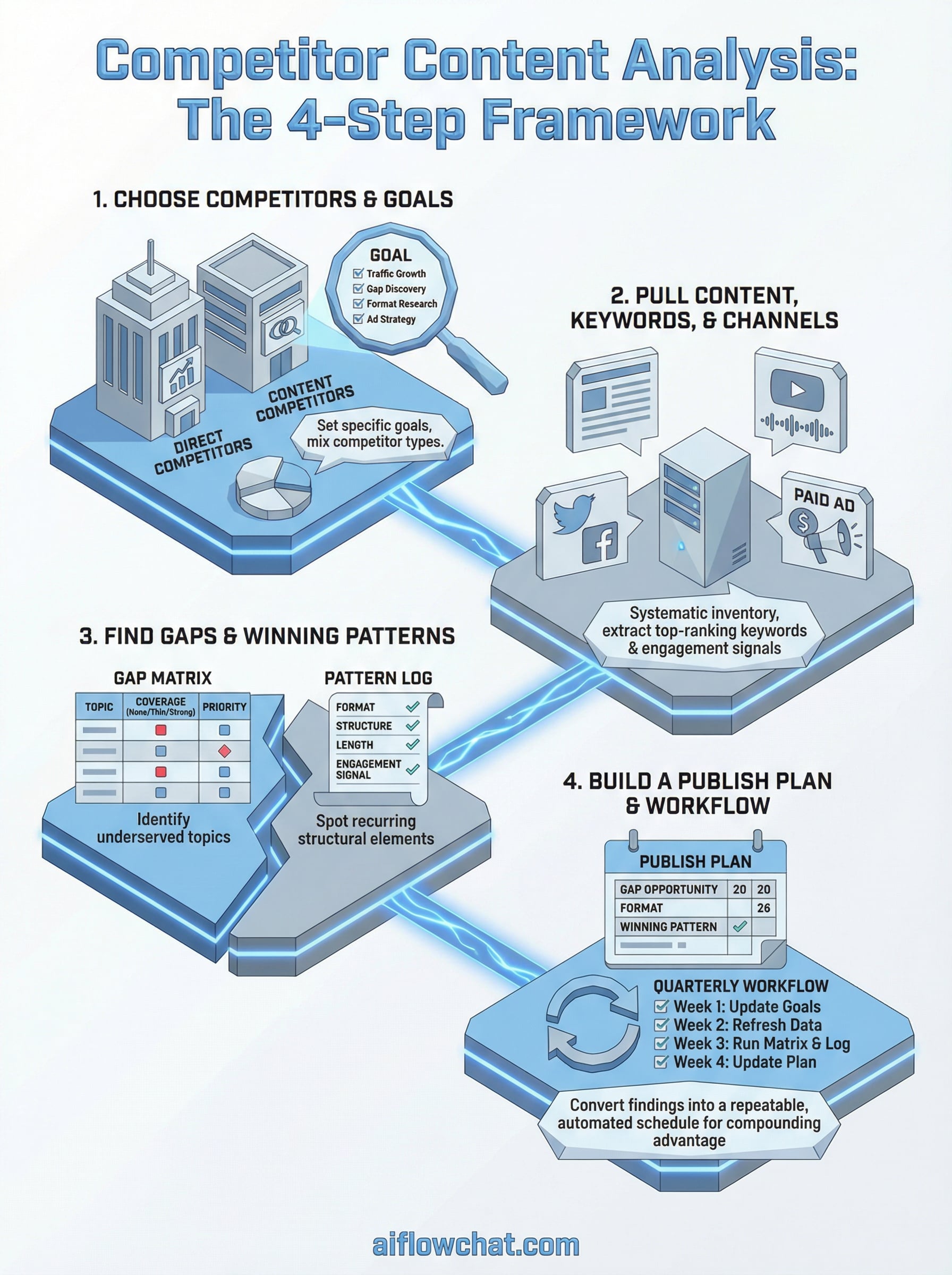
Findings without a schedule stay findings. The final step of your competitor content analysis converts everything you documented in Steps 1 through 3 into a concrete publish plan and a repeatable system you can run every quarter without rebuilding it from scratch. This is where the analysis produces real returns rather than sitting in a spreadsheet no one revisits.
Turn your findings into a publish schedule
Take your gap matrix and pattern log from Step 3 and sequence them into a calendar. Prioritize gap opportunities with the highest audience relevance first, then layer in content that mirrors the winning patterns your competitors rely on. Mixing both types gives you coverage of underserved topics while building on formats your market has already proven it responds to.
A publish plan built on competitor data removes the guesswork from your editorial calendar and replaces it with evidence.
Use this planning template to convert your research into scheduled content:
Content Publish Plan
---------------------
Month:              [e.g., May 2026]
Gap opportunity:    [Topic or keyword]
Format:             [Long-form / Video / Short-form / Case study]
Winning pattern:    [Element to incorporate, e.g., original data]
Target keyword:     [Primary search term]
Channel:            [Blog / YouTube / Social]
Publish date:       [Specific date]
Owner:              [Your name or team member]
Status:             [Not started / In progress / Published]
Add one row per planned content piece and keep this file linked directly to your gap matrix so the connection between your analysis and your output stays visible. When a content piece publishes, record its performance in the same file so you can track which gap opportunities converted into actual traffic.
Build the workflow so it repeats automatically
A single analysis cycle is useful. A documented workflow you repeat every quarter is what compounds. Write out each step in your process as a checklist so the next cycle takes you a fraction of the time the first one did.
Quarterly Competitor Content Workflow
---------------------------------------
Week 1:  Update competitor list and set new goals
Week 2:  Pull content inventory and refresh keyword data
Week 3:  Run gap matrix and update pattern log
Week 4:  Update publish plan with new opportunities
Monthly: Light check on top competitor pieces for new trends
Tools like AI Flow Chat accelerate the data-collection and pattern-extraction phases by letting you pull competitor videos, ads, and web pages directly into a visual workflow and run analysis across all of them at once. That cuts the time between raw research and a completed publish plan from days to hours, which means you actually run the process consistently rather than skipping it when the quarter gets busy.
Next moves
Running a competitor content analysis once gives you a useful snapshot. Running it every quarter on a documented workflow gives you a compounding advantage that most of your competitors won't match because they treat it as a one-time task. The steps in this guide build on each other: your competitor list feeds your inventory, your inventory feeds your keyword research, your keyword research feeds your gap matrix, and your gap matrix feeds your publish plan. Every cycle you complete makes the next one faster and more precise.
Start with a focused first cycle. Pick three direct competitors, complete the goal sheet from Step 1, and work through each step before adding more brands or channels to your scope. Once that first cycle is complete and your publish plan is live, you have a repeatable system. If you want to cut the research time significantly, try AI Flow Chat to pull competitor content directly into a visual workflow and run your analysis in one place.
Continue Reading
Discover more insights and updates from our articles
Choose an AI model for scripts, marketing copy, coding, research, long documents, and quick everyday work using a practical quality, speed, and credit-cost framework.
Compare eight current Poppy AI alternatives for visual research, creator workflows, general AI work, grounded synthesis, automation, and reusable delivery.
A practical method for turning a scattered content process into a clear AI-assisted flowchart with source context, review checks, and a reusable output.