12 Best Social Media Competitor Analysis Tool Picks (2026)
At AI Flow Chat
Contents
0%Your competitors are posting content that gets thousands of shares, running ads that print money, and growing faster than you. The question isn't whether you should pay attention, it's how. A good social media competitor analysis tool gives you the data to understand what's actually working in your niche, from posting frequency and engagement rates to the exact hooks driving virality.
But raw data only gets you halfway. Knowing that a competitor's Reel hit 2 million views is useful. Knowing why it hit, the hook structure, the CTA, the comment patterns, is what lets you reverse-engineer their wins and apply those patterns to your own content. That's exactly the gap we built AI Flow Chat to fill: a visual AI workspace where you can pull in competitor videos, ads, and pages, then use AI to extract the strategies behind the performance and turn them into original content in your voice.
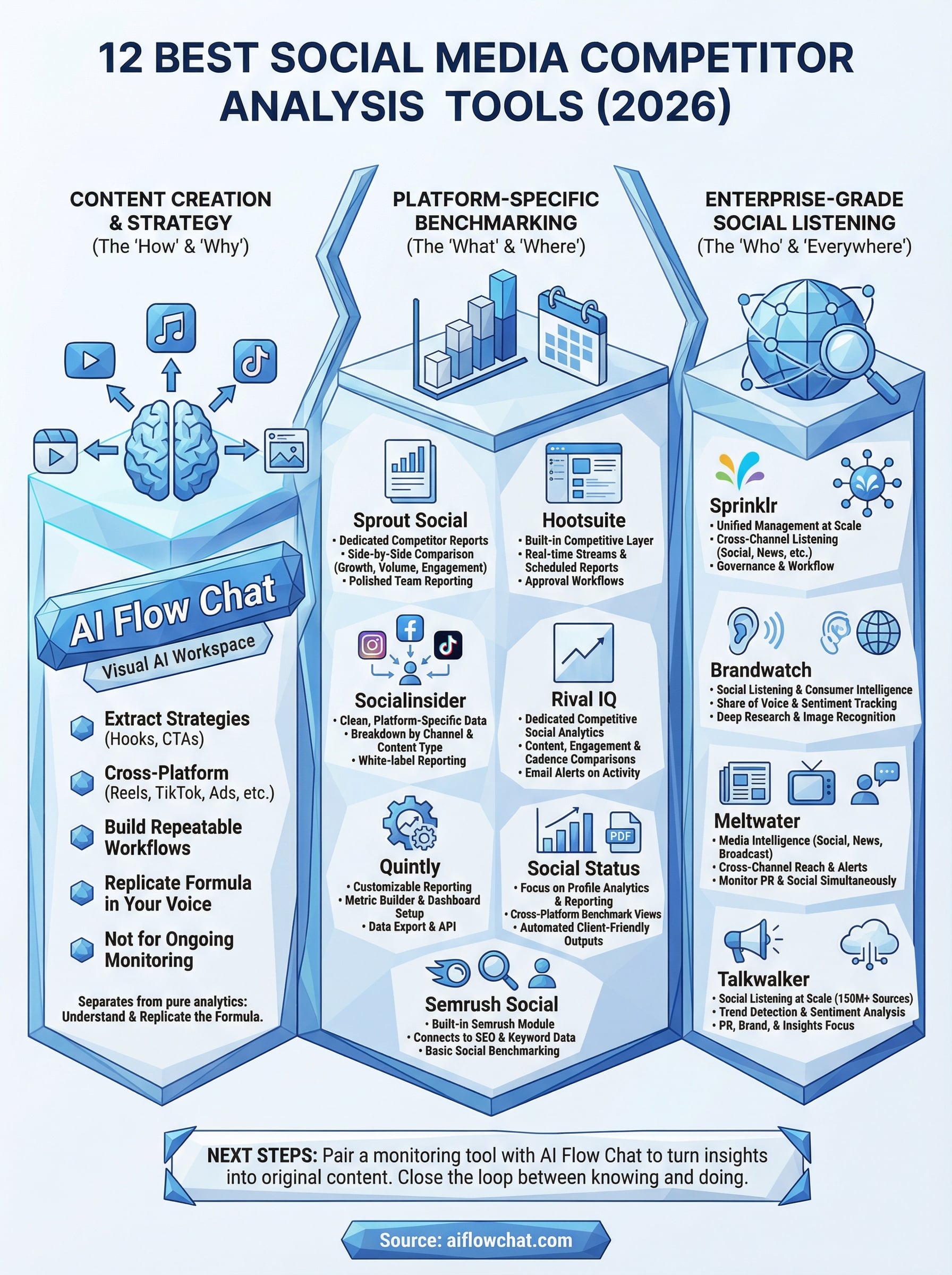
Still, AI Flow Chat focuses on the content creation side of the equation. You also need dedicated tools for ongoing monitoring, benchmarking, and reporting across platforms. So we tested and compared 12 of the best social media competitor analysis tools available right now, covering everything from free options to enterprise platforms, so you can pick the right stack for your budget and goals. Here's what we found after hands-on evaluation of each tool.
1. AI Flow Chat
AI Flow Chat sits in a different category than most tools on this list. Rather than tracking follower counts and engagement rate tables, it lets you feed competitor content directly into an AI workspace and extract the strategies behind that content, so you can replicate what's working in your own voice.
What it is and how it handles competitor research
AI Flow Chat is a visual AI whiteboard built for creators, marketers, and agencies who want to go beyond surface-level metrics. You paste in a competitor's YouTube video, TikTok, Instagram Reel, or Facebook ad, and the platform transcribes, analyzes, and breaks down the hook structure, CTA patterns, and engagement signals that made it perform. Instead of asking "how many likes did this get," you're asking "what made this work," and getting actionable answers you can build from immediately.
This is what separates AI Flow Chat from pure analytics tools: it doesn't just show you that a competitor's content performed well, it helps you understand and replicate the formula behind it.
Social sources it can analyze
The platform pulls from a wide range of content sources, which makes it genuinely useful as a social media competitor analysis tool for cross-platform research. You can import from:

- Instagram Reels
- TikTok videos
- YouTube videos
- Facebook and Meta Ads (via the built-in Ads Library spy feature)
- X/Twitter posts
- Websites via live scraping
- PDFs and Notion pages
This breadth means you can run competitor research across every major platform without switching between separate tools or managing multiple subscriptions at once.
Standout competitor analysis workflows
Where AI Flow Chat really separates itself is the ability to build repeatable AI flowcharts for competitor research. You can set up a workflow that pulls in a competitor's latest video, transcribes it, extracts the hook and structure, then generates a rewritten version in your brand voice, all without starting from scratch each time. The Meta Ads spy tool lets you monitor competitor ad creative, analyze what hooks are currently running, and clone the approach without copying the content directly.
Limitations to know before you choose it
This tool is not a traditional monitoring or benchmarking platform. You won't get automated daily reports on competitor follower growth or scheduled alerts when a rival account posts. It's a creation and workflow tool rather than a surveillance tool, so you'll want to pair it with a dedicated monitoring platform if ongoing tracking is a core requirement for your team.
Pricing
Plans start at $29 per month on a flexible credit-based model with no annual commitment required. That price includes access to OpenAI, Anthropic Claude, and Gemini models under one subscription, which replaces several separate tool costs. There's no lock-in, making it a practical option for solopreneurs and agencies with sporadic high-volume production cycles who don't want to pay for an annual plan they may not fully use.
2. Sprout Social
Sprout Social is one of the most recognized names in social media management, and its competitor benchmarking features make it a credible option if you need a well-rounded social media competitor analysis tool that also handles scheduling and team workflows in one place.
What it is and how it handles competitor benchmarking
Sprout Social gives you a dedicated competitor report where you add rival profiles and track their performance side by side with your own. The platform connects to major networks including Instagram, Facebook, X/Twitter, and LinkedIn, pulling in public data on post frequency, follower growth, and engagement so you can benchmark your results against specific accounts over a defined time period.
Competitive metrics you can track
The competitive reports inside Sprout Social surface several useful data points for ongoing monitoring:
- Audience growth compared across your profile and up to five competitors
- Post volume and cadence to see how often rivals publish across each network
- Engagement rate broken down by content type and platform
- Top performing posts from competitor accounts on supported networks
These metrics help you spot gaps in your own strategy without guessing at what's working in your niche.
Reporting and collaboration strengths
Sprout Social's reporting tools are polished and built for team environments. You can build custom reports, schedule automated delivery to stakeholders, and give team members different permission levels inside the platform. The tag-based content tracking also lets you categorize competitor content themes over time, which adds a layer of qualitative context to the quantitative data.
Limitations to know before you choose it
Sprout Social does not analyze video structure or ad creative at a strategic level, so you won't get hook breakdowns or formula extraction here. The platform focuses on quantitative benchmarking rather than content intelligence, which limits how actionable the insights are for creators who want to replicate what competitors are doing.
Pricing
Sprout Social's Standard plan starts at $249 per month for one user, and competitive analysis features sit on higher tiers. That pricing structure makes it most practical for established marketing teams with larger budgets rather than solo operators or small agencies watching spend closely.
3. Hootsuite
Hootsuite is one of the longest-running social media management platforms available, and it has built competitor monitoring capabilities directly into its core interface. For teams that already rely on it for publishing and scheduling, the built-in competitive layer removes the need to juggle a separate tool for basic benchmarking.
What it is and how it handles competitor monitoring
Hootsuite lets you track rival accounts across Facebook, Instagram, X/Twitter, and LinkedIn from inside the same dashboard you use to manage your own content calendar. You add competitor profiles directly to your workspace and monitor their public activity, including post frequency, content formats, and engagement signals, alongside your own account performance.
Competitive views, streams, and benchmarks
The platform's Streams feature lets you build custom columns that pull competitor posts in real time, so you can watch what rivals publish without checking each profile manually. You can also pull benchmark reports that surface metrics like:
- Audience growth rate compared to competitors
- Engagement benchmarks against industry averages
- Post volume and content type breakdowns by platform
This combination of real-time visibility and scheduled reporting makes Hootsuite a functional social media competitor analysis tool for teams that want both layers in one workspace.
When it works best for teams
Hootsuite fits best when your team needs a single hub for scheduling, monitoring, and performance reporting without managing separate subscriptions for each function. The approval workflows and role-based permissions make it especially practical for agencies or in-house teams where multiple people collaborate on content output and need structured access controls across accounts.
Limitations to know before you choose it
Competitor tracking inside Hootsuite covers public metrics only, so there is no content intelligence, hook analysis, or ad creative breakdown available. Reporting customization is also restricted on lower-tier plans, which limits how actionable the benchmarking data actually becomes for ongoing strategy decisions.
Pricing
Hootsuite's Professional plan starts at $99 per month for one user, with more robust competitive reporting unlocked on the Team and Enterprise plans as you scale up the number of users and connected accounts.
4. Sprinklr
Sprinklr is an enterprise-grade platform built for large organizations that need unified social management and competitive intelligence at scale. If you're running social operations across dozens of markets or managing multiple brands under one umbrella, Sprinklr brings all of that into a single governed workspace, making it a legitimate social media competitor analysis tool for teams with complex operational requirements.
What it is and how it handles enterprise competitor intelligence
The platform's approach to competitor research runs through its Sprinklr Insights module, which combines social listening with competitive benchmarking across a broad set of channels. You can track specific competitor profiles, monitor brand mentions, and measure share of voice in real time across Instagram, Facebook, LinkedIn, X/Twitter, and YouTube. The data depth here goes well beyond what standard social management tools typically provide.
Cross-channel listening and competitive insights
You can monitor competitor activity across social, news, forums, and review sites simultaneously, which gives you a fuller picture of how rivals position themselves in any given market. The platform lets you configure keyword-based listening streams tied to competitor brand names, product lines, or active campaigns so you catch shifts in their messaging as they happen.
This cross-channel view works especially well for enterprise teams that need a single source of competitive truth across regions, channels, and brand lines.
Governance and workflow features
Beyond listening, Sprinklr adds approval workflows, permission tiers, and audit trails on top of its analytics layer, which matters when multiple teams interact with competitive data inside the same workspace. You can route insights directly into publishing workflows so that what you learn from competitor monitoring feeds into your content calendar without extra manual steps.
Limitations to know before you choose it
This tool is not built for small teams or solo operators. The implementation process is lengthy, and the enterprise pricing model creates a significant barrier to entry for agencies that don't have the budget to match. The platform's breadth also means there's a real learning curve before you extract consistent value from it.
Pricing
Custom pricing is the standard here. You'll need to contact the Sprinklr sales team directly for a quote, and most packages are structured as annual enterprise contracts with no self-serve option publicly available.
5. Brandwatch
Brandwatch is a dedicated social listening and consumer intelligence platform that gives you deep insight into how brands, including your competitors, show up across the open web. It sits closer to the research end of the spectrum than the publishing end, which makes it a strong social media competitor analysis tool for teams that prioritize data depth over content scheduling.
What it is and how it handles social listening for competitors
Brandwatch monitors billions of online sources including social platforms, news outlets, forums, blogs, and review sites to surface mentions, trends, and patterns tied to the competitor accounts and keywords you configure. You set up queries around competitor brand names, product terms, or campaign phrases, and the platform pulls in matching content continuously so you can track shifts in their presence as they happen.
Competitive share of voice and sentiment tracking
The platform calculates share of voice across your tracked keywords so you can see exactly how much online conversation belongs to you versus your rivals at any point in time. Sentiment analysis runs automatically on competitor mentions, breaking down whether the conversation around a rival brand skews positive, negative, or neutral.
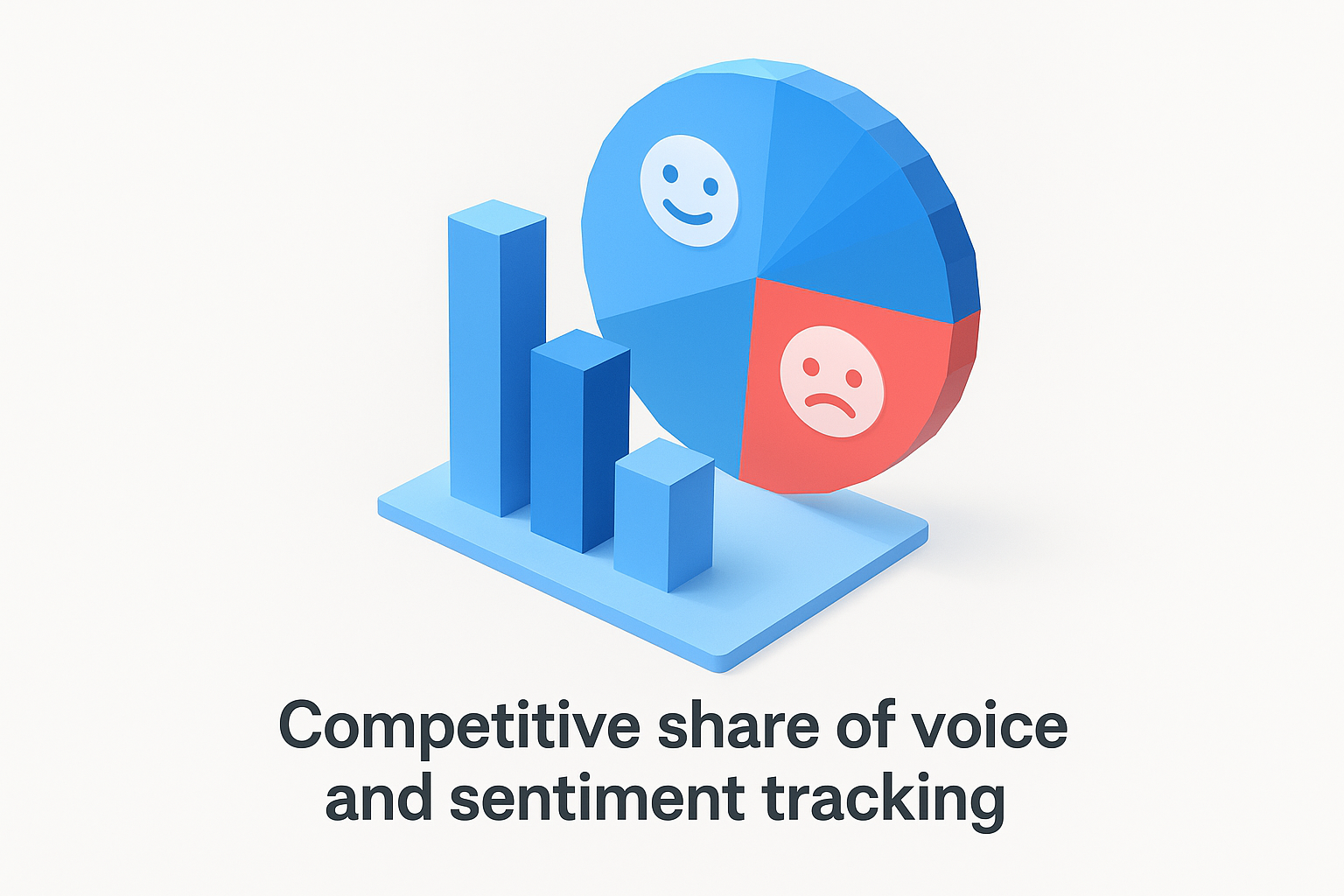
This combination of share of voice and sentiment tracking gives you a real read on how competitor positioning is landing with actual audiences, not just how much they post.
Research and reporting strengths
Brandwatch's image recognition and demographic analysis features let you dig into the audience behind competitor conversations, including who is talking, where they are, and what else they care about. You can build custom dashboards that combine multiple competitor data streams into a single view and export reports in formats suited for stakeholder presentations or ongoing research documentation.
Limitations to know before you choose it
Brandwatch does not offer content scheduling or publishing tools, so it functions purely as a research and intelligence layer. The platform's depth and pricing also make it a harder fit for smaller teams or solo operators who need simpler dashboards and lower monthly costs.
Pricing
Brandwatch uses custom pricing based on query volume and team size. You need to contact their sales team for a quote, and most plans are structured as annual contracts.
6. Meltwater
Meltwater is a media intelligence platform that covers social media monitoring alongside traditional news, broadcast, and web tracking. It works as a social media competitor analysis tool that pulls competitor activity from a broader range of sources than most pure-social platforms can reach, which makes it a practical fit for teams that need to track how rivals show up across both digital press and social channels simultaneously.
What it is and how it handles social and media competitor tracking
Meltwater tracks competitor mentions across social networks, online news outlets, broadcast media, and blogs from a single dashboard. You set up searches around competitor brand names, campaigns, or product terms, and the platform surfaces matching content continuously so you can monitor shifts in their public presence without checking each source manually.
Monitoring across social, news, and web sources
The platform's strength is its cross-channel reach, which goes well beyond what a standard social-only tool provides. You can track a competitor across Instagram, X/Twitter, and LinkedIn while simultaneously monitoring how they appear in press coverage and industry publications.
This breadth gives you a fuller competitive picture than social metrics alone, especially when a competitor is running a coordinated PR and social push at the same time.
Alerts and competitive reporting options
Meltwater lets you configure real-time alerts tied to competitor keywords so you get notified when a rival appears in a major publication or spikes in social conversation. You can also build scheduled reports that pull competitor data into shareable dashboards for weekly or monthly stakeholder updates.
Limitations to know before you choose it
Meltwater does not offer content creation tools, publishing features, or hook-level content analysis, so it functions purely as a monitoring layer. The interface can also feel overly complex for small teams who only need social-specific tracking without the broader media intelligence layer.
Pricing
Meltwater uses custom pricing based on the modules and data volume you need. You contact their sales team directly for a quote, and contracts are typically structured on an annual basis.
7. Socialinsider
Socialinsider is built specifically around social media analytics and competitive benchmarking, with no scheduling or publishing features cluttering the interface. The platform focuses on giving you clean, platform-specific performance data across Instagram, Facebook, TikTok, LinkedIn, X/Twitter, and YouTube so you can compare your results against specific competitor profiles in a structured way.
What it is and how it handles platform-by-platform benchmarking
Socialinsider works as a dedicated social media competitor analysis tool that lets you add competitor profiles and track how their content performs on each network separately. Rather than showing you a single blended score across platforms, it breaks performance data down by channel and content type, which gives you a more accurate read on where rivals are gaining traction versus where their numbers only look strong in aggregate.
Competitive metrics and content comparisons
The platform pulls engagement rate, reach, post frequency, content type breakdown, and audience growth for every competitor profile you add. You can run side-by-side comparisons between your account and rivals across a custom date range, making it straightforward to spot patterns in their publishing cadence and top-performing formats over time.
This content-type breakdown is especially useful when you want to identify whether a competitor's growth is coming from Reels, carousels, or static posts before you shift your own production mix.
Reporting workflows for agencies and brands
Socialinsider includes white-label reporting and scheduled PDF exports, which makes it a practical choice for agencies that need to deliver competitive benchmarking data to clients on a regular cadence. You can build custom report templates that pull competitor comparisons into a branded format without manual formatting work each time.
Limitations to know before you choose it
The platform does not offer content creation, AI analysis, or ad creative monitoring, so you won't get hook breakdowns or strategy-level insights here. It also does not cover Facebook Ads Library data, which limits its usefulness if paid competitor research is a priority for your team.
Pricing
Socialinsider's plans start at $99 per month on an annual billing basis, with agency-focused plans available at higher price points depending on the number of profiles and users you need to manage.
8. Rival IQ
Rival IQ is a dedicated competitive social analytics platform that strips away the publishing and scheduling features you find in most social management tools and focuses entirely on giving you performance data on competitor accounts. If benchmarking is your primary goal and you want a clean interface built around that task, Rival IQ is worth a close look as a social media competitor analysis tool.
What it is and how it handles competitive social analytics
Rival IQ lets you build a competitive landscape by adding the brands and accounts you want to track, then pulls their public performance data across Instagram, Facebook, X/Twitter, LinkedIn, TikTok, and YouTube into a single view. The platform is built from the ground up for comparison rather than content management, so the entire interface stays focused on the competitive layer without extra features pulling your attention elsewhere.
Content, engagement, and cadence comparisons
The platform surfaces engagement rate, post frequency, follower growth, and top-performing content for every competitor in your landscape. You can filter by content type and date range to pinpoint exactly when a rival shifted their posting strategy or which formats drove their strongest results during a specific period.
These cadence comparisons are especially useful when you want to validate whether a competitor's growth spike tracks back to a change in posting volume or a specific content format shift.
Alerts and competitive insights you can operationalize
Rival IQ lets you configure email alerts tied to competitor activity, including spikes in engagement, new top-performing posts, and changes in follower trajectory. This keeps you informed between reporting sessions without requiring you to log in and manually check each account on a set schedule.
Limitations to know before you choose it
Rival IQ does not offer content creation tools, ad creative monitoring, or AI-driven content analysis, so you won't get strategy-level breakdowns of what makes a competitor's content work. It also lacks paid social tracking, which limits its scope if your competitive research extends into ad campaigns.
Pricing
Rival IQ's plans start at $239 per month on an annual basis, with higher tiers unlocking more competitors and additional users.
9. Quintly
Quintly is a dedicated social media analytics platform focused on customizable reporting and competitive benchmarking. It gives you granular control over how you measure competitor performance, making it a flexible social media competitor analysis tool for data-heavy teams that need more than preset dashboards.
What it is and how it handles customizable competitor reporting
Quintly lets you add competitor profiles across Instagram, Facebook, YouTube, LinkedIn, Twitter, and TikTok, then build fully custom reports around the specific metrics that matter to your strategy. Unlike platforms that lock you into fixed report templates, Quintly gives you a metric builder where you define the data points you want to track and how you want to visualize them.
Metrics, dashboards, and benchmarking setup
You can pull engagement rate, reach, follower growth, post frequency, and content type performance for each competitor profile you add. The dashboard setup process lets you combine metrics from multiple platforms into a single view, which makes cross-channel benchmarking straightforward without jumping between separate reports for each network.
This level of customization makes Quintly especially useful when your team has specific KPIs that standard reports from other tools simply do not surface.
Data export and automation options
Quintly supports scheduled report delivery and API access, so your team can automate how competitor data flows into internal dashboards or client-facing documents. Exports come in CSV and JSON formats, which works well if you are feeding competitive benchmarks into custom spreadsheets or BI tools alongside your other performance data.
Limitations to know before you choose it
The platform has no content creation, publishing, or AI analysis features, so it functions purely as an analytics and reporting layer. The configuration process takes real time upfront before you start pulling consistent value from it, since the customization that makes Quintly powerful also means more setup work compared to tools with fixed templates.
Pricing
Quintly uses custom pricing based on the number of profiles and users you need. Contact their sales team directly for a quote, as plans are structured on annual contracts with no self-serve option publicly available.
10. Social Status
Social Status is a dedicated social media analytics platform built specifically around competitor benchmarking and performance reporting. Unlike broader social management tools that treat analytics as a secondary feature, Social Status builds its entire product around profile analytics, competitor tracking, and automated reporting, making it a clean option when those three needs are your primary focus.
What it is and how it handles competitor analytics
The platform works as a straightforward social media competitor analysis tool that lets you add competitor profiles and pull their public performance data into a structured dashboard. You set up competitor groups, track how their content performs over time, and compare those results directly against your own accounts across multiple networks without navigating through unrelated scheduling or inbox features.
Supported networks and benchmark views
Social Status covers Facebook, Instagram, X/Twitter, YouTube, LinkedIn, and TikTok, giving you cross-platform visibility from a single interface. You can run side-by-side benchmark comparisons across engagement rate, follower growth, post frequency, and content type performance for every competitor profile you add.
This cross-platform coverage makes it practical when your competitors are active across multiple networks and you need one place to track all of them at once.
Reporting and client-friendly outputs
The platform offers automated white-label reports and scheduled PDF exports that pull competitor benchmarking data into branded formats you can deliver to clients without manual formatting each time. You can configure report delivery on a weekly or monthly schedule, which keeps stakeholders updated without requiring you to rebuild the same document repeatedly.
Limitations to know before you choose it
Social Status has no content creation, AI analysis, or ad creative monitoring features, so it functions purely as an analytics and reporting layer. It also lacks social listening capabilities, which means you won't catch competitor mentions or broader brand conversation outside of profile-level metrics.
Pricing
Social Status offers a free plan with limited profiles, and paid plans start at $29 per month, scaling up based on the number of profiles and report connections you need to manage.
11. Semrush Social
Semrush Social is the social media module built into the Semrush platform, which most digital marketers already rely on for SEO and competitive search intelligence. If you want to extend your competitive research without adding another subscription, Semrush Social brings basic social benchmarking into the same workspace where you already track keywords and backlinks.
What it is and how it supports social competitor analysis
Semrush Social lets you add competitor profiles and track their public activity across Facebook, Instagram, and LinkedIn from inside your existing Semrush account. As a social media competitor analysis tool, it provides a straightforward benchmarking layer that works best when you want your social data and organic search competitive research consolidated in one platform rather than split across separate tools.
Competitor tracking features inside Semrush
The social module pulls several key performance metrics for competitor accounts you configure, including:
- Engagement rate and post frequency across all tracked profiles
- Follower growth over custom date ranges you define
- Top-performing posts broken down by content type and platform
These metrics deliver the most value when you connect them to the organic traffic and keyword data you already pull inside Semrush, giving you a cross-channel competitive picture without switching platforms.
When Semrush makes sense as an all-in-one stack
If your team already runs SEO audits, backlink analysis, and paid search research inside Semrush, adding the social module keeps your competitive workflow consolidated. You avoid paying a separate subscription for a standalone benchmarking tool, and your team pulls cross-channel competitor data from a single login. That efficiency is the clearest argument for choosing it over a dedicated platform.
Limitations to know before you choose it
The social module covers a narrower platform set than dedicated tools like Rival IQ or Socialinsider, with no TikTok or YouTube tracking currently available. It also has no social listening, ad creative monitoring, or AI content analysis, so it works as a complement to your broader Semrush setup rather than a primary competitor intelligence solution.
Pricing
Semrush Social is available as an add-on starting at $29.99 per month, applied on top of your existing Semrush plan. Base Semrush subscriptions start at $139.95 per month, which makes the combined cost substantial if your team is not already invested in the platform for SEO and search work.
12. Talkwalker
Talkwalker is a social listening and consumer intelligence platform that monitors competitor activity across social media, news, blogs, podcasts, and broadcast sources simultaneously. It positions itself as a social media competitor analysis tool built for enterprise teams that need wide-angle visibility into how competitors appear across the entire digital landscape, not just their social profiles.
What it is and how it handles social listening at scale
Talkwalker pulls data from over 150 million sources including social platforms, online news, forums, review sites, and podcasts, giving you a sweeping view of how rivals are discussed across the web. You configure boolean search queries around competitor brand names, products, or campaigns, and the platform continuously surfaces matching content in real time without manual monitoring.
Competitive monitoring, sentiment, and trends
The platform tracks share of voice, sentiment, and conversation volume for every competitor you monitor, broken down by channel, geography, and demographic segment. You can identify emerging trends in competitor messaging before they peak, which gives your team time to respond or reposition before the conversation cycle closes.
This trend detection capability separates Talkwalker from simpler benchmarking tools that only surface data after a story has already played out.
Use cases for PR, brand, and insights teams
Talkwalker fits best when your team needs to monitor brand reputation and competitive positioning across both earned media and social channels at the same time. PR teams use it to track competitor press coverage in real time, while brand and insights teams rely on its audience analytics and demographic breakdowns to understand who is driving competitor conversations and what those audiences actually respond to.
Limitations to know before you choose it
The platform offers no content creation, publishing, or ad creative analysis features, so it works purely as an intelligence layer. The depth of the tool also brings a steep learning curve and a pricing structure that makes it a poor fit for small teams or solo operators without dedicated research resources.
Pricing
Talkwalker uses custom pricing based on data volume and team size. You contact their sales team directly for a quote, and contracts run on an annual basis with no self-serve option available.
Next steps
Every social media competitor analysis tool on this list handles a specific slice of the competitive research problem. Dedicated monitoring platforms like Rival IQ and Socialinsider give you clean benchmarking data. Enterprise tools like Sprinklr and Talkwalker go wide across channels. Semrush Social works well if you already run your SEO research there. Each one tells you how competitors perform, but none of them help you act on that data by actually building content from it.
That's the gap AI Flow Chat fills. You paste in a competitor's video, ad, or post, and the platform uses AI to break down the hook structure and content formula behind it so you can replicate what's working in your own voice. Most teams get the most out of pairing a traditional monitoring tool for ongoing tracking with AI Flow Chat for turning competitive insights into original content. Start there and close the loop between knowing and doing.
Continue Reading
Discover more insights and updates from our articles
Choose an AI model for scripts, marketing copy, coding, research, long documents, and quick everyday work using a practical quality, speed, and credit-cost framework.
Compare eight current Poppy AI alternatives for visual research, creator workflows, general AI work, grounded synthesis, automation, and reusable delivery.
A practical method for turning a scattered content process into a clear AI-assisted flowchart with source context, review checks, and a reusable output.