Brand Voice Definition: What It Is and How to Create Yours
At AI Flow Chat
Contents
0%Every piece of content you publish says something about your brand, whether you've planned it or not. A brand voice definition gives you the blueprint to make sure that "something" is intentional, recognizable, and consistent across every caption, email, script, and ad you put out. Without one, your messaging drifts. Your audience notices, even if they can't articulate why.
Brand voice isn't just a branding exercise for Fortune 500 companies with style guides thicker than a novel. It matters just as much, arguably more, for solo creators, marketers, and small agencies who produce content at high volume across multiple platforms. The more content you create, the harder it gets to stay consistent. And if you're using AI tools to speed up production, that challenge multiplies. Generic outputs start creeping in, and suddenly everything you publish sounds like everyone else.
That's exactly the problem we built AI Flow Chat to solve. Our platform lets you feed your own reference materials, past content, and brand guidelines directly into AI workflows, so every output stays anchored to your voice instead of defaulting to bland, robotic copy.
This guide breaks down what brand voice actually means, how it differs from brand tone, and gives you a step-by-step process to define and document yours. Whether you're building a voice from scratch or trying to maintain one while scaling content production, you'll walk away with a framework you can put to work immediately.
What brand voice means in marketing
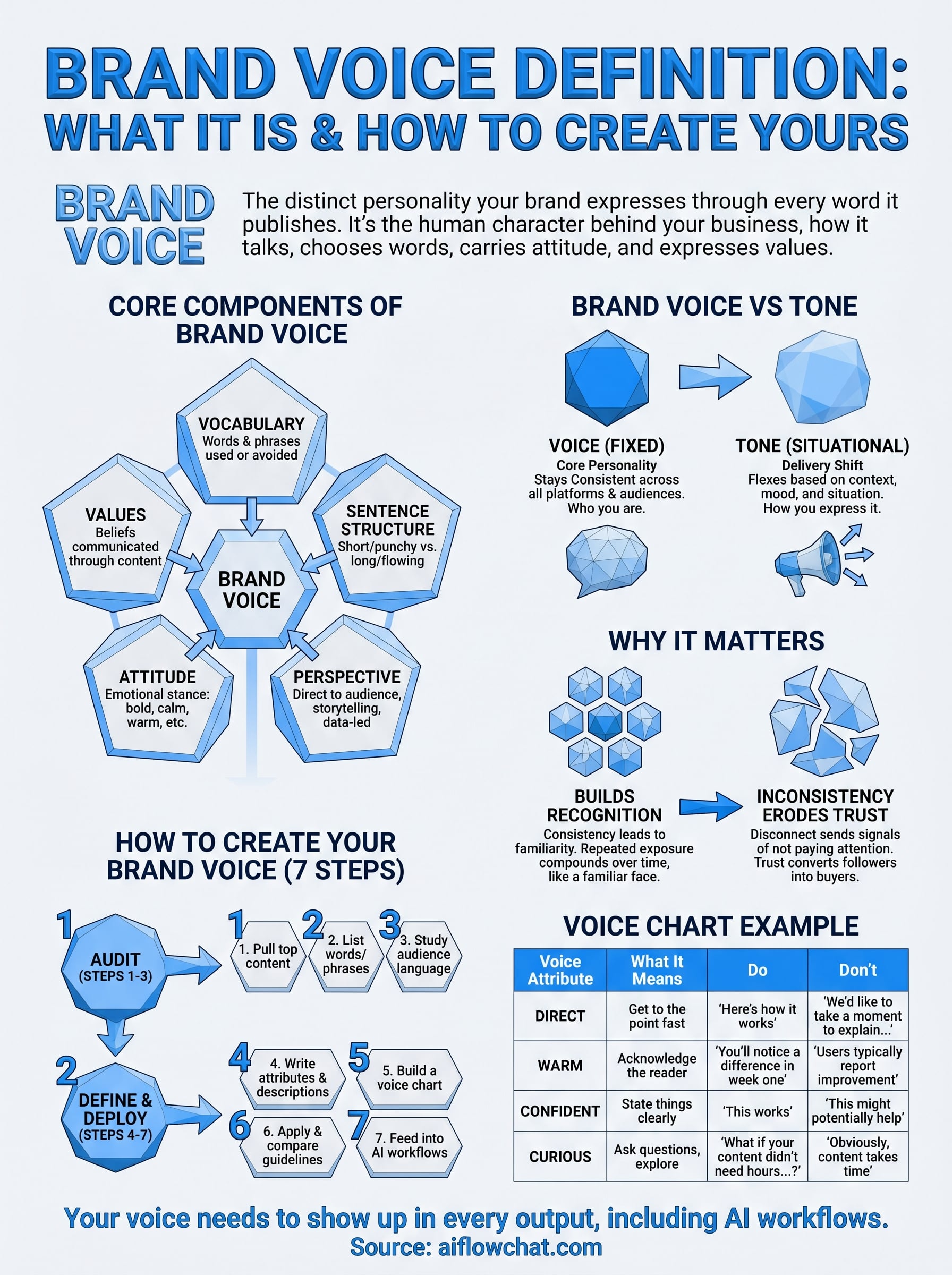
At its core, brand voice is the distinct personality your brand expresses through every word it publishes. Think of it as the human character behind your business. If your brand were a person, brand voice is how that person talks: the words they choose, the attitude they carry, and the values they express. Every caption you write, every email you send, and every script you record contributes to it. When those pieces sound consistent, audiences start to recognize and trust you. When they don't, you feel forgettable.
A solid brand voice definition in the marketing context goes beyond "we want to sound friendly" or "we want to sound professional." Those descriptors are too vague to guide actual content decisions. A real brand voice is specific enough that two different writers, working independently, produce copy that sounds like it came from the same person. That level of specificity is what separates brands people remember from brands that blend into the noise.
The goal of defining your brand voice isn't to sound good once. It's to sound like yourself every single time, regardless of who writes the content or which platform it's published on.
The core components of brand voice
Brand voice breaks down into concrete characteristics that, taken together, create a recognizable personality. Each component gives writers and AI tools a specific guardrail to stay inside when producing content on your behalf. Without these defined, every new piece of content becomes a guessing game.

The main components most marketers define are:
- Vocabulary: the specific words and phrases you use or actively avoid
- Sentence structure: whether you write in short punchy sentences, long flowing ones, or a deliberate mix
- Perspective: whether you speak to your audience directly, tell stories, or lead with data
- Attitude: the emotional stance your brand takes, whether that's bold and irreverent, calm and authoritative, or warm and direct
- Values: the beliefs your brand communicates, even indirectly, through what it chooses to talk about
What brand voice is not
Brand voice is not a tagline, a logo, or a color palette. Those are visual identity elements. Voice lives entirely in the language layer. A lot of marketers conflate brand identity with brand voice, but the two operate in different domains. Your visual identity tells people what you look like. Your voice tells them who you are.
Brand voice is also not a rigid script that locks every writer into identical sentence structures word for word. It's a set of flexible guidelines that keep the personality consistent without strangling the writer's ability to adapt. Solid brand voice guidance gives creative direction without removing creative judgment, which is exactly the kind of constraint that makes content easier to produce at scale, not harder. When you hand off content production to a team member or feed your guidelines into an AI workflow, those guardrails do the heavy lifting of keeping everything on-brand without requiring you to review every single output from scratch.
Why brand voice matters for growth and trust
A consistent brand voice does more than make your content sound polished. It functions as a growth lever by making your brand easier to recognize and remember. When someone sees your post, email, or ad and immediately knows it's from you, without looking at the logo or handle, you've built real brand equity. Recognition drives recall, and recall is what pushes someone to buy from you instead of a competitor they can barely distinguish from the rest.
Consistency builds recognition
Humans are pattern-recognition machines. When your content consistently sounds the same, your audience starts to associate that pattern with you. Repeated exposure to a consistent voice compounds over time, the same way seeing a familiar face in a crowd is immediately easier to process than a stranger's. Research from Lucidpress found that consistent brand presentation across all platforms can increase revenue by up to 23%. The mechanism is simple: predictable personality creates familiarity, and familiarity lowers the psychological barrier to trusting a brand enough to buy from it.
When your audience can predict how you sound, they start to feel like they know you, and people buy from people they know.
Trust erodes fast when your voice is inconsistent
Inconsistency in brand voice sends a subtle but damaging signal to your audience: nobody's paying attention here. If your social posts sound casual and playful, your emails read like legal documents, and your ads use entirely different vocabulary, your audience picks up on the disconnect even if they can't consciously identify it. That disconnect erodes trust. Trust is the variable that converts followers into buyers and buyers into repeat customers, which makes a clear brand voice definition one of the most underrated retention tools in your content stack.
Defining your brand voice also protects you the moment you scale. When you bring in a second writer, a contractor, or an AI tool to help produce content, a documented voice becomes the quality control layer that keeps every output on-brand without requiring you to rewrite everything yourself.
Brand voice vs tone: keep personality, shift delivery
Brand voice and brand tone are not the same thing, and conflating the two is one of the most common mistakes marketers make when building their messaging strategy. Your brand voice stays fixed. It's the core personality of your brand, the one that shows up in every piece of content you publish, regardless of the platform or the audience. Tone is what shifts based on the situation. Think of it the way you'd think about a person: you have the same personality whether you're at a job interview or a backyard barbecue, but the way you express that personality changes depending on the room.
Voice is fixed; tone is situational
A solid brand voice definition draws a clear line between what never changes and what flexes based on context. Your voice attributes, like being direct, curious, or warm, stay constant. But the tone you layer on top of those attributes adapts. A brand that's always honest and direct might use a serious, empathetic tone in a customer support email and a sharper, more energetic tone in a product launch post. The voice is the same. The delivery is different.
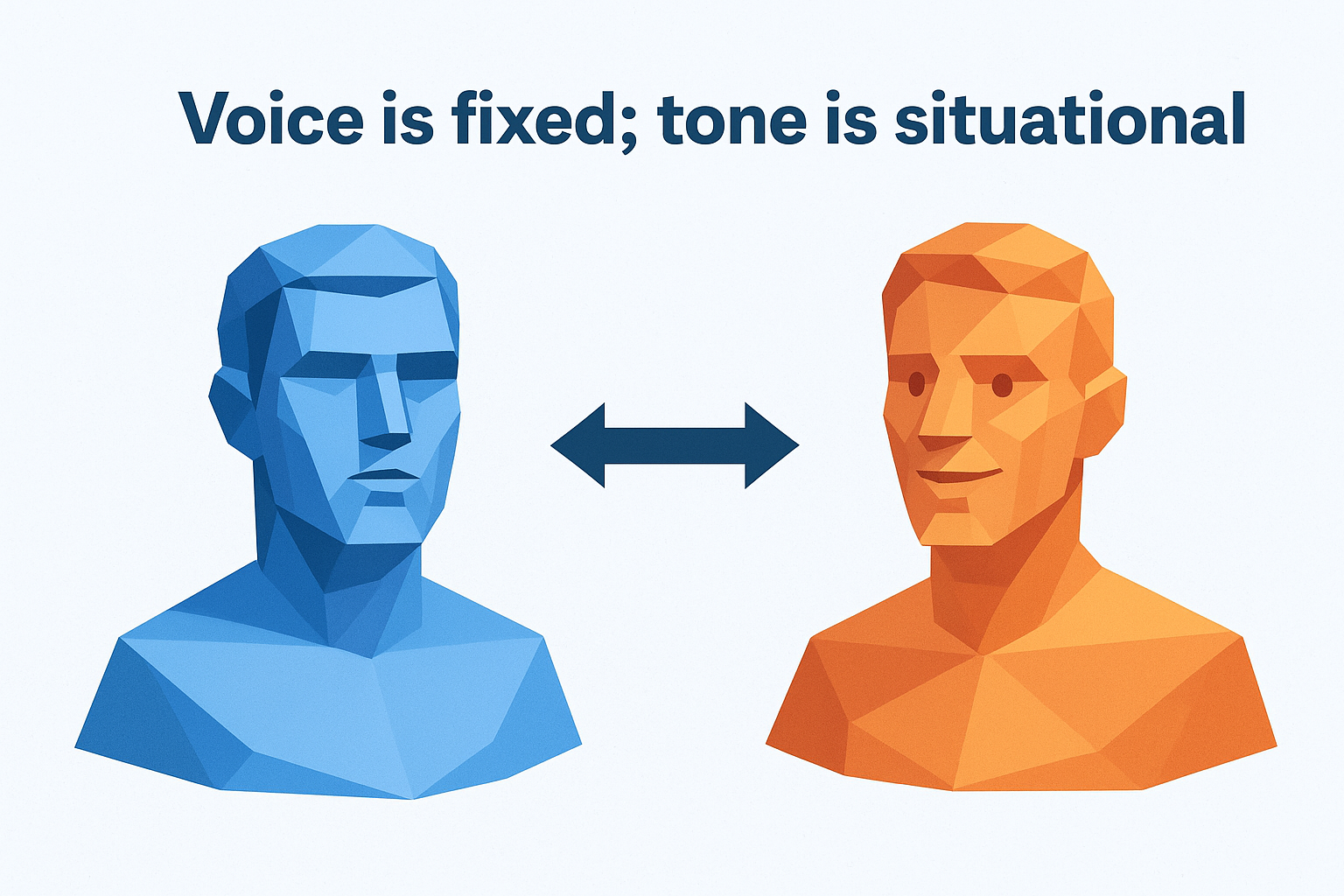
Your voice is your personality. Your tone is your mood. Personality stays stable; mood responds to what's happening around you.
Why the distinction matters in practice
Understanding the difference protects you when you scale content production across multiple platforms or hand off writing to a team. Without this distinction documented, a writer or AI tool treats every content type as identical and produces flat, uniform copy that doesn't fit the context it lands in. A LinkedIn article and a TikTok script should sound like the same brand, but they should not read like carbon copies of each other.
Document your voice attributes separately from your tone guidelines. List your core voice traits in one column, then map out how the tone shifts across different content types, customer stages, or platforms in another. That structure gives anyone producing content for you a clear, practical reference they can actually use without guessing.
How to create a brand voice in 7 steps
Building a brand voice doesn't require a full rebrand or an agency budget. You can define yours with a structured process that takes your existing instincts and converts them into repeatable guidelines anyone on your team can follow. The steps below give you a practical framework to build a clear brand voice definition from scratch, or sharpen one that already exists but has never been formally documented.
Audit what you already have (steps 1-3)
Start where you already are. Before you define anything new, look at what your brand already sounds like across your best-performing content.
Step 1: Pull your top 10 pieces of content across all platforms, the posts, emails, or pages that performed best or felt most authentic. Look for patterns in language, sentence length, and attitude.
Step 2: List the words and phrases that appear most frequently and feel most natural. Also note what you never say and which phrases feel completely off-brand even if you can't explain why yet.
Step 3: Study your audience's language. Read through comments, reviews, and direct messages. The vocabulary your audience uses often mirrors the register your brand should be speaking back to them.
The fastest way to find your brand voice is to study the content that already works and identify what those pieces have in common.
Define, document, and test (steps 4-7)
Once you've gathered your raw material, you move into active definition and deployment.
Step 4: Write three to five voice attributes that describe your brand's personality clearly, such as direct, curious, or warm. Pair each attribute with a short description and a "we are this, not that" contrast to remove ambiguity.
Step 5: Build a simple voice chart that maps each attribute to concrete dos and don'ts for any writer producing content for your brand.
Step 6: Apply your guidelines to a new piece of content and compare it against an older piece. Adjust where the gap is obvious.
Step 7: Feed your documented voice guidelines into your AI workflows so every output generates from your defined personality rather than a generic default.
Brand voice examples and a simple voice chart
The clearest way to understand a brand voice definition in action is to see how real brands use it to create instant recognition. Studying concrete examples helps you spot what specific, well-defined voice attributes actually look like in practice, so you can apply the same thinking to your own brand without guessing.
Three brand voice examples in practice
Looking at how established brands express their voice gives you a practical benchmark to work from. Each example below shows a brand with distinct, documented voice attributes that stay consistent across every platform they publish on.
Nike leads with motivation and urgency. Short sentences. Active verbs. Direct commands. Every piece of copy pushes the reader to act. Mailchimp takes the opposite approach: warm, slightly quirky, and approachable without being juvenile. Their copy explains complex things simply and adds just enough personality to keep it from feeling like a software manual. Liquid Death leans aggressively into irreverence, treating water like heavy metal merchandise. The voice is bold, funny, and completely consistent across packaging, social posts, and ads.
What separates each of these brands is not just the adjectives they use to describe their voice, but the specific choices they make at the word and sentence level every single time.
Build your own voice chart
A voice chart turns abstract personality descriptions into practical writing guidelines your team or AI tools can actually use. The format below gives you a working template to fill in for your own brand.
| Voice Attribute | What It Means | Do | Don't |
|---|---|---|---|
| Direct | Get to the point fast | "Here's how it works" | "We'd like to take a moment to explain..." |
| Warm | Acknowledge the reader | "You'll notice a difference in week one" | "Users typically report improvement" |
| Confident | State things clearly | "This works" | "This might potentially help" |
| Curious | Ask questions, explore ideas | "What if your content didn't need hours of editing?" | "Obviously, content takes time" |
Fill in this chart for your own brand and share it with every writer or AI workflow you use to produce content. The more specific each cell is, the less room there is for off-brand copy to slip through.
Your next steps
You now have a complete brand voice definition framework you can put to work today. Start with the audit: pull your best-performing content, look for the patterns that already exist, and document what you find using the voice chart structure from the previous section. That document becomes the foundation for every piece of content you produce going forward, whether you write it yourself, hand it off to a writer, or generate it with AI.
The biggest risk at this stage is treating brand voice as a one-time project you complete and shelve. Your voice needs to show up in every output, which means building it directly into your content workflows, not just your style guide. If you produce content at volume and want every output to stay anchored to your defined personality rather than defaulting to generic copy, try AI Flow Chat and feed your brand guidelines directly into your AI workflows from day one.
Continue Reading
Discover more insights and updates from our articles
Choose an AI model for scripts, marketing copy, coding, research, long documents, and quick everyday work using a practical quality, speed, and credit-cost framework.
Compare eight current Poppy AI alternatives for visual research, creator workflows, general AI work, grounded synthesis, automation, and reusable delivery.
A practical method for turning a scattered content process into a clear AI-assisted flowchart with source context, review checks, and a reusable output.