Brand Voice Guidelines: Framework, Examples, Template
At AI Flow Chat
Contents
0%Your brand publishes a LinkedIn post that sounds like a Fortune 500 press release, a TikTok caption that reads like a college freshman wrote it, and an email that could belong to literally any company on the internet. Same brand, three completely different personalities. That disconnect is exactly what brand voice guidelines exist to prevent, and most teams either skip them entirely or create a doc that collects dust in a shared drive.
A strong brand voice guideline document gives every person (and every AI tool) touching your content a clear set of rules for how your brand communicates. Not just what you say, but how you say it. The tone, the vocabulary, the attitude, the boundaries. Without it, scaling content across channels and team members turns into a game of telephone where your brand identity gets lost with every handoff.
This matters even more when you're using AI to produce content. At AI Flow Chat, we watch creators and marketers feed viral references, competitor ads, and SOPs into AI workflows every day. The ones who get consistently good output aren't just better at prompting, they've defined their voice so clearly that AI can actually replicate it. The ones who haven't? They spend more time editing than they saved generating.
This guide walks you through a complete framework for building brand voice guidelines from scratch. You'll get step-by-step instructions, real examples from brands that do it well, and a ready-to-use template so you can stop guessing and start producing content that actually sounds like you, whether a human or an AI wrote it.
What brand voice guidelines are and why they matter
Brand voice is how your brand communicates as a consistent personality across every piece of content you produce. It's not a tagline or a color palette. It's the sum of your word choices, sentence structure, attitude, and the specific way you address your audience. Brand voice guidelines are the documented ruleset that captures that personality so anyone creating content for your brand can replicate it without guessing.
Brand voice vs. tone: they're not the same thing
Your brand voice stays constant, but your tone shifts based on context. Think of it this way: your voice is who you are, and your tone is how you feel in a given moment. Mailchimp's brand voice is friendly and direct. But their tone on an error page differs from their tone in a promotional email. The underlying personality doesn't change. The emotional register does.
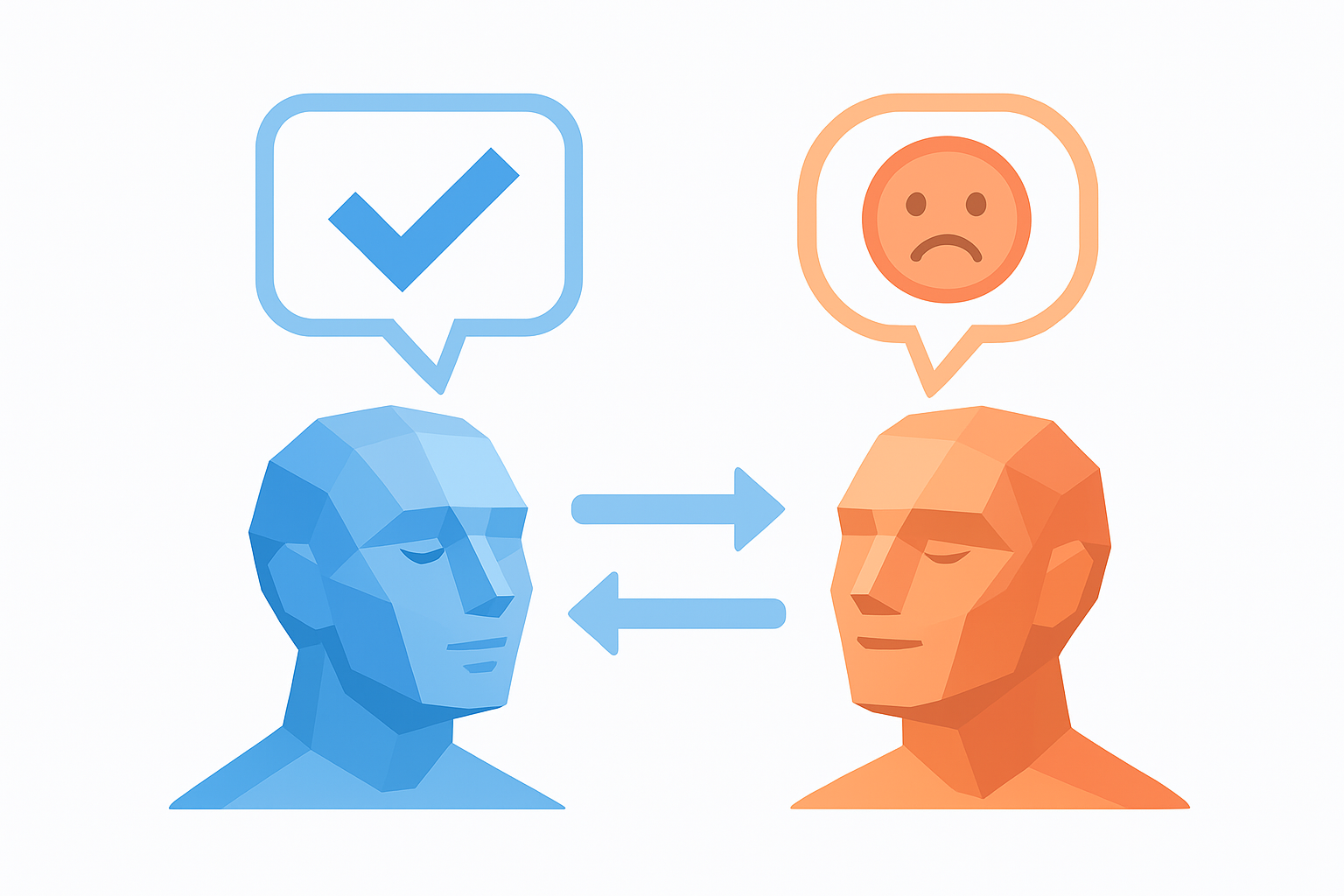
Your brand voice is the personality. Your tone is the mood. Separate them clearly in your guidelines, or your team will confuse the two and produce inconsistent content even when they're trying to follow the rules.
Strong brand voice guidelines document both. They tell your writers who the brand is as a communicator and then explain how that personality shows up differently depending on the situation. Without that distinction, content feels inconsistent even when the team believes they're following the same playbook.
Why consistency is a business problem
Most teams treat inconsistent voice as an aesthetic issue. It's not. Inconsistent brand communication directly erodes trust, because readers who encounter different personalities across your channels start to feel like they don't know who they're dealing with. Familiarity builds confidence, and confidence converts. When your LinkedIn post sounds like a corporate memo and your email reads like a friend wrote it, neither piece reinforces the other, and your audience gets no clear signal of who you are.
The problem compounds when you scale. Freelancers, agencies, and AI tools all interpret your brand differently unless you give them a specific framework to follow. The more people and tools touch your content, the more your voice drifts over time. Guidelines lock down the baseline so drift becomes detectable and correctable before it damages your audience's perception of you.
What strong brand voice guidelines actually include
A real brand voice document goes beyond "we're professional but approachable." That phrase means nothing without specifics. Strong guidelines give your team concrete, usable direction rather than vague adjectives they'll each interpret differently. Here's what a complete document typically contains:
| Component | What it covers |
|---|---|
| Voice traits | 3 to 5 adjectives with detailed explanations and examples |
| Tone map | How voice shifts across channels and situations |
| Word list | Words you use and words you never use |
| Writing rules | Sentence length, punctuation style, formatting preferences |
| Examples | Before/after rewrites that show the voice in action |
| Anti-patterns | Common mistakes your team actually makes |
Each component serves a specific job. Voice traits give writers a north star. The tone map handles situational adaptation. The word list removes ambiguity at the sentence level. Together, these components turn a vague idea of "how we sound" into a replicable system you can hand to a new hire, a freelancer, or an AI workflow and get consistent output back.
Step 1. Gather inputs and define your audience
You can't define how your brand sounds until you know what already exists and who you're trying to reach. Most teams skip this step and jump straight to writing adjectives like "bold" or "conversational" without any real evidence to back them up. Gathering real inputs first means your brand voice guidelines reflect something true about your brand and your audience, not just what sounds good in a meeting.
Start with what already exists
Before you write a single voice trait, audit your current content. Pull 10 to 15 pieces across different channels: emails, social captions, website copy, blog posts, support responses. Read them back to back and look for patterns. What words keep appearing? Where does the writing feel natural and confident? Where does it feel forced or generic? Mark the strongest examples and note what specifically works about each one. Those examples become your anchor content when you build the guidelines document.
Collect these input types to make your audit thorough:
- 3 to 5 emails sent to customers in the last 90 days
- Your 5 best-performing social posts ranked by engagement
- Your homepage, about page, and one product or service page
- Any existing style guide or brand deck, even a partial one
- 3 examples of brands whose voice you admire and want to study
Define exactly who you're talking to
Your voice only works if it connects with a specific person, not a generic audience segment. Write a one-paragraph description of your primary reader: their job, their biggest frustration, how they talk about problems in their own words, and what they distrust in communication. This isn't a demographic profile. It's a communication portrait that gives every content decision a clear filter to run through.
The more specifically you describe who you're writing for, the easier it becomes to make real decisions about word choice, sentence length, and tone.
Use this simple template to lock in your audience definition before moving to the next step:
| Field | Your answer |
|---|---|
| Who they are | Job title or life situation |
| Their core problem | What they're trying to solve |
| How they talk | Words and phrases they actually use |
| What they distrust | Communication styles that put them off |
| What earns their trust | What makes them pay attention |
Step 2. Define your voice traits and guardrails
Voice traits are the core of your brand voice guidelines. They're the 3 to 5 adjectives that define your brand's communication personality, and each one needs enough explanation to be actually useful. A single word like "bold" tells your team nothing. A trait with a clear definition, examples, and explicit limits tells them exactly what to do and what to avoid.
Choose 3 to 5 voice traits with real depth
Start by selecting 3 to 5 adjectives that describe how your brand communicates, not what your brand does. "Innovative" describes a product. "Direct" describes a communication style. You want the latter. For each trait, write two to three sentences explaining what it means for your brand specifically. Then add a short example showing the trait inside a real sentence so the meaning becomes concrete rather than theoretical.
Pick fewer traits with more depth rather than more traits with less. Five well-defined traits do more work than ten vague ones.
Use this format to build out each trait:
| Field | Example (trait: "Direct") |
|---|---|
| Trait name | Direct |
| What it means | We say exactly what we mean without softening language or padding sentences with qualifiers |
| What it sounds like | "This plan won't work. Here's what will." |
| What it does NOT mean | Rude, blunt to the point of dismissiveness, or skipping necessary context |
Complete this table for each of your 3 to 5 traits. When you finish, read them as a set and check that they describe one coherent personality rather than a contradictory mix of qualities.
Write guardrails for each trait
Guardrails are the "not" side of each trait, and they're the most overlooked part of any voice document. Every trait can tip into something unintended if you don't name the boundary explicitly. "Friendly" becomes "unprofessional." "Confident" becomes "arrogant." "Simple" becomes "condescending." Writing explicit guardrails prevents those slips before they happen.
For each trait, complete this sentence: "This trait means [X], but it does not mean [Y]." Then add one before-and-after example showing where the line sits. This gives both writers and AI tools a clear boundary to work within, not just a general direction to move toward.
Step 3. Map tone shifts by situation and channel
Your brand voice stays constant, but the emotional register you bring to each piece of content should flex based on what your reader is experiencing in that moment. A customer who just hit an error message needs a different tone than one browsing your features for the first time. Your brand voice guidelines should account for this explicitly, or your team will apply the same energy everywhere and produce content that feels off, even when the words are technically "on brand."
Identify which situations shift your tone
Certain triggers consistently change how you should communicate. A purchase confirmation, an error state, a product launch, and a customer complaint all land on a reader differently. For each major content type you produce, ask yourself what emotional state your reader is in and what they need from you in that moment. A reader who just converted needs excitement and reassurance. A reader who hit a billing problem needs calm and clarity. Document those differences explicitly so your team stops guessing.
The situation determines the tone. The voice determines how you handle the situation. Both need to be documented separately.
Map your tone shifts across these four emotional states that apply to most brands:
| Situation | Reader's state | Tone adjustment |
|---|---|---|
| Onboarding or welcome | Excited, slightly uncertain | Warm, encouraging, concise |
| Error or problem | Frustrated or anxious | Calm, direct, solution-first |
| Sales or promotional | Skeptical, browsing | Confident, specific, no pressure |
| Support or help content | Stuck, needs clarity | Patient, plain language, step-by-step |
Build a channel-by-channel tone map
Each channel your brand uses carries a different reader expectation. LinkedIn readers expect more substance and less casualness. TikTok viewers expect energy and brevity. Email subscribers gave you permission to reach them, which means they expect relevance rather than noise. Mapping tone by channel removes the guesswork for anyone producing content across your distribution platforms, whether that's a freelancer, a new hire, or an AI workflow running on a schedule.
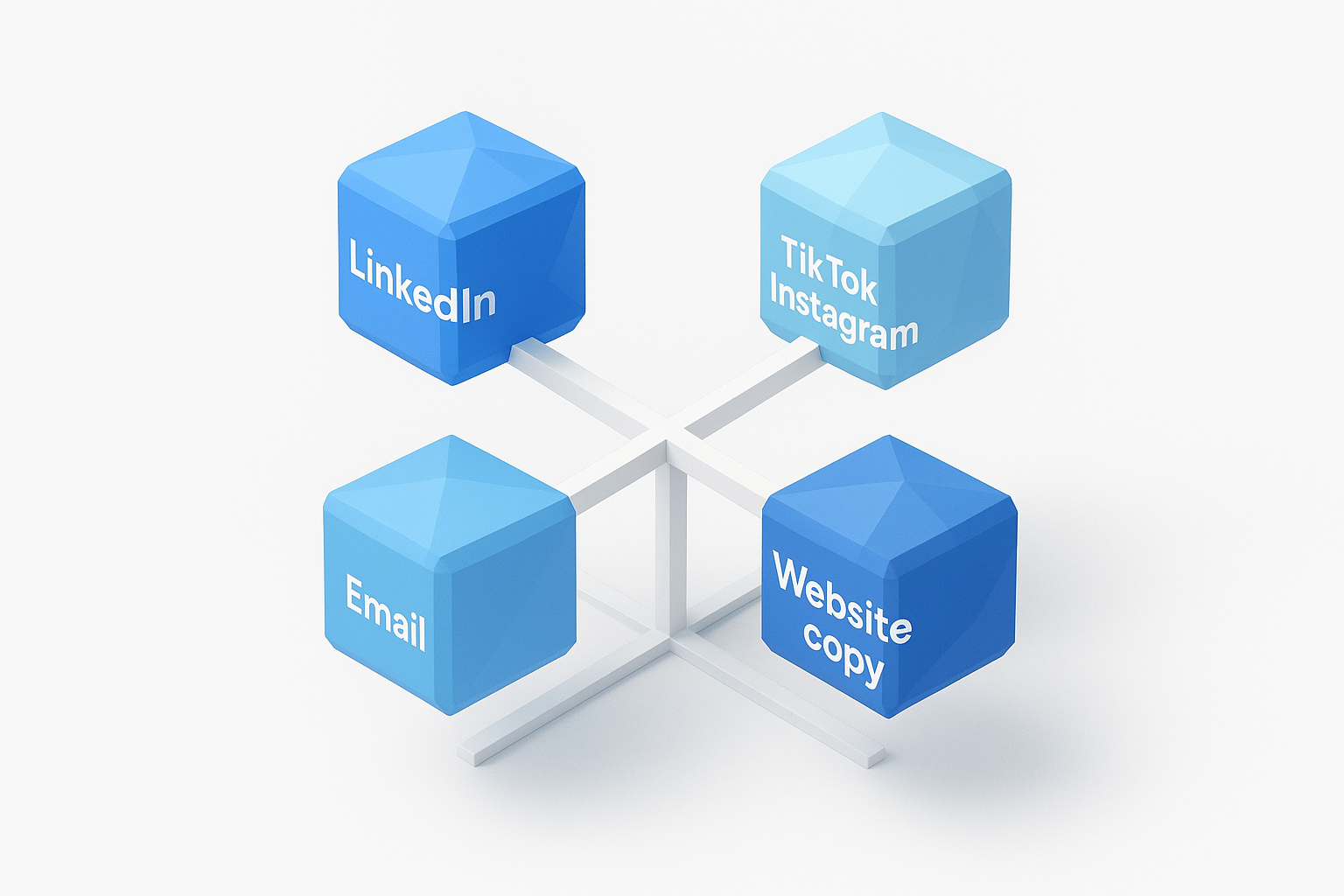
Use this format to build your channel map:
| Channel | Formality level | Sentence length | Personality dial |
|---|---|---|---|
| Semi-formal | Medium to long | Credible, grounded | |
| TikTok / Instagram | Informal | Short, punchy | Energetic, real |
| Conversational | Varied | Helpful, direct | |
| Website copy | Neutral to formal | Medium | Clear, confident |
| Support docs | Plain | Short | Patient, precise |
Step 4. Set your writing rules and word choices
Voice traits and tone maps tell your team what kind of communicator your brand is, but writing rules tell them how to execute that at the sentence level. This is where your brand voice guidelines get specific enough to actually change how someone writes. Word choices, sentence length, punctuation habits, and formatting preferences all stack up to create a recognizable style. Document them explicitly and your team stops making judgment calls that quietly drift your voice off course.
Build a word list that removes guesswork
A word list is one of the most practical tools you can include in your guidelines because it removes ambiguity at the exact moment your writer is making a decision. Instead of wondering whether to say "use" or "leverage," they check the list and move on. Build two columns: words and phrases your brand actively uses, and words your brand never uses. Keep each list under 20 items so it stays usable rather than becoming another doc nobody reads.
The goal of a word list is not to limit creativity. It is to eliminate the low-quality defaults that creep in when writers are moving fast.
| Use these | Avoid these |
|---|---|
| Get, use, build, run | Leverage, utilize, implement |
| You, your | One, the user, they |
| Now, today, fast | Expeditiously, in a timely manner |
| Simple, clear, straightforward | Seamless, frictionless, best-in-class |
| Real, specific, concrete | Robust, scalable, innovative |
Swap out the examples above with words that reflect your brand specifically. Pull vocabulary directly from your best-performing content so the list is grounded in what already works.
Define your core writing rules
Writing rules cover the mechanics that shape how your content feels to read. Set clear preferences for each of the following so your writers have a concrete standard to work against, not just a vague style to imitate.
- Sentence length: Keep most sentences under 20 words. Break anything longer into two sentences.
- Paragraph length: Three to four sentences maximum in body copy. One to two for social and email.
- Punctuation: Use Oxford commas. Avoid exclamation points unless the context is genuinely celebratory.
- Contractions: Use them. "You'll" reads warmer than "you will" in most contexts.
- Formatting: Bold for emphasis only, not decoration. Avoid underlining text that is not a link.
Step 5. Use a simple brand voice template
Knowing what to include in your brand voice guidelines is one problem. Actually building the document is another. Most teams stall here because they try to write it from scratch and end up with either a ten-page doc nobody uses or a half-finished slide deck that never gets shared. A one-page template removes that friction and gives you a structure to fill in rather than a blank page to fill out.
The one-page template structure
Below is a complete brand voice template you can copy and adapt. Fill in each row based on the work you did in the previous steps. Keep your answers short and specific. The goal is a document someone can read in five minutes and immediately apply to a piece of content, not a style guide they need to study for an afternoon.

| Section | What to fill in |
|---|---|
| Brand name | Your brand's name |
| Voice in 3 words | Three adjectives that define your communication style |
| Primary audience | One sentence describing who you write for |
| Voice trait 1 | Trait name, what it means, one example sentence, one guardrail |
| Voice trait 2 | Trait name, what it means, one example sentence, one guardrail |
| Voice trait 3 | Trait name, what it means, one example sentence, one guardrail |
| Words we use | Up to 10 preferred words or phrases |
| Words we avoid | Up to 10 words or phrases to cut |
| Tone by channel | One sentence per channel (LinkedIn, email, social, support) |
| Writing rules | Sentence length, contractions, punctuation, formatting |
| Strong example | One paragraph of on-brand writing with a note on why it works |
| Weak example | One paragraph of off-brand writing with a note on what went wrong |
A template you actually fill in beats a comprehensive framework you never finish.
How to make it usable from day one
Once you complete the template, format it as a shareable single page rather than burying it inside a larger document. A Google Doc with a table of contents works. A Notion page works. What does not work is a 40-slide brand deck where the voice section sits on slides 22 through 28. Keep it accessible and short so that new freelancers, team members, and AI tools can reference it before producing a single piece of content, not after they have already delivered a draft you need to rewrite.
Step 6. Train the team and keep it consistent
A finished brand voice document only works if your team actually reads it and applies it. Most guidelines fail not at the writing stage but at the adoption stage, because teams share a document once during an onboarding call and never reference it again. Building a light training process and a review habit into your workflow turns your brand voice guidelines from a one-time deliverable into a living standard your content consistently meets.
Run a short onboarding session for new contributors
Every new writer, freelancer, or agency you bring on needs a direct walkthrough of your voice document before they touch your content. Do not assume they will read it independently and interpret it correctly. Schedule a 20-minute call to walk through each voice trait, show the before-and-after examples, and answer questions. Then give them one paid test piece before assigning real work so you can catch misunderstandings early, before they produce a full batch of off-brand content.
The best time to correct a voice misunderstanding is before someone has spent hours producing content in the wrong direction.
Use this checklist to cover the essentials in every onboarding session:
- Walk through each voice trait and its guardrail out loud
- Read two examples together: one strong, one weak
- Explain which channels have tone adjustments and why
- Review the word list together rather than just sending it over
- Assign a short test piece with written feedback before full production begins
Build a review process that catches voice drift
Drift happens gradually and usually goes unnoticed until your content sounds noticeably inconsistent across channels. Set a quarterly review where you pull five to ten recent pieces and score them against your voice traits. You do not need a formal rubric. Read each piece and mark whether it passes or fails on each trait, then note whether the same issues keep appearing. If they do, update the word list or add a new anti-pattern example to the guidelines so the correction gets baked in permanently.
Catch voice problems before they compound by building one simple rule into your existing editorial process: every piece of content that ships gets a voice check, not just a factual or grammar check. Add a single line to your review checklist that asks "does this sound like us?" That one prompt, applied consistently, does more to protect your voice than any comprehensive style guide sitting unused in a shared drive.
Wrap up and apply it
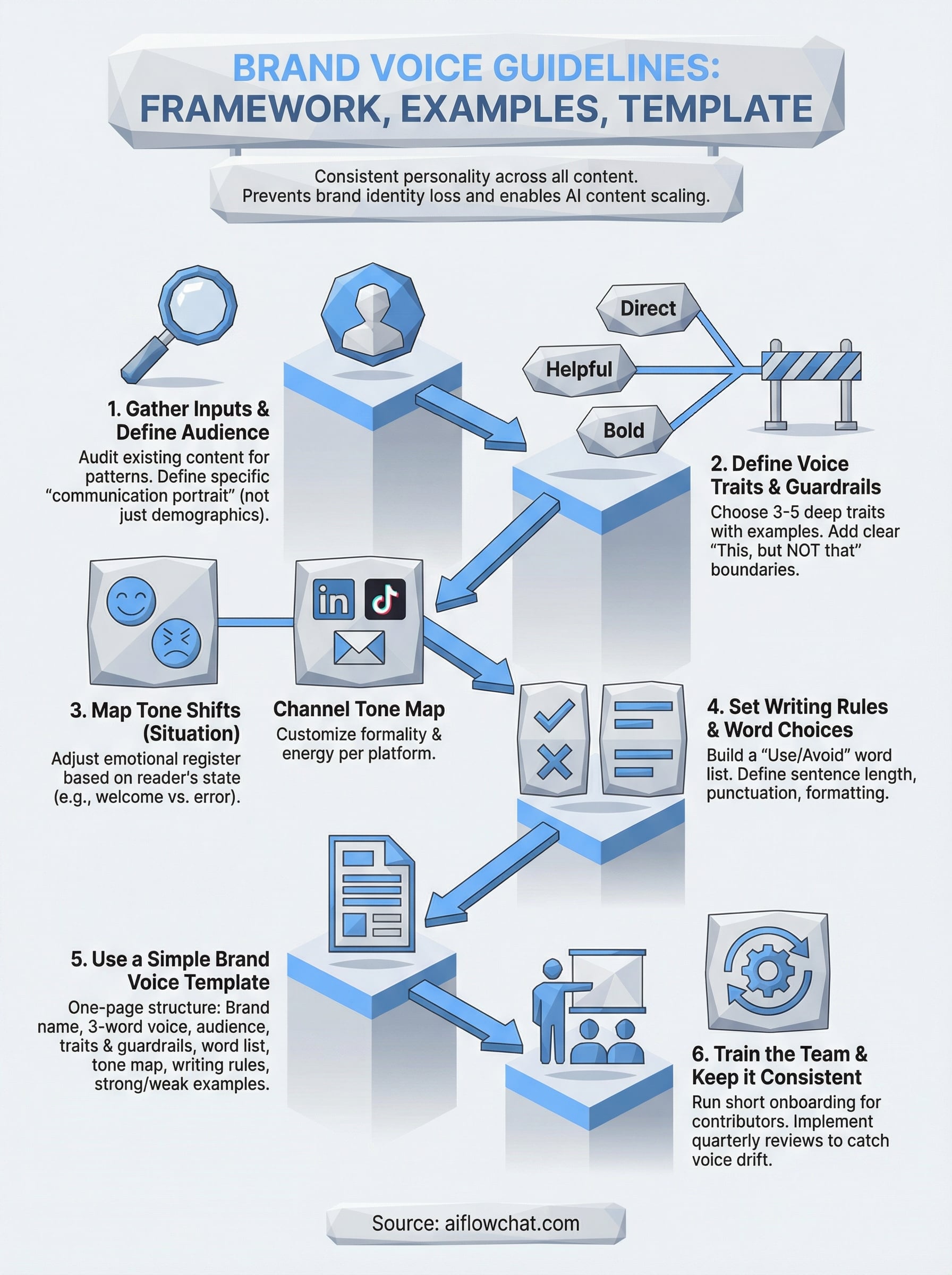
You now have everything you need to build brand voice guidelines that hold up under daily content production. The framework is straightforward: audit what exists, define your traits with guardrails, map tone by channel, lock in your writing rules, fill the template, and brief every contributor who touches your content before they write a single word.
The biggest mistake teams make is waiting until the voice feels broken enough to fix. Start with the template from Step 5, fill it in today using your best-performing content as source material, and share it before your next piece goes out. A one-page document you finish beats a comprehensive guide you never complete.
Once your voice is documented, putting it to work inside AI-powered workflows is the next logical step. Try AI Flow Chat to run your brand voice through repeatable content workflows and generate on-brand output at scale without losing the consistency you just built.
Continue Reading
Discover more insights and updates from our articles
Choose an AI model for scripts, marketing copy, coding, research, long documents, and quick everyday work using a practical quality, speed, and credit-cost framework.
Compare eight current Poppy AI alternatives for visual research, creator workflows, general AI work, grounded synthesis, automation, and reusable delivery.
A practical method for turning a scattered content process into a clear AI-assisted flowchart with source context, review checks, and a reusable output.