What Is Brand Voice? Definition, Examples, And How To Create
At AI Flow Chat
Contents
0%Every brand says something, even when it's not trying to. The words you choose, the humor you use (or don't), and the way you explain your product all signal something to your audience. That signal is your brand voice, and it's one of the few things that can make people feel connected to a business before they ever buy anything.
Yet most creators and marketers skip this step entirely. They jump straight into content production, cycling through trending formats and viral hooks without a consistent personality holding it all together. The result? Content that blends in, gets ignored, or worse, confuses the people it's supposed to attract. A strong brand voice fixes that by giving every piece of content a recognizable thread, whether it's a TikTok script, a blog post, or a Facebook ad.
This is exactly why we built AI Flow Chat with multi-source referencing and reusable prompt libraries, so you can define your voice once and scale it across every channel without losing consistency. In this guide, you'll get a clear definition of brand voice, see real examples worth studying, and walk away with a step-by-step process to build your own from scratch.
What brand voice is and what it includes
Brand voice is the distinct personality your brand expresses through every piece of written or spoken communication. If you've ever wondered what is brand voice exactly, the simplest way to think about it is this: it's not what you say, it's how you say it. A brand voice stays consistent whether you're writing a product description, responding to a comment, or publishing a long-form article. It reflects your values, your audience, and the relationship you want to build with people before they ever buy anything.
The core elements that shape a brand voice
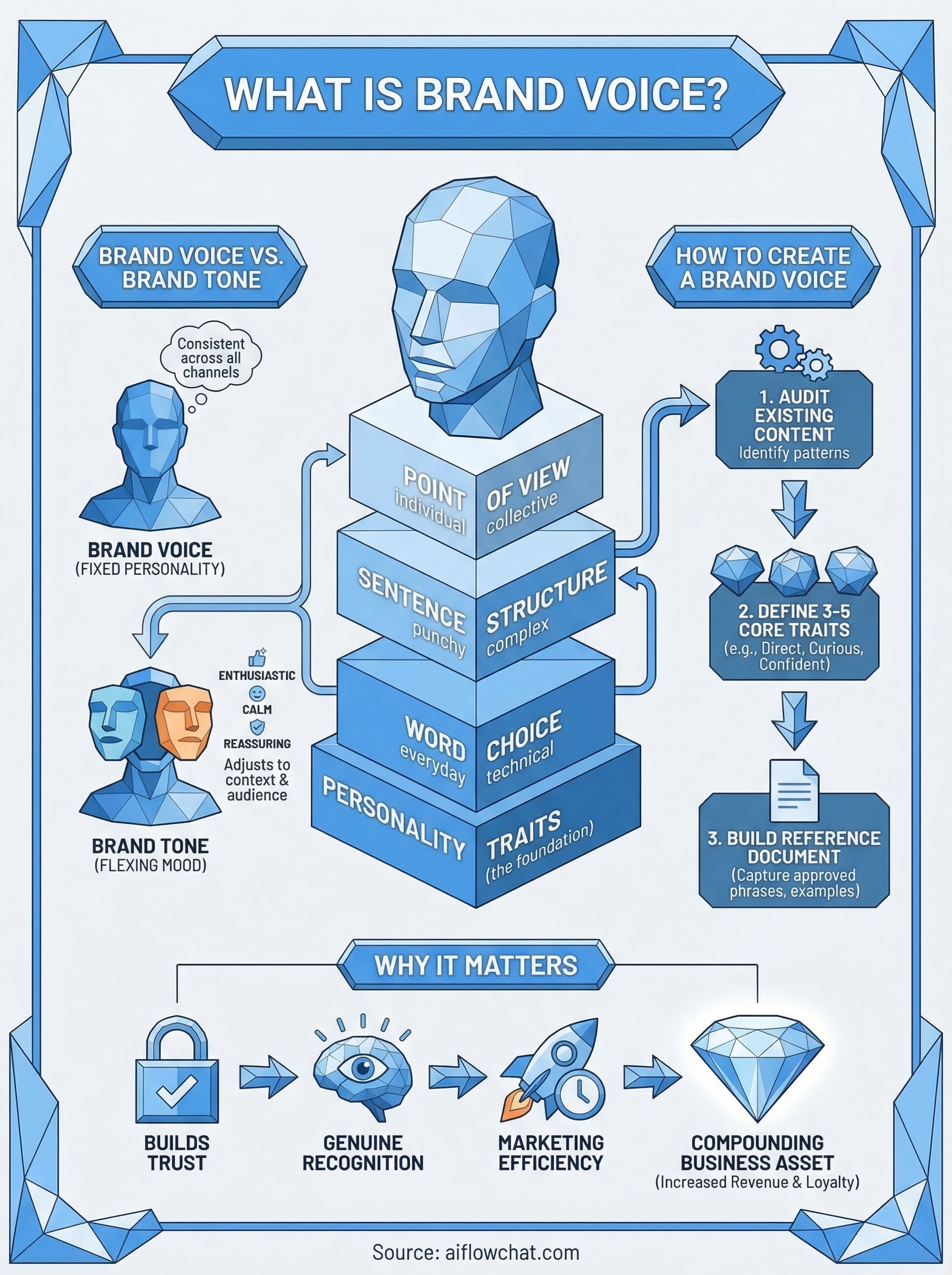
Your brand voice is assembled from several specific building blocks that work together to create a recognizable personality. The most important is character and personality, which defines the human traits your brand embodies, such as being direct, playful, authoritative, or empathetic. Every other element flows from that central decision. Here are the primary components that make up a complete brand voice:

- Personality traits: the human characteristics that define how your brand behaves in conversation
- Word choice: whether you use simple everyday language or technical terminology
- Sentence structure: how long, complex, or punchy your sentences tend to run
- Point of view: whether you speak as an individual, a collective, or an authority figure
Your personality traits and word choices are the foundation everything else is built on, and switching them inconsistently is exactly what makes brands feel untrustworthy over time.
What brand voice actually covers in practice
Brand voice covers every touchpoint where your audience reads or hears from you. That includes website copy, social media captions, email newsletters, ad scripts, customer support replies, and even product packaging. Each channel requires some adjustment in style, but the underlying voice stays the same. Think of it like an actor playing different scenes: the costume changes, but the character does not.
Knowing your audience is what makes the right voice obvious. A brand serving busy solopreneurs should sound efficient and confident rather than academic or verbose. When your voice aligns with who you're talking to, every piece of content you produce starts to feel coherent rather than scattered.
Why brand voice matters in marketing
When you understand what is brand voice and actually apply it, your content stops looking like it came from a content factory and starts building genuine recognition. People follow brands the same way they follow people: because of personality, familiarity, and trust. A consistent voice is the foundation that turns casual readers into repeat visitors and, eventually, paying customers.
How consistency builds trust with your audience
Audiences notice inconsistency faster than you think. If your Instagram captions sound casual and fun but your emails read like legal disclosures, people register that disconnect even if they can't name it. That friction quietly erodes trust. When your voice stays consistent across every channel, your audience builds a mental model of who you are, and that familiarity makes them more likely to engage, share, and buy.
Consistency in voice is what separates brands people remember from brands people scroll past without a second thought.
The business impact of a recognizable voice
A clear brand voice also makes your marketing more efficient. When your team, freelancers, or AI tools all work from the same voice guidelines, you spend less time editing for tone and more time producing content that performs. According to research consistently cited in brand strategy literature, brands that present themselves consistently across all channels see significant increases in revenue compared to those that don't. Your voice is not just a creative exercise. It's a business asset that compounds over time, making every new piece of content you publish work harder than the last.
Brand voice vs brand tone
Brand voice and tone are related but they are not the same thing. When people research what is brand voice, they often conflate these two concepts and end up with unclear guidelines that are hard to apply consistently. Your brand voice is fixed. It's the personality your brand carries at all times, the same in a product description as in a social media caption.
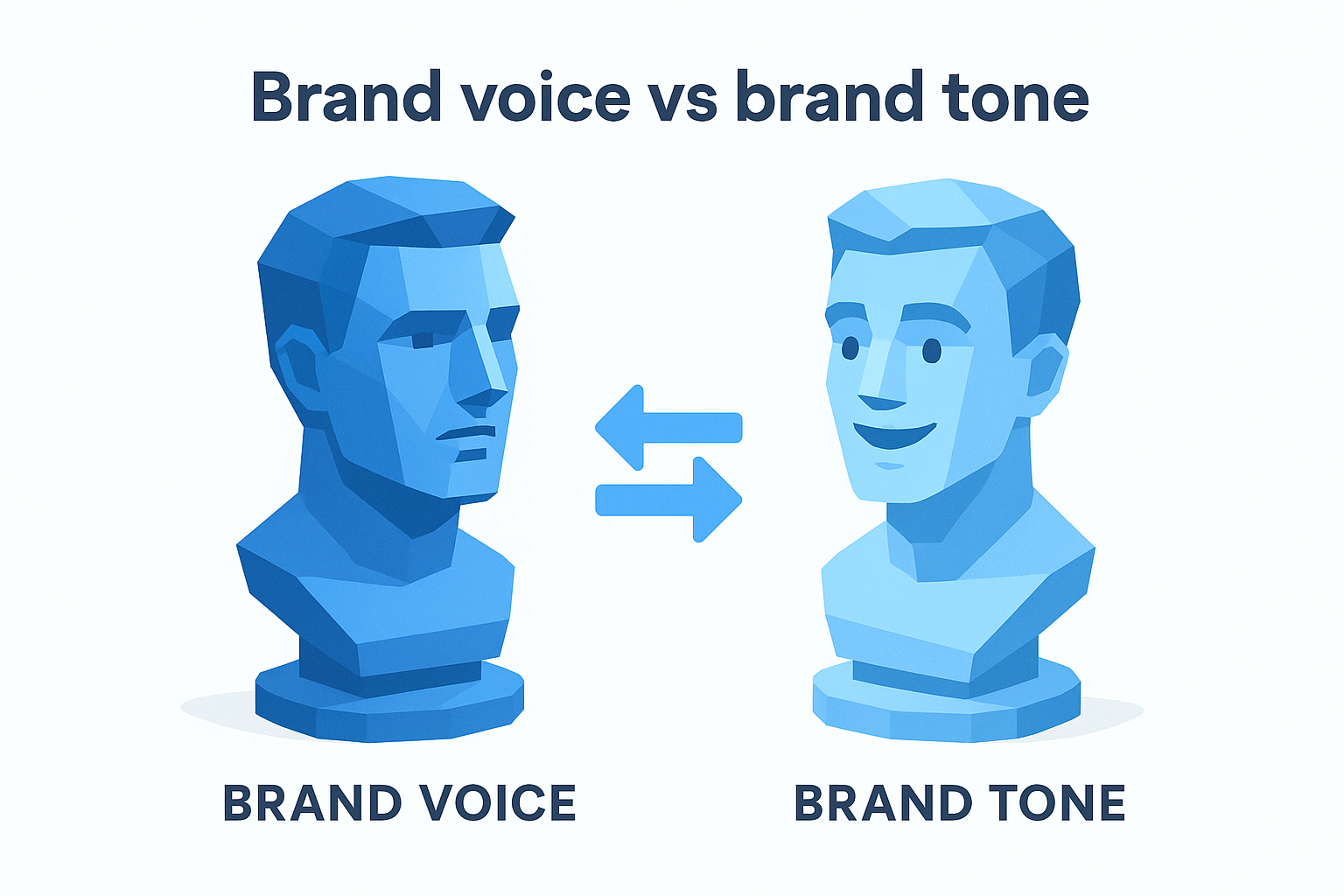
How tone shifts while voice stays fixed
Tone is the emotional register you bring to a specific message or context. Your voice stays constant, but your tone flexes based on what you're communicating and who you're talking to in that moment. Think of it this way: a friend who is naturally warm and direct is still warm and direct whether they're congratulating you or delivering bad news. The personality does not change, but the emotional weight does.
Your voice is the personality you never change; your tone is the mood you adjust to fit the moment.
A useful way to see the difference in practice is to compare the same brand across contexts. A brand with a confident and clear voice might use an enthusiastic tone in a product launch email and a calm, reassuring tone when handling a customer complaint. Both messages feel like they came from the same brand because the underlying character is consistent. Keeping these two concepts separate in your guidelines helps everyone on your team apply them correctly, whether they're writing ad copy or responding to support tickets.
How to create a brand voice step by step
Now that you understand what is brand voice and why it matters, building your own comes down to a few focused steps. You don't need a branding agency or a 40-page style guide to start. You need clarity on who you are, who you're talking to, and how those two things should sound when they meet on the page.
The fastest way to define your voice is to study what already works and reverse-engineer the personality behind it.
Start by auditing your existing content
Pull together 10 to 15 pieces of your best-performing content across different channels. Look for patterns in word choice, sentence length, and the overall feeling each piece creates. If you notice inconsistencies, that gap is exactly where your voice guidelines need to go. Pay close attention to the posts or emails that got the strongest response, because those pieces reveal the personality your audience already responds to.
Define three to five core voice traits
Pick three to five adjectives that describe how your brand communicates, such as direct, curious, or confident. For each trait, write one sentence explaining what it means in practice and one sentence showing what it does not mean. "Direct means efficient, not blunt" is the kind of distinction that prevents your team from misapplying the guidelines when they produce content without you in the room.
Build a simple reference document
Capture your traits, word-choice preferences, and a few approved and avoided phrases in a single document. Include two or three short examples for each trait so anyone writing for your brand can match the standard without guessing. Revisit this document every six months as your content strategy and audience continue to evolve.
Brand voice examples and a simple template
Seeing what is brand voice in action across real brands makes the concept click faster than any definition. Three well-known companies show how different personalities can each feel completely consistent once you understand the core traits driving every word they publish.
Three brands with distinct, recognizable voices
Each brand below demonstrates a specific personality that runs through every channel they use, from website copy to social media captions.
| Brand | Core voice traits | What it sounds like in practice |
|---|---|---|
| Apple | Minimal, confident, precise | Short sentences, no technical filler, product-first framing |
| Duolingo | Playful, direct, self-aware | Casual humor, short bursts, speaks to the user's daily habits |
| Patagonia | Mission-driven, honest, grounded | Plain language with strong conviction, never oversells |
The most effective brand voices feel like a person, not a press release.
A simple brand voice template you can use today
Once you have your core traits defined, capturing them in a reusable template keeps your team aligned without lengthy documentation. Fill in each line based on your content audit and the traits you identified earlier.
- Brand personality in three words: [direct] [curious] [confident]
- We sound like: concise, specific, and conversational
- We never sound like: corporate, vague, or overly formal
- Approved phrases: "Here's how it works" / "You don't need to..."
- Avoided phrases: "Best-in-class solution" / "Leverage synergies"
This single document gives every writer on your team a clear standard to match, whether they're drafting an ad script or replying to a customer comment.
Final takeaway
Understanding what is brand voice gives you a practical tool that makes every piece of content you publish work harder. Your voice is not a creative extra you add once you have traffic. It's the single thread that determines whether your audience recognizes you on sight or scrolls past without stopping. Define your core personality traits, document them in a simple reference document, and apply them consistently across every channel you use.
The brands that build loyal, engaged audiences do it through a consistent personality, not just great products or clever campaigns. Once your voice is locked in, you can use a tool like AI Flow Chat to scale your content production without losing the consistency you worked to build. Every new piece you publish reinforces your identity, compounds your recognition over time, and makes it easier for your audience to trust you before they ever buy anything from you.
Continue Reading
Discover more insights and updates from our articles
Choose an AI model for scripts, marketing copy, coding, research, long documents, and quick everyday work using a practical quality, speed, and credit-cost framework.
Compare eight current Poppy AI alternatives for visual research, creator workflows, general AI work, grounded synthesis, automation, and reusable delivery.
A practical method for turning a scattered content process into a clear AI-assisted flowchart with source context, review checks, and a reusable output.