5 Best Content Brief Generators for SEO Content in 2026
At AI Flow Chat
Contents
0%Writing SEO content without a clear brief is like building a house without blueprints, you'll waste time, miss key details, and end up reworking most of it. A good content brief generator takes the guesswork out of planning by pulling together search intent, competitor data, and structural guidelines into one document your writers can actually follow.
The problem is that most briefs either take too long to build manually or come out too thin to be useful. That's where dedicated tools come in, they automate the research-heavy parts so you can move straight to writing content that ranks. Some tools handle briefs as a standalone feature, while platforms like AI Flow Chat let you build briefs inside visual workflows where you can reference competitor pages, pull in live data from URLs, and chain the output directly into content drafts.
Below, you'll find five content brief generators worth considering in 2026, broken down by what they do best and who they're built for, whether you're a solo SEO specialist or running content ops for an agency.
1. AI Flow Chat
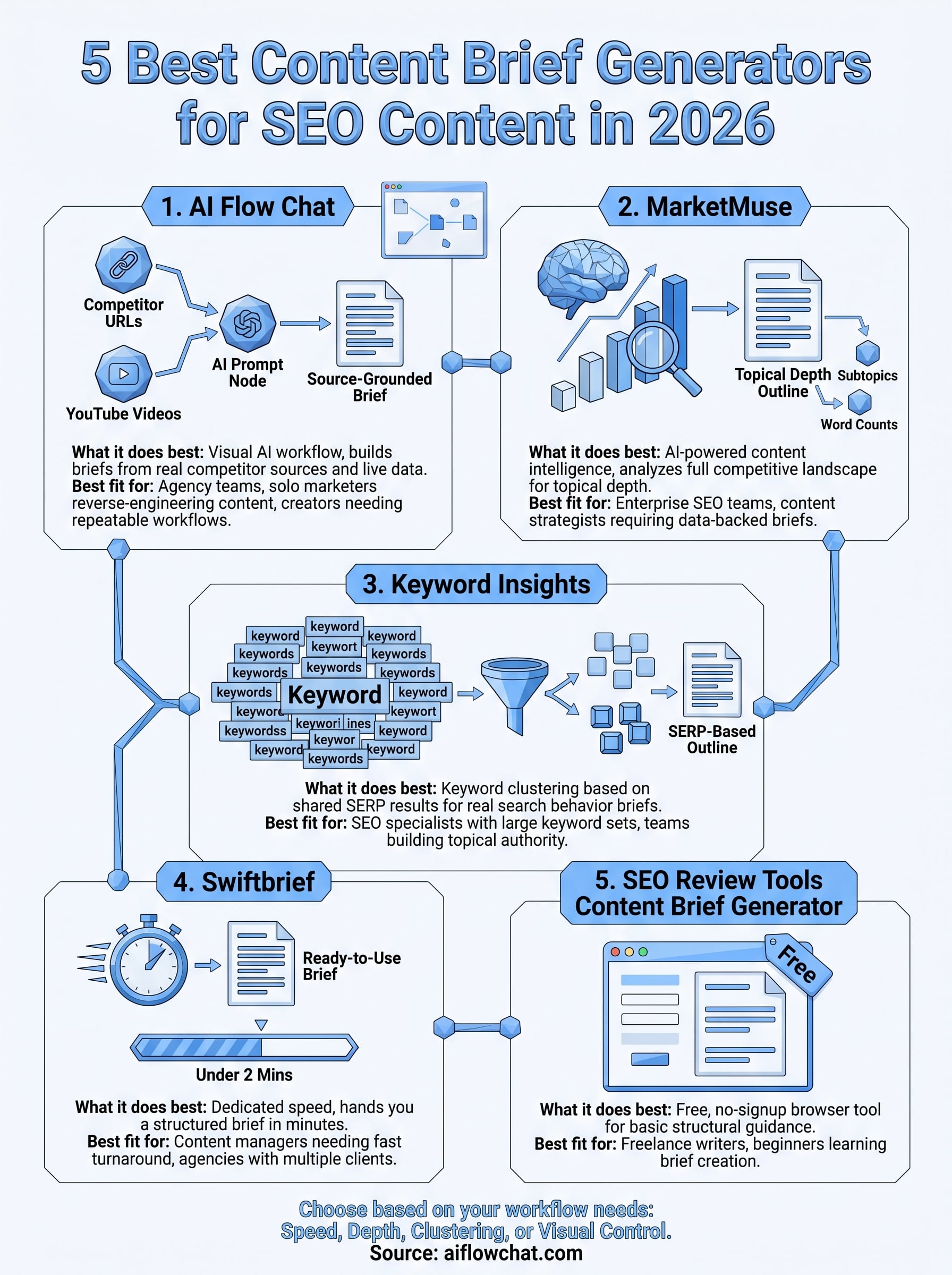
AI Flow Chat is not a traditional content brief generator that spits out a template from keyword data. It is a visual AI workflow platform where you build briefs by pulling in real competitor pages, YouTube videos, and live URLs as reference material, so every brief you produce is grounded in actual SERP evidence rather than guesswork.
What makes it different for SEO briefs
Most brief tools pull from a keyword database and call it research. AI Flow Chat lets you paste competitor article URLs directly into the canvas and extract headings, structure, and content angles from what is already ranking. You can combine multiple sources on a spatial whiteboard interface and feed them all into a single AI prompt to generate a brief that reflects the real competitive landscape.
Your brief is only as good as the sources behind it, and AI Flow Chat makes those sources visible and editable at every step.
How you build a brief from real sources
You drag competitor pages, YouTube videos, or PDFs onto the canvas, then connect them to a prompt node that instructs the AI to analyze structure, extract talking points, and outline a brief. The output stays tethered to your reference material, which cuts down on hallucinated subtopics or headings that have no basis in what actually ranks.
Best fit use cases
- Agency content teams managing briefs across multiple clients simultaneously
- Solo marketers who want to reverse-engineer top-ranking articles without building from scratch
- Creators building repeatable brief workflows they can reuse across content categories
Limits to know
AI Flow Chat rewards users who want workflow control and customization. If you need a one-click brief with zero setup, the canvas approach requires more initial configuration than simpler tools.
Pricing
Plans start at $29 per month on a flexible credit-based model with no annual commitment, which works well for teams with variable content output month to month.
2. MarketMuse
MarketMuse is an AI-powered content intelligence platform that builds briefs by analyzing your target topic against the full competitive landscape in search results. It scores your content against competitors and tells you exactly which subtopics you need to cover to match or beat what already ranks.
What makes it different for SEO briefs
MarketMuse uses topic modeling to map the relationship between your main keyword and related concepts, so your brief reflects topical depth rather than just keyword density. Other tools give you headings; MarketMuse tells you which concepts you are missing entirely.
How it builds content briefs from SERP data
The platform pulls the top-ranking pages for your target keyword and identifies the questions, subtopics, and entities those pages share. Your brief comes out as a structured outline with recommended word counts and topic coverage targets based on that SERP analysis.
Best fit use cases
- Enterprise SEO teams managing large content programs across competitive niches
- Content strategists who need data-backed briefs to hand off to writers with confidence
Limits to know
MarketMuse is built for serious content operations, and the pricing reflects that. Lighter users will likely find the platform more than they need.
The depth of its SERP analysis is genuinely hard to match for competitive topics.
Pricing
Plans start at $149 per month, with a free plan available that includes limited monthly queries.
3. Keyword Insights
Keyword Insights is a keyword clustering and content intelligence tool that takes a list of keywords and groups them by search intent before building a brief around the clusters that matter most to your target page.
What makes it different for SEO briefs
Keyword Insights approaches the content brief generator problem from the keyword side rather than the competitor side. You start with a bulk list of keywords, and the tool sorts them into clusters based on shared SERP results, so your brief reflects how search engines actually group related queries together.
Clustering by SERP overlap gives you briefs built on real search behavior, not assumed topic relationships.
How it handles clustering and brief creation
The platform runs your keyword list through a clustering algorithm that identifies which terms share ranking pages, then maps those clusters into a structured content outline. Each cluster becomes a heading or section recommendation, so your brief is shaped by what search results confirm belongs together.

Best fit use cases
- SEO specialists managing large keyword sets who need fast brief generation at scale
- Teams building topical authority across an entire content category
Limits to know
Keyword Insights is keyword-first, so if you need deep competitor content analysis or editorial guidance, you will need to supplement it with another tool.
Pricing
Plans start at $58 per month, with usage based on keyword credits consumed.
4. Swiftbrief
Swiftbrief is a dedicated content brief generator built around speed. It pulls SERP data, analyzes competitor pages, and delivers a structured brief in minutes rather than hours.
What makes it different for SEO briefs
Unlike tools that ask you to configure clustering or load sources manually, Swiftbrief focuses on one task: handing you a ready-to-use brief as fast as possible. You get a clean output formatted for writers without extra editing steps.
How fast brief generation works
You enter your target keyword and Swiftbrief scrapes the top-ranking pages to extract headings, word counts, and key questions. The brief lands in your workspace in under two minutes with recommended structure and competitor insights already baked in.
For teams running high brief volumes, that speed compounds into serious time savings across a full content calendar.
Best fit use cases
- Content managers who need fast turnaround on briefs at scale
- Agencies handling multiple clients across different niches and brief requirements
Limits to know
Swiftbrief trades depth for speed. If your niche requires nuanced topical authority planning or you want to pull in custom reference sources, you will hit its limits quickly.
Pricing
Plans start at $29 per month, with higher tiers unlocking more brief credits per cycle.
5. SEO Review Tools Content Brief Generator
SEO Review Tools offers a free, no-signup content brief generator that runs directly in your browser. It is a straightforward option for anyone who needs a basic brief without committing to a paid platform.
What makes it different for SEO briefs
The biggest differentiator here is accessibility. You get a working brief tool at zero cost, which makes it practical for freelancers or small teams testing the brief workflow before investing in a more robust platform.
For occasional use or quick structural guidance, a free tool removes all friction from getting started.
What the brief includes out of the box
You enter a target keyword, and the tool returns a structured outline with suggested headings and related terms pulled from search data. The output is clean and readable without requiring any configuration on your end.
Best fit use cases
- Freelance writers who need basic structural guidance without a monthly subscription
- Beginners learning how to build content briefs before scaling up
Limits to know
SEO Review Tools lacks the depth and customization that competitive niches demand. There is no competitor URL analysis, no topical modeling, and no workflow integration.
Pricing
The tool is completely free to use with no account required.
What to pick for your workflow
The right content brief generator depends on what slows you down most. If you need fast, structured briefs with minimal setup, Swiftbrief handles that well. If you are managing a large-scale content program with serious competition, MarketMuse gives you the topical depth to back every brief with real data. For bulk keyword work, Keyword Insights fits naturally into a clustering-first workflow, and SEO Review Tools covers anyone who just needs basic guidance at no cost.
For creators and marketers who want full control over their sources and workflow, AI Flow Chat sits in a different category entirely. You pull in real competitor pages, videos, and documents, build your brief on a visual canvas, and chain the output directly into content drafts without switching tools. If that kind of end-to-end workflow matters to your process, try AI Flow Chat and see how fast a source-grounded brief comes together.
Continue Reading
Discover more insights and updates from our articles
Choose an AI model for scripts, marketing copy, coding, research, long documents, and quick everyday work using a practical quality, speed, and credit-cost framework.
Compare eight current Poppy AI alternatives for visual research, creator workflows, general AI work, grounded synthesis, automation, and reusable delivery.
A practical method for turning a scattered content process into a clear AI-assisted flowchart with source context, review checks, and a reusable output.