7 Brand Voice Examples From Iconic Brands (With Takeaways)
At AI Flow Chat
Contents
0%Every brand says something. Few brands sound like something. The difference between forgettable marketing and content people actually recognize comes down to voice, a consistent personality that shows up in every caption, ad, email, and video script. If you're searching for brand voice examples, you're already ahead of most creators and marketers who skip this step and wonder why nothing sticks.
Studying how iconic companies communicate is one of the fastest ways to define your own voice. Not to copy them, but to reverse-engineer what makes their messaging feel intentional. You start to notice patterns: word choice, sentence rhythm, the ratio of humor to authority. These are decisions, not accidents. And once you see them clearly, you can make those same deliberate choices for your own brand.
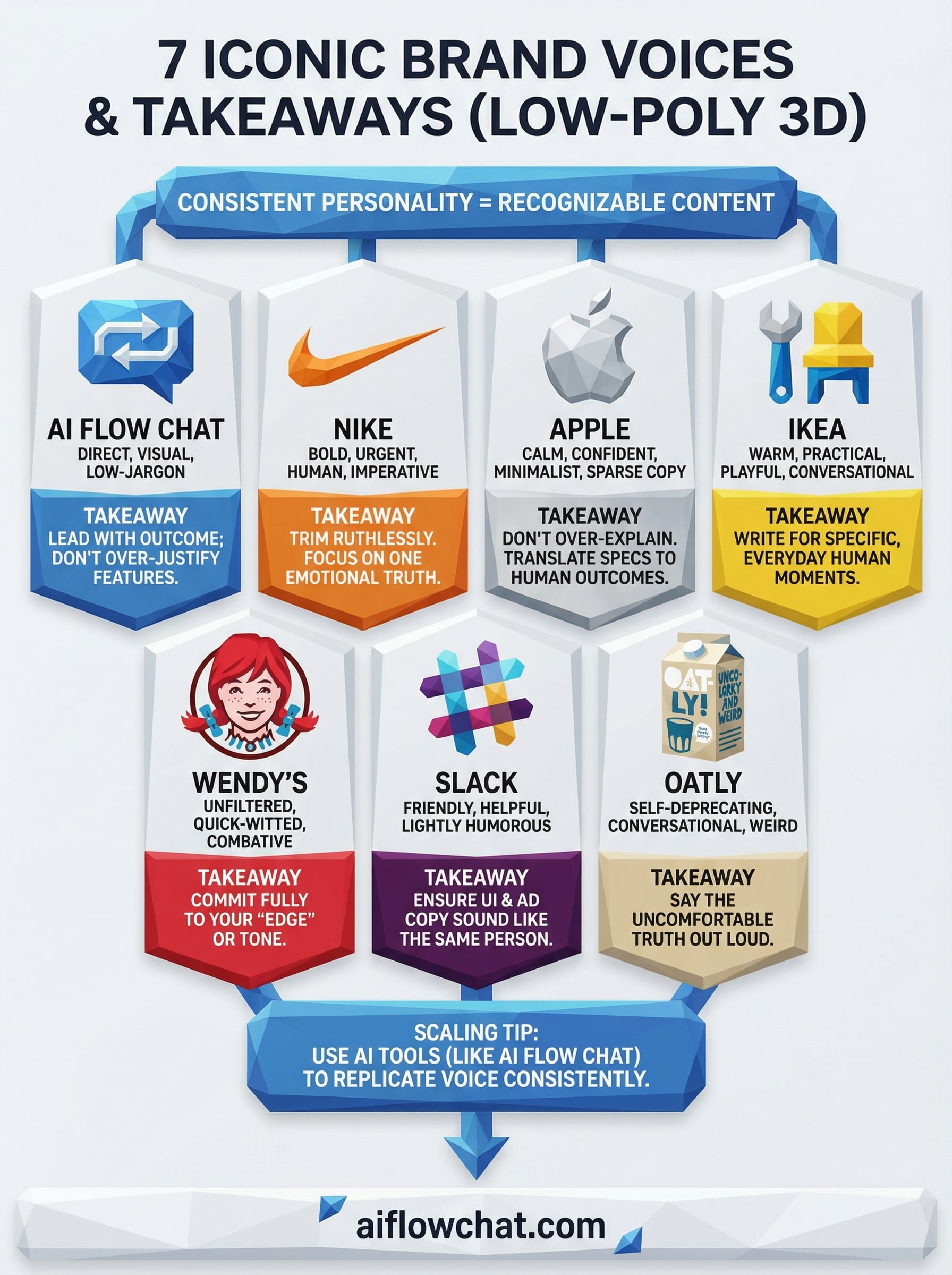
This article breaks down seven brands that have nailed their voice, from scrappy startups to household names, with specific takeaways you can apply immediately. Whether you're a solo creator, an agency owner, or a marketer scaling content across platforms, these examples will give you a concrete reference point. And once you've locked in your voice, a tool like AI Flow Chat makes it easy to replicate at scale, feed your brand guidelines and reference content into a visual workflow, and every output stays consistent without you rewriting everything from scratch.
1. AI Flow Chat
AI Flow Chat speaks directly to creators who are done starting from scratch. The brand voice is direct, visual, and low on jargon, built for marketers, solopreneurs, and agency owners who think in systems rather than sentences. It sits at the intersection of practical and energizing, always anchored to outcomes rather than process descriptions.
Voice snapshot
The tone is sharp and grounded, like a knowledgeable peer who skips the preamble and gets straight to what matters. AI Flow Chat doesn't oversell its features; it explains exactly what you can do with them. The voice avoids buzzword stacking and instead relies on concrete, action-oriented language that mirrors how its audience actually thinks about building and scaling content workflows.
What makes it recognizable
What stands out most is the lack of corporate distance. The brand addresses you like you're already mid-workflow, not like you're being sold to. It assumes competence and skips over-explanation, which is genuinely rare in the productivity SaaS space. That trust in the audience creates a voice that feels collaborative rather than instructional, and it builds credibility fast.
When a brand talks to you as if you already know what you're doing, it signals respect, and your audience picks up on that immediately.
How it shows up across touchpoints
On the website, feature descriptions lead with what you gain, not how the underlying technology works. In product walkthroughs, the language stays visual and spatial, with words like "drag," "connect," and "reference" reflecting the literal experience of using the canvas. Across social content, the voice prioritizes showing over telling, using real workflow examples instead of vague capability claims.
Takeaways you can steal
Your brand doesn't need to over-justify itself. Lead with the outcome, then layer in context if needed. Also study how AI Flow Chat ties its voice directly to the audience's identity: visual thinkers, fast movers, people who build content systems instead of chasing one-off posts. When your voice reflects how your audience sees themselves, they recognize it instantly, and they keep coming back.
2. Nike
Nike is one of the most studied brand voice examples in marketing because it does something most brands fail at: it makes you feel something without describing the product at all. The voice is bold, urgent, and human, built around the idea that athletic achievement belongs to everyone.

Voice snapshot
Nike's tone is short, punchy, and emotionally charged. Sentences rarely exceed ten words. The brand leans on imperatives and second-person address to pull you into the action rather than observe it from a distance. There is no hedging, no conditional language, just direct statements that assume you're already capable.
What makes it recognizable
The voice stays consistent across every format. Whether it's a three-word billboard or a three-minute brand film, the emotional register never shifts. Nike treats its audience as athletes regardless of ability level, and that radical inclusion is what separates it from competitors who qualify their messaging.
When you write for everyone who has ever doubted themselves, you speak to almost everyone.
How it shows up across touchpoints
Ad copy strips out everything unnecessary. Product pages lead with performance language, not technical specs. Campaign films prioritize personal struggle over product features, with the brand appearing only at the end.
Takeaways you can steal
Trim your sentences ruthlessly and see what survives. If a sentence still lands without the adjectives, cut them. Pick one emotional truth your audience lives with, and build your voice around that single tension instead of broadcasting a list of benefits.
3. Apple
Apple is one of the most referenced brand voice examples in marketing because it achieves something counterintuitive: it sells premium technology using the language of simplicity. The voice is calm, confident, and minimalist, never raising its pitch even when launching category-defining products.
Voice snapshot
The tone is quiet and assured, like a brand that has nothing to prove. Copy is sparse, sentences are short, and the brand almost never uses superlatives. The restraint itself becomes a signal of quality, letting the product's visual presence carry most of the weight while words play a supporting role.
What makes it recognizable
Apple avoids technical language in consumer-facing copy, even though the technology behind its products is genuinely complex. The brand translates specs into human outcomes, not "3-nanometer chip" but "the fastest chip we've ever made." That translation keeps the voice accessible without losing credibility.
When you strip away everything that doesn't need to be said, what's left carries far more weight.
How it shows up across touchpoints
Product pages use single declarative sentences as headlines, often fewer than five words. Retail environments mirror the copy: clean, unhurried, and confident. Even setup flows and error messages maintain the same calm register throughout.
Takeaways you can steal
Resist the urge to over-explain your product. Pick the one human outcome your feature creates and lead with that single idea. If your copy would look cluttered on a billboard, cut it in half and see if it hits harder with less.
4. IKEA
IKEA is one of the most underrated brand voice examples in retail marketing. The voice is warm, practical, and playful, built around the idea that good design belongs to everyone, not just people with big budgets or interior design degrees.
Voice snapshot
The tone is conversational and gently witty, like a friend who genuinely wants to help you solve a real furniture problem. IKEA never talks down to its audience. Instead, it meets you at your actual level of expertise, whether you're a first-time apartment renter or a seasoned home renovator.
What makes it recognizable
IKEA consistently ties its voice to everyday human moments: lazy Sunday mornings, chaotic family dinners, awkward small living spaces. That specificity makes the brand feel genuinely relatable rather than aspirational in a distant, untouchable way. The humor is light and self-aware, never at the customer's expense.
When your brand acknowledges real life as it actually is, not as people wish it were, you build trust faster than any clever tagline ever could.
How it shows up across touchpoints
Product descriptions use straightforward, friendly language that treats assembly instructions as part of the brand experience rather than a necessary evil. Catalog copy blends practical specs with lifestyle storytelling, grounding even simple products in recognizable human context.
Takeaways you can steal
Pick a specific human moment your audience lives through daily and write directly toward that. Specificity beats aspiration every time. Also, find the one thing your brand can be gently self-aware about, and lean into it rather than hide from it.
5. Wendy's
Wendy's is one of the most talked-about brand voice examples in social media marketing, and for good reason. The voice is unfiltered, quick-witted, and deliberately combative, built around the idea that a fast food brand can speak like a sharp-tongued person with zero patience for corporate politeness.
Voice snapshot
The tone is roastingly confident, almost confrontational. Wendy's writes like it has nothing to lose and everything to say. Short sentences, blunt observations, and targeted humor define almost every piece of copy the brand puts out, especially on social platforms where the audience expects brands to either bore them or entertain them.
What makes it recognizable
Wendy's built its reputation by responding to competitors and customers in real time with the kind of wit most brand teams are too cautious to approve. That consistency of character, even in throwaway replies, is what makes the voice feel authentic rather than manufactured.
When a brand maintains the same personality in a quick reply as it does in a polished campaign, that's when the voice becomes genuinely trustworthy.
How it shows up across touchpoints
On social media, every interaction is an opportunity to stay in character. Menu descriptions occasionally carry the same dry humor, and promotional content leans on self-aware comedy rather than generic hype language.
Takeaways you can steal
Decide how much edge your brand can hold and then commit to it fully. Half-hearted personality reads as awkward. Pick one tonal extreme, witty, warm, dry, or bold, and let it run through every single response you write.
6. Slack
Slack is one of the more nuanced brand voice examples in the B2B software space. The voice is friendly, helpful, and lightly humorous, built for people who spend most of their working day inside the product and need communication that feels human rather than corporate.
Voice snapshot
The tone is warm and approachable without being unprofessional. Slack writes like a capable colleague who keeps things moving: clear on what needs doing, pleasant to interact with, and never preachy. Sentences stay short and conversational, and the brand uses humor sparingly so it lands when it appears rather than blending into the background.
What makes it recognizable
Slack consistently sounds like it genuinely cares about the person reading, not the task at hand. That subtle shift in focus, from product to person, runs through every message the brand writes. Error messages, onboarding prompts, and marketing copy all share the same register, which is rare in enterprise software where different teams typically write in completely different voices.
When every touchpoint sounds like the same person wrote it, your audience builds a real relationship with your brand rather than just a habit of using your product.
How it shows up across touchpoints
In-app copy treats context switches as conversation, not instructions. Marketing materials lead with team dynamics and human outcomes rather than feature lists or integration counts.
Takeaways you can steal
Write your UI copy and your ad copy in the same sitting. If they don't sound like the same voice, something is off. Pick one human relationship your brand represents, a helpful colleague, a trusted advisor, and write every line from that single perspective.
7. Oatly
Oatly is one of the most distinctive brand voice examples in the food industry. The voice is self-deprecating, conversational, and deliberately weird, built around a dairy alternative brand that refuses to act like a conventional consumer packaged goods company.
Voice snapshot
The tone is rambling and honest in a way that feels intentional, like someone who decided transparency was funnier than polish. Oatly writes the way a person thinks, with tangents, admissions, and occasional absurdity baked directly into packaging copy and campaign materials.
What makes it recognizable
Oatly does something almost no brand does: it argues with itself in public. The copy acknowledges awkward truths about marketing, the product, and the brand itself. That self-awareness creates a voice that feels genuinely human rather than carefully managed.
When your brand admits what everyone is already thinking, you stop sounding like an ad and start sounding like a person.
How it shows up across touchpoints
Packaging becomes a reading experience, not just a label. Oatly fills every surface with long, wandering copy that rewards people who actually read it. Digital content carries the same rambling honesty, making the voice feel consistent rather than packaged.
Takeaways you can steal
Identify the one uncomfortable truth about your product or industry that your audience already knows, then say it out loud before they do. Leaning into that honesty builds far more credibility than a polished claim ever could.
Put these voices to work
These brand voice examples share one thing in common: none of them happened by accident. Every brand on this list made deliberate choices about word length, emotional register, and how much personality to carry into every piece of content they publish. The pattern you can steal is the decision-making process itself, not the specific tone.
Now take what you noticed here and apply it to your own brand. Write down three adjectives that describe how you want to sound, then test them against your last ten pieces of content. If the match is weak, you have a clear starting point. Consistency is the real work, and it compounds over time.
Once your voice is defined, replicating it at scale is where most creators lose momentum. AI Flow Chat lets you feed your brand guidelines and reference content directly into visual workflows, so every output you generate stays on voice without starting from scratch each time.
Continue Reading
Discover more insights and updates from our articles
Choose an AI model for scripts, marketing copy, coding, research, long documents, and quick everyday work using a practical quality, speed, and credit-cost framework.
Compare eight current Poppy AI alternatives for visual research, creator workflows, general AI work, grounded synthesis, automation, and reusable delivery.
A practical method for turning a scattered content process into a clear AI-assisted flowchart with source context, review checks, and a reusable output.