What Is Prompt Engineering? Techniques, Examples, Careers
At AI Flow Chat
Contents
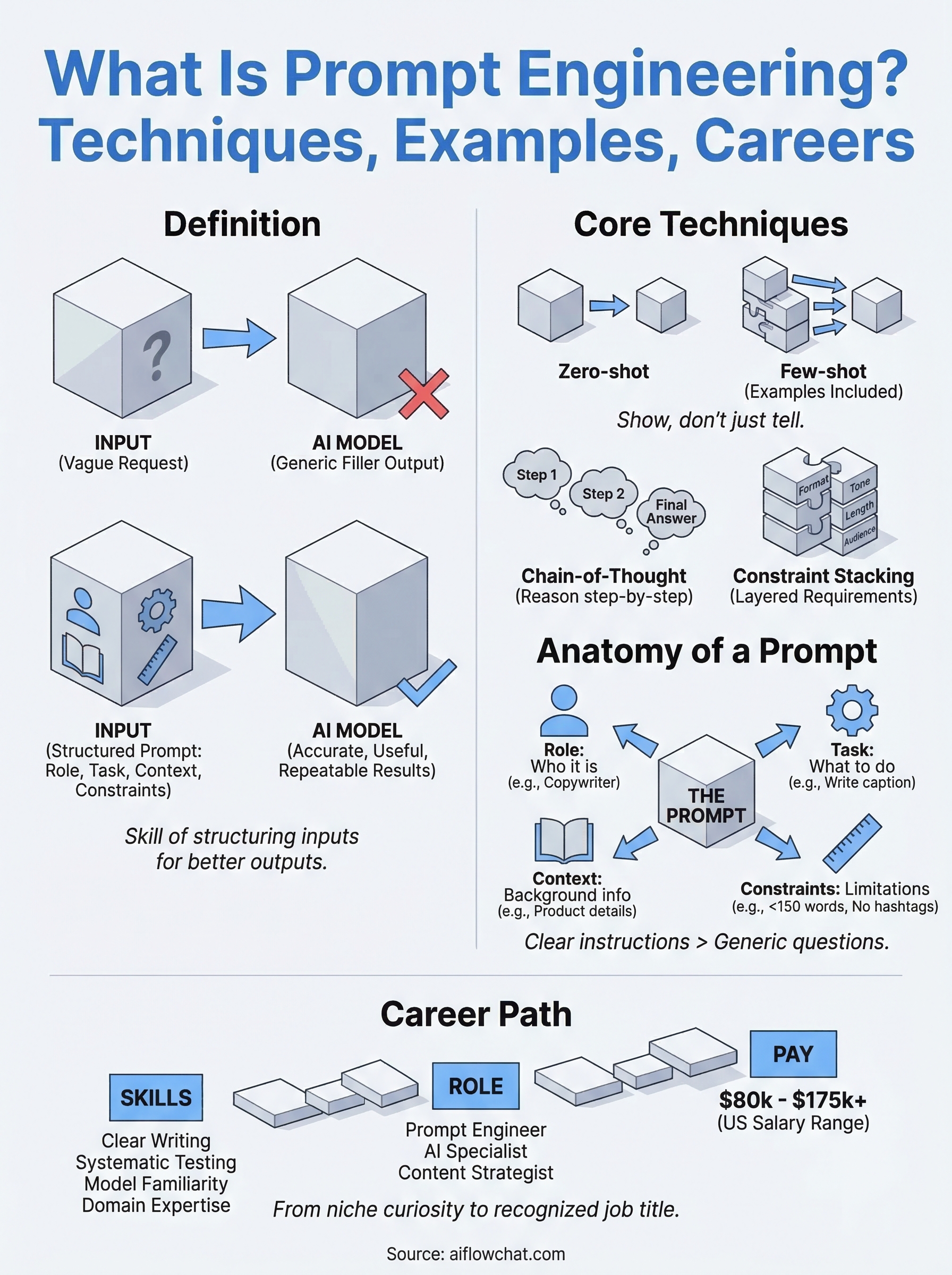
0%The difference between a mediocre AI output and one that actually saves you hours comes down to how you talk to the model. What is prompt engineering? It's the skill of structuring your inputs, your instructions, context, and constraints, so that a large language model produces accurate, useful, and repeatable results instead of generic filler.
This matters more than most people realize. As AI models get more capable, the bottleneck shifts from what the model can do to how well you can direct it. A vague prompt gets a vague answer. A specific, well-structured prompt gets output you can actually publish, send to a client, or build a workflow around, which is exactly why we built AI Flow Chat as a visual canvas where prompts, reference sources, and outputs connect spatially instead of disappearing in a linear chat thread.
This guide breaks down prompt engineering from the ground up: core techniques with real examples, how it applies to content creation and marketing, and what the career path looks like if you want to specialize in it. Whether you're writing your first prompt or building repeatable AI workflows, you'll walk away with a clear framework to get better results from any model.
Why prompt engineering matters
Most people treat AI models like search engines. They type a short question, skim the response, and move on. That approach works fine for simple lookups, but it leaves most of the model's capability untouched. Understanding what is prompt engineering, and applying it deliberately, is what separates people who get useful, publish-ready outputs from people who spend more time fixing AI responses than they saved by using AI at all.
The output quality gap
The gap between a weak prompt and a strong one is not subtle. A weak prompt like "write me a social media post" gives the model almost no information to work with, so it defaults to the safest, most generic response it can generate. A well-engineered prompt that includes context, format instructions, tone guidelines, and reference material gives the model enough signal to produce something that actually fits your brand, your audience, and your specific goal.
The quality of your output almost always reflects the quality of your input.
Research from Microsoft and other AI labs consistently shows that structured prompting techniques improve output accuracy, relevance, and consistency across a wide range of tasks. This is not about tricking the model or finding magic words. It's about communicating with enough specificity that the model does not have to guess at what you actually want.
Consistency and scale
For individual creators, prompt quality determines how much editing you need to do after the model generates a draft. A strong prompt can cut your revision time to almost nothing. A vague or poorly structured prompt means you spend more time cleaning up the output than you would have spent writing it yourself, which eliminates the core benefit of using AI.
For marketers, agency owners, and anyone building repeatable content workflows, the stakes scale with volume. You're not writing one post. You're building systems that need to produce consistent results across multiple clients, platforms, and content types week after week. Sloppy prompts break those systems. Well-engineered prompts make them reliable.
There's also a compounding advantage worth considering. As more teams adopt AI tools, the quality of their prompts increasingly determines the quality of their outputs and the speed of their production. Teams that treat prompting as a core skill, that document what works, iterate on it, and build reusable prompt libraries, are building an asset. Teams that treat every prompt as a one-off are just spinning their wheels. The gap between those two approaches widens over time, and it starts with how seriously you take the craft of writing a good prompt.
How prompt engineering works in practice
Understanding what is prompt engineering in theory is one thing. Seeing it in action is where it clicks. Every prompt you write is made up of a few core components: the instruction (what you want the model to do), the context (background information it needs), and the constraints (format, tone, length, or anything else that shapes the output). When you treat those components as deliberate, specific choices rather than afterthoughts, your results improve immediately.
The anatomy of a prompt
A well-built prompt gives the model a clear job description. Think of the model as a skilled contractor: it will do exactly what you specify, but if your specifications are vague, it fills in the gaps with its own assumptions, which usually means generic output you did not ask for. The more specific context and constraints you provide, the less the model has to guess, and the closer the first draft lands to what you actually need.
A prompt is not a question. It is a set of instructions with enough context for the model to produce a specific, usable result.
Here is what a complete prompt typically includes:
- Role: Tell the model who it is ("You are a direct-response copywriter with 10 years of experience")
- Task: State clearly what you want ("Write a 150-word Instagram caption")
- Context: Provide relevant background ("The product is a $29 project management app for freelancers")
- Constraints: Specify format, tone, or limits ("Use a conversational tone, no hashtags, end with a question")
From single prompt to workflow
One well-crafted prompt solves an immediate problem. The real leverage comes from chaining prompts together into a repeatable sequence: one prompt extracts key points from a piece of content, the next reformats them for a specific platform, and another adapts the tone for a different audience. Each step builds on the last.
Reusable prompt sequences let you replicate that process consistently across projects without rebuilding from scratch each time. That is where prompt engineering stops being a writing skill and starts being a production system.
Core prompt engineering techniques
Once you understand what is prompt engineering at a structural level, the next step is learning the specific techniques practitioners use to push models toward better outputs. These techniques are not advanced or difficult to learn. Most of them require nothing more than restructuring how you phrase your instructions, and each one addresses a specific failure mode you have likely already run into when working with AI tools.
Zero-shot and few-shot prompting
Zero-shot prompting means giving the model a task with no examples attached. It works well for straightforward requests where the format and intent are obvious to the model. Few-shot prompting means including one or more examples directly in your prompt so the model can pattern-match against them. When you need a specific structure, tone, or style that is difficult to describe in words, a well-chosen example outperforms a paragraph of written instructions every time.
If the model keeps missing the format you need, stop describing it and show it instead.
Chain-of-thought prompting
Chain-of-thought prompting instructs the model to reason step by step before producing a final answer. You trigger it by adding phrases like "think through this step by step" or "explain your reasoning before giving the final output." This technique is especially useful for complex tasks such as content strategy, competitive analysis, or multi-part writing projects where a shallow response misses important nuance.
Constraint stacking
Constraint stacking means layering multiple specific requirements into a single prompt rather than adding them one at a time through follow-up messages. You set the format, length, tone, audience, and any exclusions all upfront. This approach cuts back-and-forth and keeps every output consistent with your standards from the first draft. For anyone building repeatable content workflows, constraint stacking is what turns a prompt from a one-time request into a reliable production template you can reuse across projects.
Prompt examples you can copy
Knowing what is prompt engineering in theory helps, but seeing fully built prompts gives you something you can test and adapt right away. The examples below apply the techniques from the previous section: they each include a role, a clear task, relevant context, and stacked constraints. Copy them directly, swap in your details, and adjust based on what your project needs.
A reusable prompt template you document and save is worth far more than a single great prompt you forget about.
Social media content from a reference video
This prompt works when you have a video transcript and need platform-ready captions without starting from scratch.
"You are a social media copywriter who specializes in short-form content. I'm going to give you a transcript from a YouTube video. Extract the single strongest insight from the transcript, then write three Instagram captions based on that insight. Each caption should be under 150 words, use a conversational tone, start with a hook that creates curiosity, and end with a direct question to drive comments. Do not use hashtags or emojis. Here is the transcript: [paste transcript]"
Competitive ad analysis
Use this prompt when you want to reverse-engineer a competitor's ad and understand what makes it work before writing your own version.
"You are a direct-response marketing strategist. I'm going to paste the copy from a competitor's Facebook ad. Analyze it across four dimensions: the hook, the core value proposition, the objection it addresses, and the call to action. Then write a new ad for my product that uses the same structural approach but in my brand voice. My product is [product name]. It helps [target audience] achieve [main outcome]. My tone is [tone description]. Here is the competitor ad: [paste ad text]"
Both prompts follow the same pattern: role, task, context, and constraints defined upfront so the model produces a usable first draft without requiring multiple rounds of follow-up corrections.
Prompt engineer role, skills, and pay
Understanding what is prompt engineering as a skill is one thing. Turning it into a career is another. Prompt engineering has moved from a niche curiosity to a recognized job title at companies ranging from startups to enterprise tech teams. Some organizations hire dedicated prompt engineers; others fold the responsibility into existing roles like content strategist, AI specialist, or marketing operations manager.
What a prompt engineer actually does
A prompt engineer's core job is designing, testing, and refining the instructions that direct AI models toward consistent, high-quality outputs. In practice, that means building reusable prompt libraries, documenting what works across different use cases, and collaborating with product or marketing teams to turn those prompts into repeatable workflows. You're not writing code in most cases, but you are thinking systematically about how language shapes model behavior and iterating quickly when outputs miss the mark.
The best prompt engineers treat every failed output as useful data, not a setback.
Skills that get you hired
You do not need a computer science degree to work as a prompt engineer, but you do need a specific mix of analytical and communication skills. Here is what hiring teams consistently look for:
- Clear writing: The ability to write precise, unambiguous instructions is the foundation of everything else.
- Systematic testing: You need to vary prompts methodically and track what changes the output.
- Model familiarity: Hands-on experience with OpenAI, Anthropic, and Gemini models signals practical knowledge.
- Domain expertise: Prompt engineers who specialize in marketing, legal, or product copy command higher rates than generalists.
What prompt engineers earn
Salaries vary widely based on specialization and industry. Prompt engineering roles in the United States currently range from $80,000 to $175,000 per year, with senior roles at AI-focused companies pushing toward the higher end. Freelance prompt engineers billing by project or retainer often exceed salaried equivalents once they build a strong portfolio of documented, high-performing workflows.
Next steps
You now have a complete picture of what is prompt engineering: the core mechanics, the techniques that produce consistent results, and the career path for those who want to specialize. The practical skill, though, only develops through repetition. Start with the example prompts from this guide, run them against your actual projects, and document what works so you build a library of reliable templates rather than starting from scratch each time.
The biggest jump in output quality comes when you connect prompts to real reference material: transcripts, competitor ads, existing documents, and live web content. That is where a single well-engineered prompt becomes a repeatable production system instead of a one-off experiment. If you want a workspace built around that exact workflow, try AI Flow Chat, a visual canvas that lets you link prompts directly to your source materials and build the kind of reusable AI workflows that scale with your content operation.
Continue Reading
Discover more insights and updates from our articles
Choose an AI model for scripts, marketing copy, coding, research, long documents, and quick everyday work using a practical quality, speed, and credit-cost framework.
Compare eight current Poppy AI alternatives for visual research, creator workflows, general AI work, grounded synthesis, automation, and reusable delivery.
A practical method for turning a scattered content process into a clear AI-assisted flowchart with source context, review checks, and a reusable output.