More Prompts:

Best prompts for ChatGPT Marketing for landing pages using SEO enhancement

12 copy-ready prompts to optimize landing pages for search and conversions. Each prompt is practical, specific, and ready to paste into a supported AI to generate headlines, meta tags, content outlines, schema markup, localization, Core Web Vitals fixes, and more.


GPT-5
Claude Opus 4
Claude Sonnet 4
Gemini 2.5 Flash
Gemini 2.5 Pro
You've probably spent hours crafting the perfect landing page copy, only to watch it get buried on page 3 of Google search results. Or maybe you've generated decent traffic but can't figure out why visitors bounce faster than a rubber ball. The struggle of balancing SEO requirements with conversion-focused copy while juggling technical elements like schema markup and Core Web Vitals feels like trying to solve a Rubik's cube blindfolded.
This collection of 12 battle-tested prompts transforms that overwhelming process into a systematic approach that actually works. You'll get ready-to-use prompts for everything from SEO-optimized headlines and meta descriptions to structured data markup and Core Web Vitals fixes. Instead of guessing what Google wants or spending days researching competitor strategies, you'll have specific, actionable prompts that generate landing pages optimized for both search engines and conversions in minutes rather than months.
1
SEO-Optimized Landing Page Headline Generator
You are an expert marketing copywriter and SEO specialist. For the landing page below, produce 5 H1 headline options that: 1) include the primary keyword exactly as given at least once, 2) reflect the target audience and brand voice, 3) are between 40–65 characters where possible, and 4) include an indicator of expected conversion angle (benefit or urgency). Return headlines as a numbered list and include character counts. Input: landing page purpose: [purpose]. Primary keyword: [primary keyword]. Target audience: [target audience]. Brand voice: [brand voice].
Generate multiple H1 headline options that include the primary keyword, match target audience and tone, and respect character limits for SERP display.
2
Meta Title & Description Pairing for CTR
You are an SEO copywriter. For the landing page below, generate 5 meta title and meta description pairs optimized for the primary keyword. Each title should be 50–60 characters and include the keyword. Each description should be 120–155 characters, include a clear CTA and one supporting keyword, and avoid duplication. Also mark which pair is best for paid vs organic. Input: product/service: [product/service]. Primary keyword: [primary keyword]. Supporting keyword: [supporting keyword]. Target location: [country/state].
Create multiple meta title and description pairs optimized for SEO, keyword placement, and click-through rate, following SERP length limits and including CTAs.
3
Keyword Mapping & Content Outline
You are an SEO strategist. Create a keyword-to-content map for this landing page. Provide: 1) prioritized keyword list (primary, 5 secondaries, 10 long-tail/LSIs), 2) a detailed outline with H1, H2, H3, H4 headings and target word counts per section, 3) recommended sentence/phrase to include in the intro with the primary keyword, and 4) three internal pages to link to with suggested anchor text. Input: product/service: [product/service]. Primary keyword: [primary keyword]. Target audience and intent: [audience & intent].
Map primary and secondary keywords to a landing page structure: H1–H4 headings, suggested word counts per section, and internal link targets.
4
SEO-Friendly URL & Technical Setup
Act as an SEO and technical web specialist. For the landing page below, deliver: 1) 3 optimized URL slug options (short, descriptive, including primary keyword), 2) example canonical tag HTML, 3) hreflang tag suggestions for specified locales, and 4) 2 redirect rules (301) for common legacy paths. Input: primary keyword: [primary keyword]. Page topic: [topic]. Locales to support: [comma-separated locales, e.g., en-US, en-GB]. Legacy URLs: [list if any].
Produce SEO-friendly URL slugs, canonical tag examples, hreflang suggestions for multi-language pages, and redirect rules for legacy URLs.
5
Structured Data JSON-LD for Landing Page
You are an SEO schema specialist. Create a JSON-LD block for the landing page using the best matching schema type (Product, Service, or LocalBusiness). Include name, description, url, logo, image, price or priceRange (if product/service), aggregateRating (placeholder values), availability, areaServed, sameAs (social links), and contact details. Return valid JSON-LD only, with placeholders like {COMPANY_NAME}, {PRICE}. Input: choose schema type: [Product|Service|LocalBusiness]. Provide example values and note which fields to replace.
Generate ready-to-paste JSON-LD structured data for Product, Service, or LocalBusiness schema with placeholders filled for common fields.
6
LSI & Semantic Keyword List with Usage Plan
You are an SEO content strategist. For the landing page topic below provide: 1) 25 semantic/LSI keyword phrases grouped by intent (informational, transactional, navigational), 2) recommended placement for each phrase (H2, paragraph intro, alt text, meta), and 3) suggested usage frequency (e.g., 0.5–1.2% or 'use in 2–3 headings'). Input: primary keyword: [primary keyword]. Page length target: [e.g., 1,200 words].
Return a list of semantic keywords (LSI), label their user intent, and recommend where to place them on the landing page and ideal densities.
7
Content Gap Analysis vs Top Competitors
You are an SEO analyst. Compare the landing page idea to the following competitor URLs and produce: 1) top 10 content gaps (topics competitors cover that this page doesn't), 2) recommended new sections or microsites to fill gaps, 3) 8 FAQ entries to add (with short answers), and 4) 5 potential backlink or partnership targets (types of sites and outreach angle). Input: primary landing page topic: [topic]. Competitor URLs: [url1], [url2], [url3].
Compare your landing page to specified competitor URLs and produce a prioritized list of missing topics, content types, FAQs, and backlink/partnership opportunities.
AI Flow Chat

Stop Losing Your AI Work

Tired of rewriting the same prompts, juggling ChatGPT and Claude in multiple tabs, and watching your best AI conversations disappear forever?

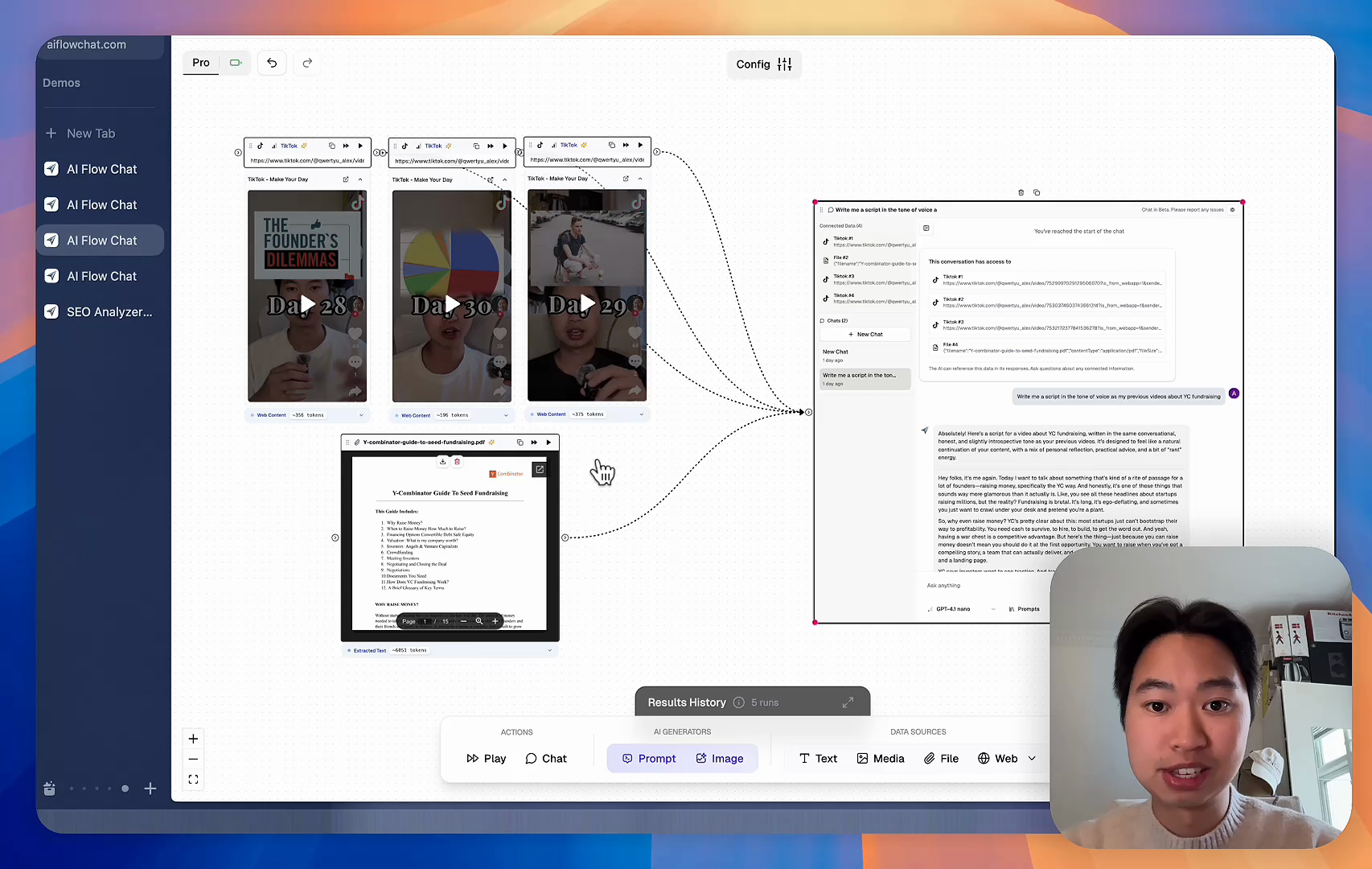
AI Flow Chat lets you save winning prompts to a reusable library, test all models in one workspace, and convert great chats into automated workflows that scale.
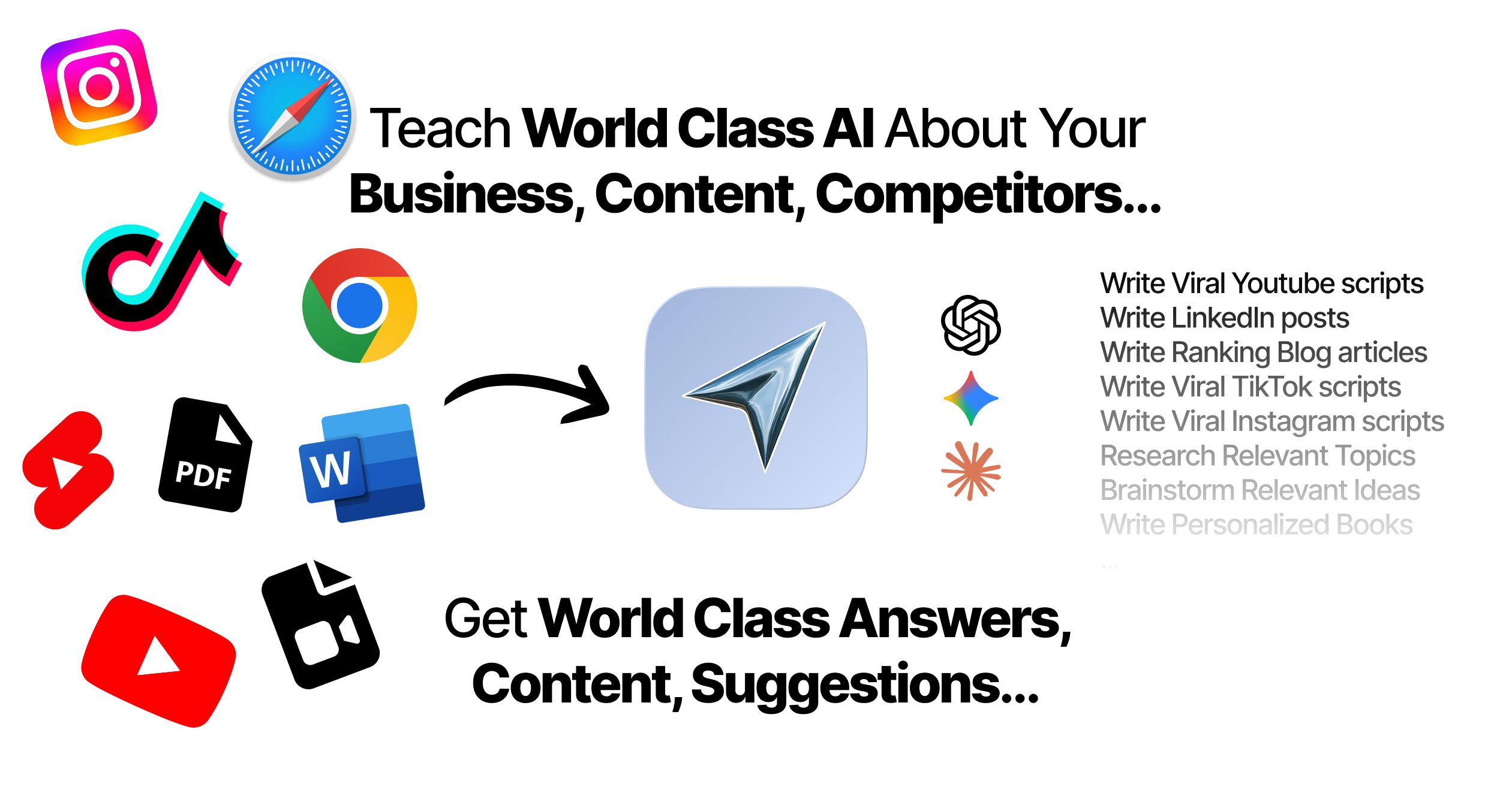
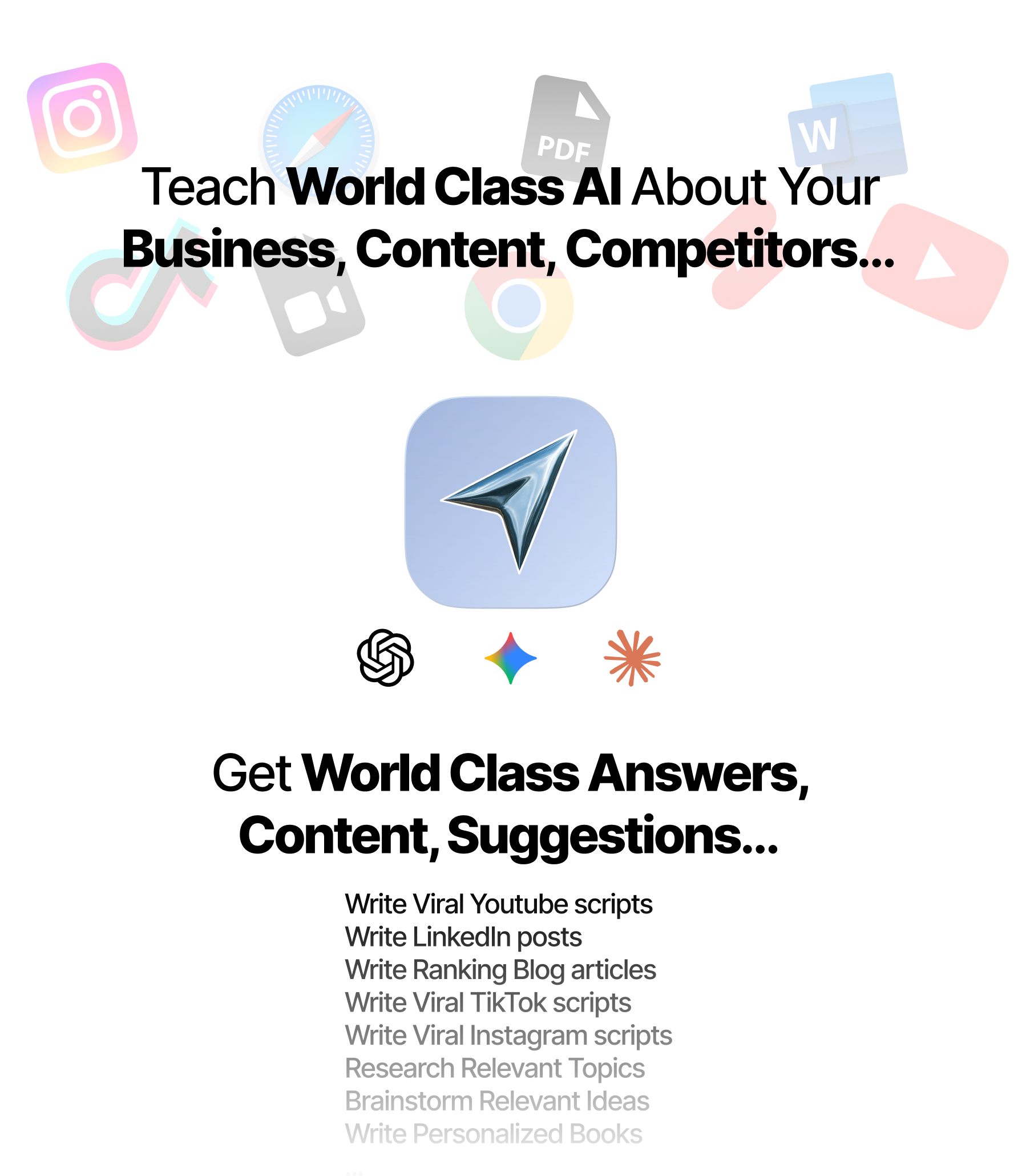
Teach World Class AI About Your Business, Content, Competitors… Get World Class Answers, Content, Suggestions...
AI Flow Chat powers our entire content strategy. We double down on what’s working, extract viral elements, and create stuff fast.
Video thumbnail

Reference Anything

Bring anything into context of AI and build content in seconds

YouTube

PDF

DOCX

TikTok

Web

Reels

Video Files

Twitter Videos

Facebook/Meta Ads

Tweets

Coming Soon

Audio Files

Coming Soon

Choose a plan to match your needs

Upgrade or cancel subscriptions anytime. All prices are in USD.

Basic

For normal daily use. Ideal for getting into AI automation and ideation.

$30/month
  • See what Basic gets you
  • 11,000 credits per month
  • Access to all AI models
  • 5 app schedules
  • Free optional onboarding call
  • 1,000 extra credits for $6
Get Started

No risk, cancel anytime.

ProRecommended

For power users with high-volume needs.

$100/month
  • See what Pro gets you
  • 33,000 credits per month
  • Access to all AI models
  • 10 app schedules
  • Remove AI Flow Chat branding from embedded apps
  • Free optional onboarding call
  • 2,000 extra credits for $6
Get Started

No risk, cancel anytime.

Frequently Asked Questions

Everything you need to know about AI Flow Chat. Still have questions? Contact us.