More Prompts:

Best prompts for LIM for ideation using design thinking frameworks

12 copy-ready prompts for language interaction models (LIMs) to run fast, structured ideation using core design thinking tools (empathy maps, journey maps, HMW, SCAMPER, etc.). Each prompt tells the model exactly what input to expect and what formatted output to produce.


GPT-5
Claude Opus 4
Claude Sonnet 4
Gemini 2.5 Flash
Gemini 2.5 Pro
You know that moment when you're staring at ChatGPT or Claude, trying to brainstorm ideas for your next product feature, and all you get back is a generic bulleted list that sounds like it came from a textbook? You end up spending more time figuring out how to ask the right question than actually solving your design problem. It's like having a brilliant research assistant who speaks a different language.
These 12 battle-tested prompts transform your AI from a confused intern into your most productive design thinking partner. Each prompt gives you structured frameworks for empathy mapping, journey mapping, SCAMPER ideation, assumption testing, and more, complete with exact input requirements and formatted outputs. Instead of wrestling with vague AI responses, you'll get actionable insights, prioritized ideas, and clear next steps that move your projects forward faster than traditional brainstorming sessions.
1
Create an Empathy Map from a short persona
You are an ideation assistant. Input: a one-paragraph persona. Output: an empathy map with these sections: 1) Persona header (name, role, age, context), 2) Says (3 bullets), 3) Thinks (3 bullets), 4) Does (3 bullets), 5) Feels (3 bullets), 6) Supporting evidence (3 bullets linking persona text to map), 7) Key insights (3 numbered), 8) Design opportunities (3 brief HMW-style statements). Keep each bullet concise. Use plain text.
Generate a 4-quadrant empathy map (Says, Thinks, Does, Feels), 3 supporting evidence bullets, 3 insights, and 3 design opportunity statements from a single-paragraph persona.
2
Customer Journey Map for a specific scenario
You are an ideation assistant. Input: a scenario title and 2–3 sentence description of the user and goal. Output: a journey map broken into 5 phases (e.g., Discover, Evaluate, Purchase, Use, Support). For each phase include: Phase name, User goal (1 sentence), Actions (3 bullets), Touchpoints (2 bullets), Pain points (2 bullets), Emotion score (1-5), Opportunity (1 short idea). Return plain text with phases labeled.
Produce a phase-by-phase journey map with goals, actions, touchpoints, pain points, emotions (1-5), and opportunity ideas per phase.
3
Turn research notes into prioritized How Might We (HMW) questions
You are an ideation assistant. Input: 6–10 short research observations (each 1 sentence). Output: 8 HMW questions grouped under 3 opportunity headings. For each HMW include a one-sentence rationale and a one-line quick prototyping idea. Mark each HMW as High/Medium/Low impact. Return plain text.
Convert 6–10 short research observations into 8 HMW questions, grouped by opportunity area, and rank by potential impact (high/medium/low).
4
Apply SCAMPER to generate product variants
You are an ideation assistant. Input: product name and 1-line description. Output: For each SCAMPER letter list 2–3 concrete idea variants (1–2 sentences each) and a feasibility note (low/medium/high). Keep responses concise and numbered by letter.
Run through SCAMPER (Substitute, Combine, Adapt, Modify, Put to another use, Eliminate, Reverse) and give 2–3 concrete idea variants per letter with a quick feasibility note.
5
Assumption mapping and top-3 experiment plans
You are an ideation assistant. Input: one-sentence product concept and up to 6 supporting claims. Output: 1) Table-like list of assumptions with tags (Critical/Not-critical, High/Low uncertainty), 2) Select top 3 high-risk assumptions and for each provide: Hypothesis, Experiment type (qual/quant), Steps (3 bullets), Success metric and target. Return plain text.
Identify product assumptions, classify them by (critical/less-critical) and (high/low uncertainty), then propose 3 quick experiments (hypothesis, method, metric, target) to test the highest-risk assumptions.
6
Rapid constrained brainstorming: 30 ideas
You are an ideation assistant. Input: problem statement and constraints (max budget, tech allowed, timeline in weeks). Output: 30 short ideas (one line each), grouped into three sections: Now (can do within constraints), Next (needs moderate lift), Later (bigger bets). At the end list top 3 ideas to prototype and one-sentence justification per idea.
Generate 30 distinct ideas under given constraints (time, budget, technical limits); group into Now/Next/Later tiers and pick top 3 to prototype with a 1-line reason each.
7
Create 3 data-driven personas from analytics summary
You are an ideation assistant. Input: 4–6 bullet analytics summary items (traffic segments, device split, top use cases, top drops). Output: three personas (name, age, segment), each with Goals (2 bullets), Frustrations (2 bullets), Tech comfort (low/medium/high), Representative quote (1 line), and one priority feature that would serve them best. Use plain text.
Turn an analytics summary (traffic segments, top tasks, key drop-offs, demographics) into three actionable personas with goals, frustrations, tech comfort, quote, and a primary feature recommendation per persona.
AI Flow Chat

Stop Losing Your AI Work

Tired of rewriting the same prompts, juggling ChatGPT and Claude in multiple tabs, and watching your best AI conversations disappear forever?

AI Flow Chat lets you save winning prompts to a reusable library, test all models in one workspace, and convert great chats into automated workflows that scale.
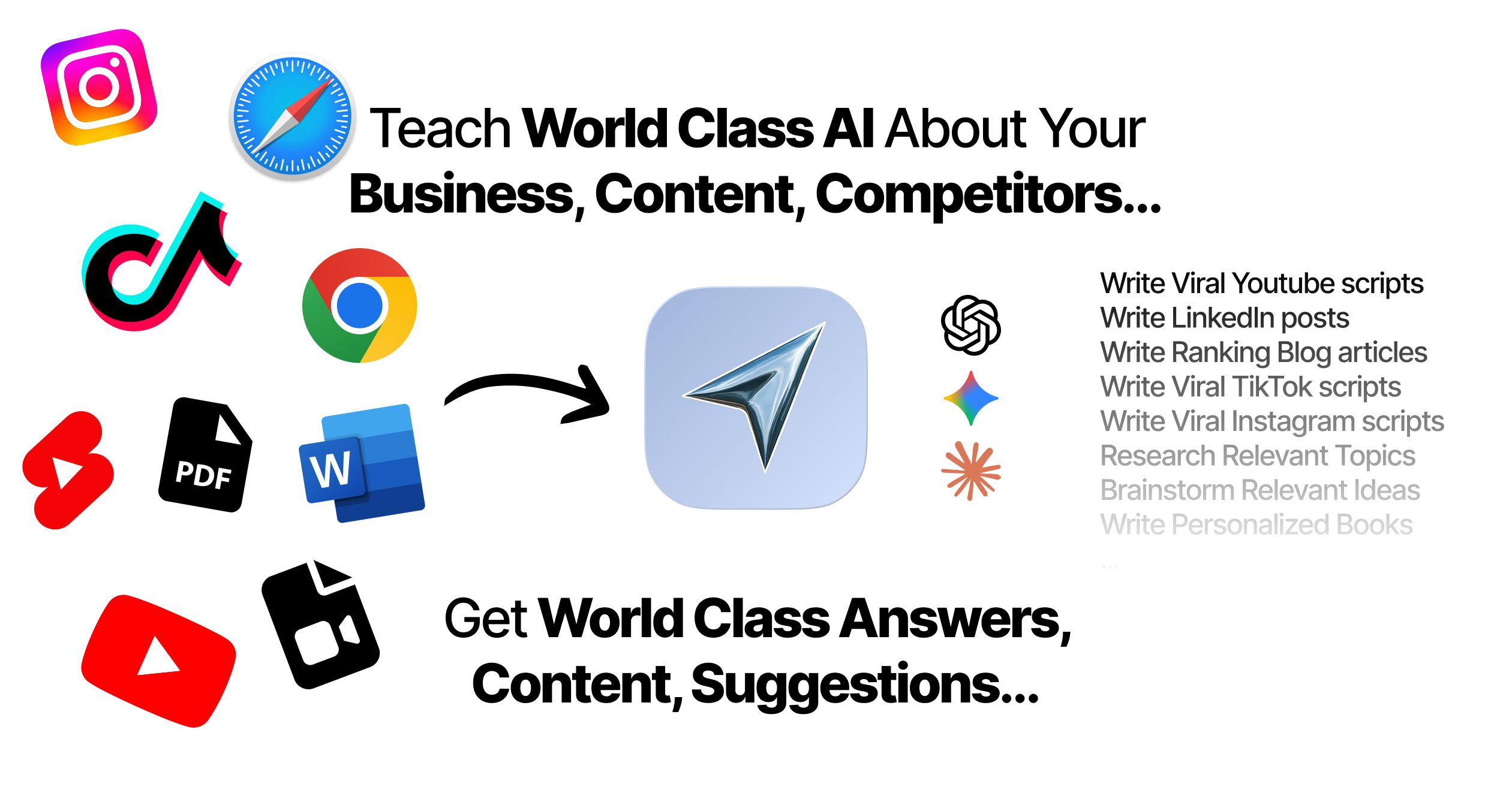

Teach World Class AI About Your Business, Content, Competitors… Get World Class Answers, Content, Suggestions...
AI Flow Chat powers our entire content strategy. We double down on what’s working, extract viral elements, and create stuff fast.
Video thumbnail

Reference Anything

Bring anything into context of AI and build content in seconds

YouTube

PDF

DOCX

TikTok

Web

Reels

Video Files

Twitter Videos

Facebook/Meta Ads

Tweets

Coming Soon

Audio Files

Coming Soon

Choose a plan to match your needs

Upgrade or cancel subscriptions anytime. All prices are in USD.

Basic

For normal daily use. Ideal for getting into AI automation and ideation.

$30/month
  • See what Basic gets you
  • 11,000 credits per month
  • Access to all AI models
  • 5 app schedules
  • Free optional onboarding call
  • 1,000 extra credits for $6
Get Started

No risk, cancel anytime.

ProRecommended

For power users with high-volume needs.

$100/month
  • See what Pro gets you
  • 33,000 credits per month
  • Access to all AI models
  • 10 app schedules
  • Remove AI Flow Chat branding from embedded apps
  • Free optional onboarding call
  • 2,000 extra credits for $6
Get Started

No risk, cancel anytime.

Frequently Asked Questions

Everything you need to know about AI Flow Chat. Still have questions? Contact us.