7 Best Coursera Prompt Engineering Course Options (2026)
At AI Flow Chat
Contents
0%Knowing how to write effective prompts is quickly becoming a core skill for anyone who works with AI tools daily, whether you're generating content, analyzing competitor ads, or building automated workflows. A Coursera prompt engineering course gives you structured, university-backed training to sharpen that skill, but with dozens of options on the platform, picking the right one isn't straightforward. Some courses cover beginner-level fundamentals, while others go deep into advanced techniques for specific models like GPT-4 or Gemini.
We put this guide together because prompt quality directly affects output quality, something we see every day at AI Flow Chat. Our platform lets creators and marketers reference viral content, build visual AI workflows, and generate outputs across multiple models, all in one workspace. But none of that matters much if your prompts are vague or poorly structured. Better prompts mean better results, regardless of which tool you're using.
Below, you'll find seven Coursera prompt engineering courses worth your time in 2026, broken down by skill level, course length, and what you'll actually learn. Each pick includes honest notes on who it's best for, so you can skip the guesswork and enroll in the one that fits where you are right now.
1. Prompt Engineering for ChatGPT by Vanderbilt
If you're looking for a structured, university-level introduction to prompt engineering, this course is one of the most popular starting points on Coursera. Taught by Jules White, a computer science professor at Vanderbilt University, the course walks you through how to communicate with ChatGPT more effectively using a set of repeatable prompt patterns. It consistently ranks among the highest-rated results when you search any coursera prompt engineering course category.

Best for
This course fits beginners and intermediate learners who want a solid foundation in prompt engineering without drowning in theory. If you use ChatGPT regularly for writing, research, or content production but feel like your outputs are inconsistent or underwhelming, this course directly targets that problem with a practical, pattern-driven method.
What you'll learn
The curriculum focuses on practical prompt patterns you can apply immediately rather than abstract concepts. Jules White teaches a repeatable system for structuring prompts across different tasks, which means the skills transfer well beyond ChatGPT.
Key techniques covered in the course include:
- Few-shot and zero-shot prompting to control output format and style
- Role-based prompting to shift the model's perspective and tone
- Chain-of-thought prompting to improve reasoning in multi-step tasks
- Flipped interaction patterns where the AI asks you clarifying questions before responding
- Template and meta-language prompting for consistent content generation at scale
The pattern-based framework in this course transfers across AI models, so the skills you build here stay useful even as tools evolve.
Format and time commitment
The course runs approximately five weeks at a pace of two to three hours per week, putting your total time investment around 10 to 15 hours. Lessons use short video lectures paired with practical exercises, so you spend more time applying techniques than watching slides. The pacing works well if you're fitting learning around a full work schedule.
Prerequisites and tools
You need no prior programming or technical background to start this course. A working ChatGPT account covers everything you need on the tools side. A ChatGPT Plus subscription helps some exercises run faster, but the free tier handles most of the course content without any issues.
Pricing and certificate
Auditing the course is completely free, which gives you access to video lectures but not graded assignments or the completion certificate. To earn a shareable certificate, you either pay a one-time fee of around $49 or access it through a Coursera Plus subscription, which covers most courses on the platform under one monthly rate.
2. Prompt Engineering Specialization by Vanderbilt
This specialization builds directly on the foundation of the standalone Vanderbilt course and packages multiple courses into a single credential. Also led by Jules White, it covers a wider range of prompt engineering applications and gives you a more complete skill set than any single course can. If you've already taken the introductory course or you want to go deeper from the start, this specialization is a natural step up.
Best for
This program suits intermediate to advanced learners who want a broader, more structured certification rather than a single course completion. It works especially well for marketers, content teams, and agency owners who need to apply prompt engineering across multiple use cases, from writing and coding to data analysis and workflow automation.
What you'll learn
The specialization expands well beyond basic prompt patterns. You'll cover more complex techniques like combining prompt strategies across multi-step tasks and applying AI systematically to real business workflows.
This specialization is one of the few Coursera prompt engineering course options that treats prompt engineering as a repeatable system rather than a one-off skill.
Expect to work through topics like refining outputs through iteration, applying prompts to specific professional domains, and building reusable frameworks that hold up across different AI models.
Format and time commitment
The specialization runs three to four months at roughly three hours per week, depending on your pace. It includes multiple shorter courses bundled together, so you can progress through each module and track your completion as you go.
Prerequisites and tools
No technical background is required. A standard ChatGPT account covers the practical exercises, and Vanderbilt keeps the content accessible to non-developers throughout.
Pricing and certificate
You can audit individual courses for free, but the full specialization certificate requires either a per-course fee or an active Coursera Plus subscription.
3. Generative AI: Prompt Engineering Basics by IBM
IBM's entry into prompt engineering education takes a slightly different angle than the Vanderbilt offerings. This coursera prompt engineering course focuses on grounding you in the fundamentals of generative AI alongside prompt techniques, so you walk away understanding not just how to write prompts but why certain structures produce better outputs from language models.
Best for
This course suits absolute beginners who want a short, digestible introduction to both generative AI concepts and prompt engineering at the same time. It works well if you're new to AI tools entirely and want a low-pressure starting point before committing to a longer specialization.
What you'll learn
The course covers the core mechanics of how large language models process prompts, which helps you write better inputs with actual understanding behind your choices. You'll work through techniques like zero-shot and few-shot prompting, prompt chaining, and basic output formatting strategies.
Understanding why a prompt works makes it far easier to fix one that doesn't, and IBM structures this course around that principle.
The curriculum also introduces prompt iteration, walking you through how to refine and test prompts systematically rather than guessing your way to better results.
Format and time commitment
The course runs approximately three to five hours total, making it one of the shortest options on this list. It uses a mix of short video lessons and reading materials with no heavy project requirements.
Prerequisites and tools
No technical background or coding experience is needed. You don't need a paid AI subscription to complete the course content.
Pricing and certificate
Auditing is free, and a shareable IBM-backed certificate is available through a paid enrollment or an active Coursera Plus subscription.
4. Essentials of Prompt Engineering by Amazon Web Services
Amazon Web Services brings a cloud and enterprise perspective to prompt engineering that you won't find in most academic courses. This coursera prompt engineering course was built by AWS to help practitioners write better prompts within the context of large language model applications, with a focus on how prompts interact with production AI systems rather than just chat interfaces.
Best for
This course fits professionals and business users who work with AI in an operational or enterprise setting. If you're building AI-powered tools or automating internal workflows, this course gives you context-specific prompt skills that go beyond general-purpose techniques.
It's also a good fit if you want cloud vendor-backed training with a practical slant and a recognized certificate to show for it.
What you'll learn
The curriculum covers core prompting techniques like zero-shot and few-shot prompting, chain-of-thought reasoning, and structured output formatting. AWS also covers how prompt design affects model behavior at scale, which matters when you're building repeatable workflows rather than writing one-off prompts.
Prompt engineering in production contexts requires a different mindset than casual use, and AWS builds this course around that distinction.
Format and time commitment
The course runs approximately four to five hours total, making it one of the shortest options on this list. You can realistically finish it over a weekend without rearranging your schedule.
Prerequisites and tools
No prior programming experience is required, though some familiarity with AI tools helps you absorb the material faster. You don't need an active AWS account to complete the core course content.
Pricing and certificate
Auditing is free, and a shareable AWS-backed certificate is available through paid enrollment or an active Coursera Plus subscription.
5. Start Writing Prompts like a Pro by Google
Google's own take on prompt engineering keeps things practical and beginner-friendly, which makes it stand out from the more technical or theory-heavy options on this list. This coursera prompt engineering course was built for everyday users who want to write better prompts across Google's AI tools, including Gemini, without any prior experience holding them back. The format is tight and the scope is intentionally narrow, which works in your favor if you want to build a usable skill quickly rather than commit to a multi-month program.
Best for
This course fits complete beginners who want a fast, accessible introduction to prompt writing. If you primarily use Google Workspace tools like Docs, Gmail, or Slides, this course shows you how to apply AI prompting skills directly inside the tools you already use every day.
What you'll learn
The curriculum focuses on practical techniques for writing clear, specific, and effective prompts. You'll cover prompt structuring basics, how to adjust tone and format through your inputs, and how to use AI to speed up common tasks like drafting emails, summarizing documents, and generating outlines.
Writing tighter prompts from the start saves you the time you'd otherwise spend editing weak or off-target AI outputs.
Format and time commitment
The course runs approximately three to four hours total. You can finish it in a single sitting or spread it across a few evenings without losing momentum.
Prerequisites and tools
No technical background is required. A free Google account gives you everything you need to follow along with the practical exercises throughout the course.
Pricing and certificate
You can audit the course for free, and a shareable Google-backed certificate is available through paid enrollment or an active Coursera Plus subscription.
6. Google Prompting Essentials Specialization
The Google Prompting Essentials Specialization takes the beginner-friendly approach of the standalone Google course and expands it into a full credential with broader coverage of AI skills and real-world applications. This coursera prompt engineering course packages multiple focused modules into one structured program, making it the right choice if you want a Google-certified path through prompt engineering rather than a single short lesson.

Best for
This specialization suits professionals and intermediate learners who want a recognized credential backed by Google. If you work across Google Workspace tools regularly and want to integrate AI prompting into your daily tasks more systematically, this program gives you the structured training to do that with confidence rather than trial and error.
What you'll learn
The specialization covers advanced prompt structuring techniques, responsible AI use, and how to apply prompting skills across different Google tools and contexts. You'll build on core fundamentals and work toward writing prompts that produce consistently reliable outputs across a range of professional tasks, from content drafting to data summarization.
A Google-backed certification carries real weight with employers and clients who recognize the brand's authority in AI development.
Format and time commitment
The specialization runs approximately one month at roughly five hours per week. The modular format lets you work at your own pace while tracking clear progress through each course in the bundle.
Prerequisites and tools
No prior technical experience is required. A free Google account covers all the hands-on exercises built into the curriculum, so there are no additional tool costs to factor in.
Pricing and certificate
You can audit individual courses for free, but the full specialization certificate requires paid enrollment or an active Coursera Plus subscription.
7. Advanced Prompt Engineering for Everyone by Vanderbilt
Vanderbilt rounds out its prompt engineering curriculum with a course designed for learners who have already covered the basics and want to push further. This coursera prompt engineering course goes beyond foundational techniques and digs into more sophisticated strategies that produce more precise, more reliable outputs from modern AI models. Jules White leads this course with the same practical, pattern-driven approach that makes the beginner Vanderbilt offering so effective.
Best for
This course suits intermediate to advanced learners who already write prompts regularly but want to close the gap between average and genuinely strong results. If you've completed the introductory Vanderbilt course or have significant hands-on experience with AI tools, this is the logical next step before pursuing a full specialization.
What you'll learn
The course focuses on advanced prompt structures and strategies that go well beyond zero-shot and few-shot prompting. You'll work through techniques for handling complex, multi-step tasks and learn how to design prompts that hold up across different models and contexts.
Advanced prompting techniques reduce the back-and-forth revision cycle significantly, which saves you real time on high-volume content work.
Topics include iterative prompt refinement, structured reasoning chains, and strategies for generating more consistent outputs when the stakes are higher.
Format and time commitment
The course runs approximately four to six hours total and uses Vanderbilt's standard format of short video lectures paired with practical exercises. You can finish it over a single focused weekend.
Prerequisites and tools
You need prior experience with prompt engineering before starting this course. A standard ChatGPT account covers the hands-on exercises throughout the curriculum.
Pricing and certificate
Auditing is free, and a shareable Vanderbilt-backed certificate is available through paid enrollment or an active Coursera Plus subscription.
Next Steps
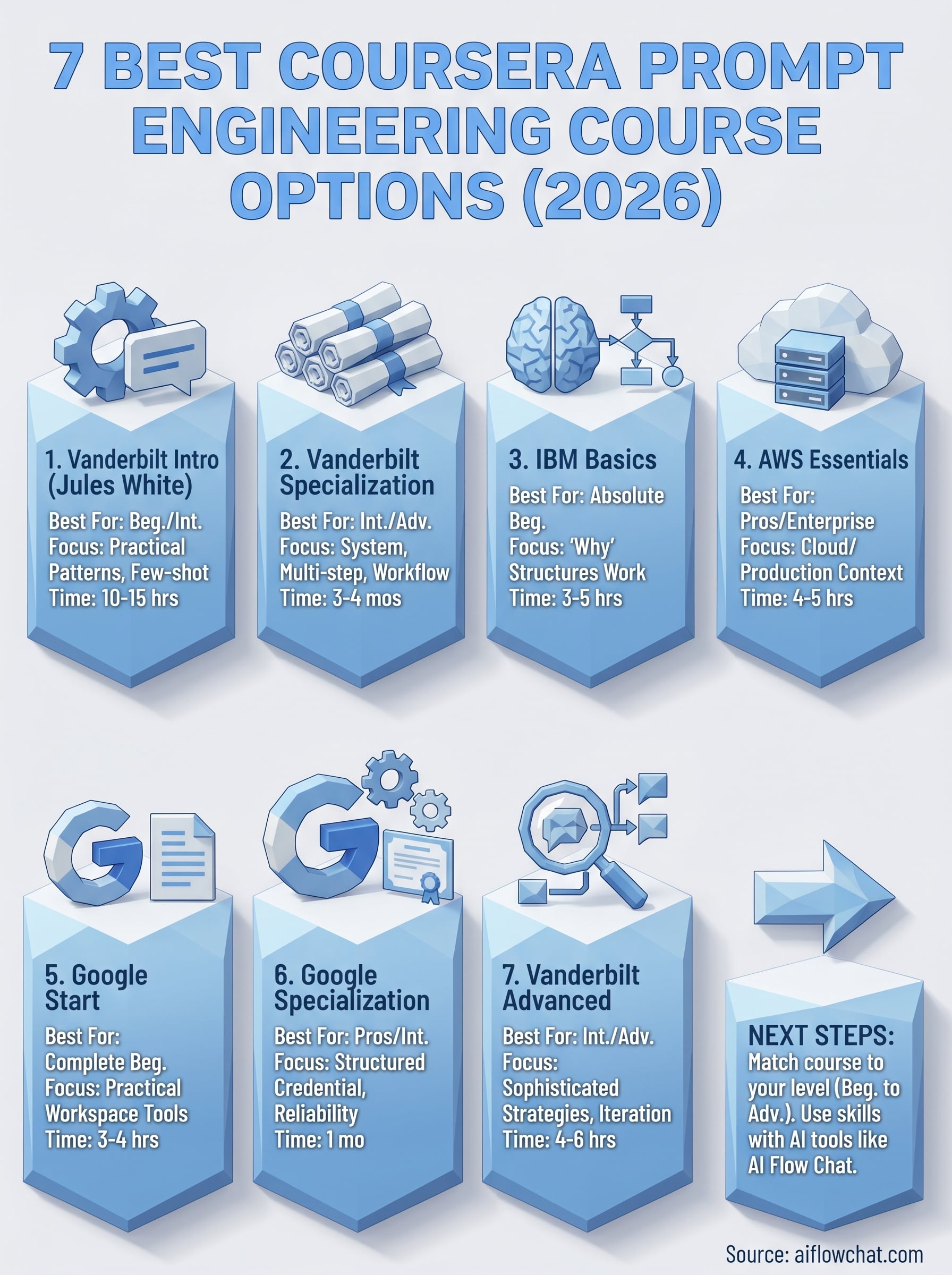
Every coursera prompt engineering course on this list teaches you something different, so your best move is to match the course to where you actually are right now. If you're starting from zero, go with the IBM basics course or Google's beginner option. If you already write prompts regularly, Vanderbilt's advanced course or the Google Prompting Essentials Specialization gives you the structure to level up without repeating ground you've already covered.
Learning prompt engineering is only half the equation. You also need a workspace where strong prompts translate directly into high-quality outputs, and that means having the right tools in place once your skills sharpen. AI Flow Chat is built for exactly that, letting you reference viral content, run multi-source AI workflows, and generate outputs across multiple models from a single visual canvas. If you're ready to put your new skills to work at scale, try AI Flow Chat and see how far better prompts can take you.
Continue Reading
Discover more insights and updates from our articles
Choose an AI model for scripts, marketing copy, coding, research, long documents, and quick everyday work using a practical quality, speed, and credit-cost framework.
Compare eight current Poppy AI alternatives for visual research, creator workflows, general AI work, grounded synthesis, automation, and reusable delivery.
A practical method for turning a scattered content process into a clear AI-assisted flowchart with source context, review checks, and a reusable output.