10 Best Ad Testing Tools to Optimize Creative Performance
At AI Flow Chat
Contents
0%Running ads without testing your creatives is like throwing money at a wall and hoping something sticks. The difference between a winning campaign and a budget drain often comes down to one thing: knowing which creative actually resonates before you scale spend. That's exactly where ad testing tools come in, they give you data-backed confidence that your hooks, visuals, and copy are pulling their weight before you commit serious dollars.
But here's the catch: testing is only half the equation. Once you identify what works, you still need to produce variations fast enough to keep up with ad fatigue. That's why we built AI Flow Chat, a visual AI platform where marketers and agencies can analyze competitor ads, extract winning patterns from the Facebook Ads Library, and generate new creative concepts at scale using proven formulas as reference material.
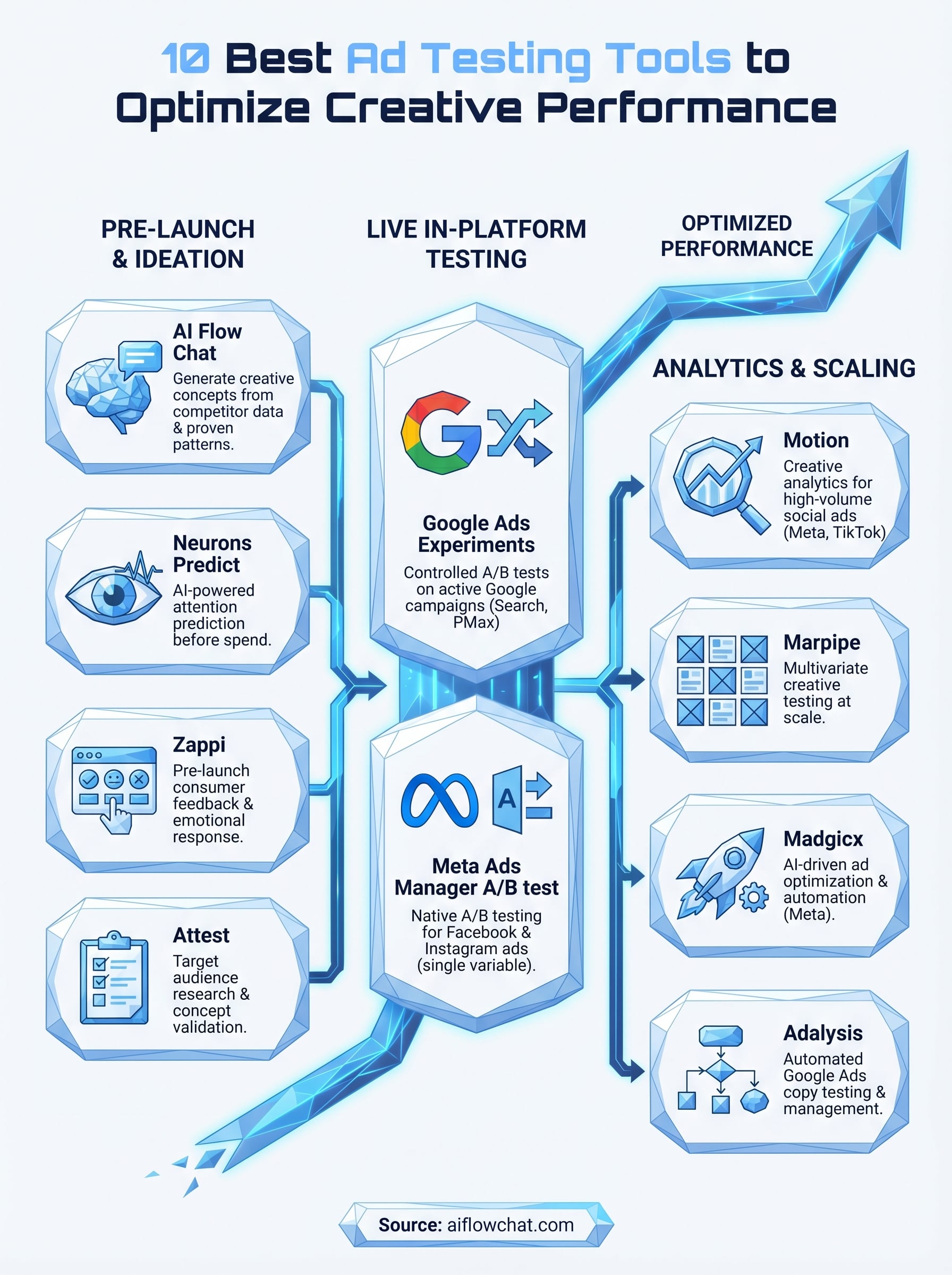
This guide breaks down 10 of the best tools for testing ad creatives in 2026, covering everything from multivariate testing platforms to AI-powered prediction engines. Whether you're a solo media buyer or managing campaigns for multiple clients, you'll find the right fit for your workflow and budget below.
1. AI Flow Chat
AI Flow Chat takes a fundamentally different angle than most ad testing tools on this list. Rather than running live split tests on active campaigns, it helps you build creatives already informed by proven patterns before you spend a single dollar on distribution.
What it does
AI Flow Chat is a visual AI whiteboard where you pull in competitor ads, viral social content, and reference materials from the Facebook Ads Library, TikTok, Instagram Reels, and YouTube, then use AI to extract patterns and generate new ad concepts based on what's already working. The canvas-style interface connects sources to prompts to outputs, so you can see exactly how your inputs shape the creative result.
This source-to-output transparency is what separates AI Flow Chat from a standard AI chat tool: every generated concept is tethered to real reference material, which keeps outputs grounded and reduces hallucination significantly.
Best for
AI Flow Chat is built for performance marketers, agency owners, and solo media buyers who need to move fast without sacrificing creative quality. It's particularly well-suited for teams managing multiple client accounts who need to systematize the research-to-creation process rather than starting from scratch every campaign cycle.
Key features to look at
The Meta/Facebook Ads spy tool lets you monitor competitor ads directly inside the platform, pulling hooks and creative structures without jumping between tabs. You can also paste links from TikTok, Instagram Reels, and YouTube for automatic AI transcription and engagement analysis.
Key capabilities worth noting:
- Repeatable AI flowcharts for automated, consistent creative production
- Multi-model access across OpenAI, Anthropic Claude, and Gemini under one subscription
- Scheduled tasks that run creative workflows automatically on a set cadence
- A reusable prompt library with a community gallery for sharing what works
Limits to know
AI Flow Chat is not a live A/B testing platform. It does not run controlled experiments on active campaigns or generate statistical significance reports on creative variants. You'll still need a dedicated testing tool to validate performance after your creatives go live.
Pricing
Plans start at $29 per month on a flexible, credit-based model with no annual commitment required. That single subscription covers access to multiple AI models, the visual canvas, the ads spy tool, and all automation features.
2. Google Ads Experiments
This tool is one of the most widely used ad testing tools available, and it lives directly inside the platform where your campaigns already run, which removes a lot of setup friction.
What it does
Google Ads Experiments lets you run controlled A/B tests on your active Search, Display, and Performance Max campaigns without creating duplicate campaign structures from scratch. You split traffic between a base campaign and an experiment variant, then measure performance differences against a specific goal, whether that's conversions, clicks, or cost per action.
Best for
Google Ads-focused media buyers and PPC managers benefit most from this tool, especially those who want to test campaign-level changes like bidding strategies, ad copy, or audience targeting without disrupting live campaign performance.
Key features to look at
The platform gives you direct control over your testing variables inside a familiar, native interface you already use daily.
- Traffic split control: Choose what percentage of impressions go to your experiment versus your base campaign
- Statistical significance tracking: Google flags when results reach a confidence threshold so you know when to act
- One-click apply: Roll winning changes into your base campaign instantly
The one-click apply feature is particularly useful when you're managing multiple campaigns and need to move fast on a proven winner.
Limits to know
Google Ads Experiments only works within Google's own ad ecosystem, so cross-channel creative testing is off the table. Results are also campaign-level, which means granular testing of individual creative elements requires additional workarounds.
Pricing
The tool is completely free inside your Google Ads account. You only pay for the ad spend you allocate to the experiment itself.
3. Meta Ads Manager A/B test
Meta Ads Manager includes a built-in A/B testing feature that lets you run controlled experiments directly within your paid social campaigns. It's one of the most accessible ad testing tools for anyone already running Facebook or Instagram ads, since it requires no third-party integrations to get started.
What it does
The A/B test tool splits your audience into non-overlapping groups and shows each group a different version of your ad. You define a single variable to test, such as creative, audience, or placement, and Meta measures which version drives better results against your selected campaign objective.
Best for
This tool works best for Facebook and Instagram advertisers who want to validate creative decisions on the platform where those ads actually run. It's especially useful for brands testing different hooks or visual formats across a cold audience before committing to scale.
Key features to look at
Several capabilities make Meta's native testing stand out from most standalone platforms.
- Single-variable testing: Isolates one element per test to produce clean, actionable data
- Audience deduplication: Prevents the same user from seeing both ad variants, which keeps results accurate
- Cost per result comparison: Surfaces a clear winner based on your specific campaign goal
The audience deduplication feature is something many third-party tools don't replicate well, making Meta's native option more reliable for Facebook-specific experiments.
Limits to know
Testing is limited to Meta's ecosystem, so cross-channel creative validation isn't possible here. Reaching statistical significance also requires sufficient budget and run time, which can be a real barrier for smaller accounts with limited spend.
Pricing
Meta Ads Manager is free to use. Your only cost is the ad spend you allocate to run the experiment itself.
4. Motion
Motion is a creative analytics platform built specifically for performance marketers who run high volumes of paid social ads. It connects directly to your Meta and TikTok ad accounts to surface which creatives are winning, which are fading, and why.
What it does
The platform pulls your creative performance data into a visual reporting dashboard that organizes results by concept, format, and hook. Rather than digging through raw numbers in Ads Manager, you get a structured view of how each creative variant performs over time against your key metrics like cost per result and thumbstop rate.
Best for
This tool is designed for performance marketing teams and DTC brands that ship a large number of ad creatives each month and need a faster way to identify winners without manually reviewing every campaign. It works especially well for teams using a concept-testing framework where multiple variations of the same idea run simultaneously.
Motion's visual organization makes it one of the more intuitive ad testing tools for creative teams who think in concepts rather than campaign structures.
Key features to look at
- Creative scorecards that rank ads by performance tiers
- Hook rate and hold rate tracking to diagnose exactly where viewers drop off
- Concept-level reporting to compare creative families, not just individual ads
Limits to know
Motion is a reporting and analytics tool, not a testing engine. It does not run live experiments or manage ad spend directly; you still need your ad platform to handle that.
Pricing
Motion starts at $999 per month, which makes it a better fit for established teams with significant ad budgets rather than early-stage advertisers.
5. Marpipe
Marpipe focuses on one thing: multivariate creative testing at scale. Unlike standard A/B tools that test two variants at a time, Marpipe generates and tests hundreds of ad creative combinations automatically, helping you pinpoint exactly which visual elements, copy lines, and CTAs actually drive performance.
What it does
Marpipe connects to your Meta ad account and automates the production and distribution of ad variants by mixing different creative components. You define the elements you want to test, such as background images, headlines, and product shots, and the platform builds every possible combination and pushes them live as a controlled experiment.
Best for
This tool suits DTC brands and e-commerce advertisers who run catalog-heavy campaigns and need statistically reliable data on which creative combinations convert. It's one of the more specialized ad testing tools for teams that treat creative testing as a systematic, repeatable process.
Marpipe's automated variant generation removes the manual production bottleneck that slows most teams down when running multivariate tests at volume.
Key features to look at
- Automated ad creative production from component-level inputs
- Statistically significant result reporting built directly into the dashboard
- Creative intelligence reports that surface your top-performing element combinations
Limits to know
Marpipe works exclusively with Meta at this time, so Google, TikTok, and other channels are off the table. You also need clean, modular creative assets prepared in advance to get meaningful output from its combination engine.
Pricing
Marpipe starts at $499 per month, which positions it as a mid-tier investment better suited for growth-stage brands with consistent creative testing budgets than for early-stage advertisers.
6. Madgicx
Madgicx is an AI-powered ad optimization platform that combines creative analytics with automated media buying decisions. It sits at the intersection of audience targeting intelligence and creative performance data, making it one of the more comprehensive ad testing tools for Meta advertisers who want automation baked into their optimization workflow.
What it does
Madgicx connects to your Meta ad account and uses AI to analyze creative performance, audience behavior, and bidding data simultaneously. The platform surfaces which ad combinations are underperforming, recommends when to cut or scale, and gives you a consolidated view of creative health across your entire account without manual report building.
Best for
This tool works best for Meta advertisers and agency owners managing multiple ad accounts who want to reduce the manual work involved in monitoring creative fatigue and scaling decisions. It fits teams that want AI-driven recommendations rather than a purely self-serve analytics dashboard.
Madgicx's strength is connecting creative performance data directly to budget decisions, which removes a step that most testing workflows handle manually.
Key features to look at
- AI Ad Launcher: Automates ad creation and audience targeting based on performance signals
- Creative Insights reports that break down winning patterns by format, audience segment, and placement
- Automated rules for pausing underperforming creatives based on preset thresholds
Limits to know
Madgicx works exclusively within Meta's ecosystem, so cross-channel testing is not supported. The platform also carries a steeper learning curve than simpler analytics tools, which can slow down smaller teams without a dedicated media buyer on staff.
Pricing
Pricing starts at $44 per month and scales based on your monthly ad spend, making it more accessible at lower budgets but increasingly costly as your accounts grow.
7. Adalysis
Adalysis is a Google Ads management and optimization platform that automates the monitoring and testing of ad copy at scale. It's one of the more focused ad testing tools for PPC managers who run large Search campaigns and need structured oversight of creative performance without building custom reports from scratch.
What it does
The platform connects to your Google Ads account and continuously monitors ad group performance, flags underperforming copy, and surfaces A/B test results across your entire campaign portfolio. It automates the detection of statistically significant winners so you can pause losers and promote winning variants without reviewing each ad group manually.
Best for
This tool is built for PPC specialists and search marketing teams managing large Google Ads accounts with hundreds of ad groups. It fits advertisers who run ongoing copy tests and need a system that tracks results across the entire account rather than one campaign at a time.
Adalysis removes the manual monitoring work that typically slows down copy testing at scale, which is where most PPC teams lose time.
Key features to look at
- Automated A/B test monitoring with statistical significance alerts
- Ad copy analysis across your full account in a single dashboard
- Pause and promote recommendations based on performance thresholds
Limits to know
Adalysis works exclusively with Google Ads and does not support paid social channels. The platform also focuses primarily on text-based ad copy, so creative testing for display or video formats is limited.
Pricing
Plans start at $99 per month, with pricing scaling based on your account size and monthly spend.
8. Neurons Predict
Neurons Predict takes a different approach than most ad testing tools on this list. Instead of measuring performance after your ads go live, it uses neuroscience-based AI to predict how viewers will respond to your creative before you spend a single dollar on distribution.
What it does
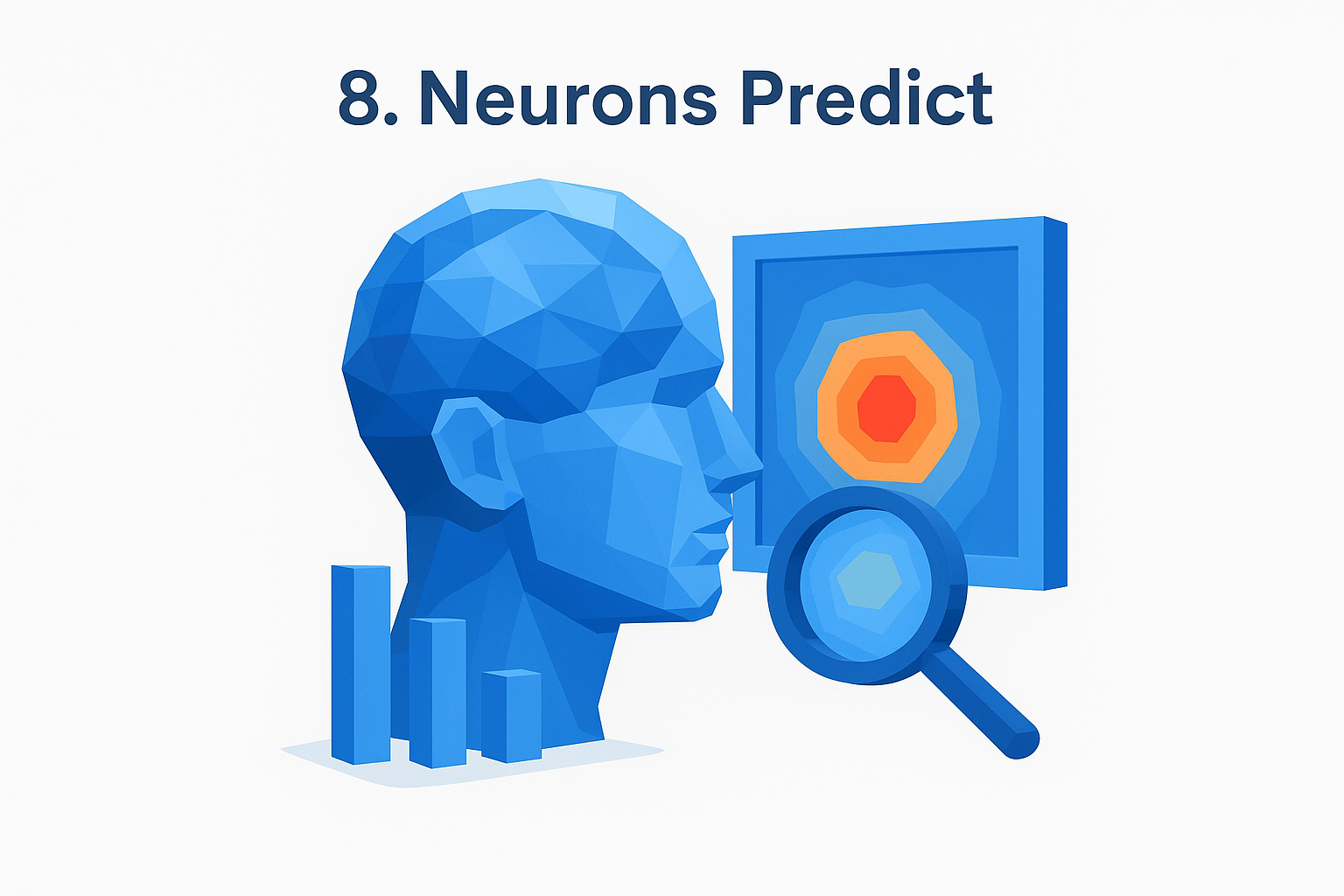
Neurons Predict analyzes your ad creatives using AI trained on neuroscience data collected from eye-tracking studies and consumer attention research. Upload your static image or video ad, and the platform generates a heatmap and attention score that shows you exactly where viewers are likely to look and whether your key message elements will register.
This pre-launch prediction layer makes Neurons Predict one of the few tools that can reduce wasted spend on creatives that look good internally but fail to capture real audience attention.
Best for
This tool works best for brand marketers and creative directors who need objective data on visual attention and cognitive response before committing to a media buy. It fits teams that want to validate creative decisions without running live experiments that require budget and wait time.
Key features to look at
- Attention heatmaps that show predicted viewer focus areas
- Cognitive demand scoring to flag creatives that overload the viewer
- Clarity scoring for headline and CTA visibility
Limits to know
Neurons Predict measures predicted attention, not actual conversion performance. It does not connect to ad platforms or track clicks, spend, or revenue in any way.
Pricing
Neurons Predict offers plans starting at $59 per month, with higher tiers unlocking additional monthly creative analyses and team collaboration features.
9. Zappi
Zappi is a consumer intelligence platform that tests your ad creatives with real audiences before you go live. Rather than relying on in-platform metrics after launch, it gives you predictive performance data from actual human respondents so you can make informed creative decisions earlier in the process.
What it does
Zappi runs your ad concepts through survey-based consumer panels that measure emotional response, memorability, and brand linkage. You upload your creative, select your target demographic, and the platform returns structured feedback and scoring that tells you how the concept is likely to perform with your actual audience before a dollar goes to media spend.
Best for
This tool fits brand marketers and insights teams at larger organizations who need to validate creative concepts against a specific consumer segment. It's particularly useful when you're testing multiple campaign directions and need a clear, data-backed way to narrow the field before committing budget.
Zappi's approach works well alongside other ad testing tools that measure live performance, since it covers the pre-launch validation step those platforms skip entirely.
Key features to look at
- Emotional resonance scoring from real consumer panels
- Brand recognition testing to measure how well your ad drives recall and association
- Normative benchmarks that compare your creative against category averages
Limits to know
Zappi does not connect to ad platforms or track live campaign performance. Turnaround time for results also depends on panel availability, which can slow fast-moving teams down.
Pricing
Zappi uses custom enterprise pricing, so you'll need to contact their sales team directly for a quote based on your testing volume and research needs.
10. Attest
Attest is a consumer research platform that lets you test your ad concepts with real people before you commit budget to a media buy. Like Zappi, it sits at the pre-launch end of the ad testing tools spectrum, giving you direct feedback from your target audience on creative direction, messaging clarity, and brand fit.
What it does
Attest runs your ad concepts through survey-based research panels made up of verified consumers matched to your target demographic. You set the audience criteria, upload your creative or messaging concept, and the platform returns structured responses with scoring across dimensions like message recall, emotional response, and purchase intent.
This pre-spend validation step means you enter the live testing phase with creatives that already have a track record with real people, not just internal opinions.
Best for
Attest works best for brand and insights teams at mid-size to enterprise companies who need consumer validation before a major campaign launch. It fits teams running multiple creative directions and needing a structured way to choose between them before budget gets allocated.
Key features to look at
- Brand tracking surveys to monitor how creative campaigns shift perception over time
- Audience targeting across 58+ countries for region-specific creative validation
- Real-time results dashboard with filtered breakdowns by demographic segment
Limits to know
Attest does not integrate with ad platforms or track live campaign performance. It measures stated consumer response, not actual click or conversion behavior.
Pricing
Attest offers custom pricing based on your research volume and team size, so you need to contact their sales team for a quote.
Next steps
Each of the ad testing tools covered in this guide solves a different part of the same problem: figuring out which creatives drive results before you waste budget on the ones that don't. Your best move is to match the tool to your stage. If you're running live campaigns on Google or Meta, start with the native testing features built into those platforms. If you need predictive validation before spending, Neurons Predict or Zappi fill that gap. For creative analytics at scale, Motion or Marpipe give you the structured data your team needs.
Before any of those tools can do their job, though, you still need strong creative concepts to test in the first place. That's where AI Flow Chat fits into your workflow. You can use it to analyze competitor ads, extract winning patterns, and generate informed concepts before a single dollar goes to media spend. Try AI Flow Chat and build your next round of creatives from proven reference material instead of guesswork.
Continue Reading
Discover more insights and updates from our articles
Choose an AI model for scripts, marketing copy, coding, research, long documents, and quick everyday work using a practical quality, speed, and credit-cost framework.
Compare eight current Poppy AI alternatives for visual research, creator workflows, general AI work, grounded synthesis, automation, and reusable delivery.
A practical method for turning a scattered content process into a clear AI-assisted flowchart with source context, review checks, and a reusable output.