More Prompts:

Best prompts for Suno for mashups using Vocal integration skills

13 copy-ready Suno prompts focused on vocal integration for creative mashups. Each prompt is practical, specific, and includes a realistic example and recommended AI companions for arrangement, lyric smoothing, and vocal processing guidance.


Claude Opus 4
Claude Sonnet 4
Gemini 2.5 Flash
GPT-5
Gemini 2.5 Pro
You've spent hours trying to get Suno to create the perfect mashup, only to end up with vocals that sound like they're fighting the instrumental instead of dancing together. Every attempt feels like you're speaking a different language than the AI, leaving you frustrated with clunky transitions and vocals that just don't fit. What if there was a way to communicate exactly what you want, so Suno could deliver those seamless, professional-sounding mashups you hear in your head?
These 13 battle-tested Suno prompts transform your mashup struggles into studio-quality results by giving you the exact language and structure AI understands best. From tempo-synced vocal integration to smooth genre transitions and professional radio edits, each prompt includes specific technical details, realistic examples, and recommended AI companions for arrangement and processing. Instead of hoping Suno guesses what you want, you'll have the precise instructions that turn your creative vision into polished, seamless vocal mashups every single time.
1
Tempo-and-key aligned vocal stem mashup
Create a 2:10 mashup using lead_vocal_A.wav (original key F# minor, 90 BPM) laid over instrumental_B.wav (original key D minor, 120 BPM). Time-stretch instrumental_B to 105 BPM and transpose it +2 semitones to F# minor. Keep vocal_A untouched in timbre, add a 2-bar reverse reverb pre-chorus, sidechain synth pad to kick at -6 dB, and perform a 2-bar crossfade between verse and chorus. Deliver stems: mixed_master, vocal_lead_aligned, instrumental_time_stretched.
Combine one vocal stem with another instrumental by aligning BPM and key, detail transposition and time-stretching, specify sections and transition points.
2
Two-vocal duet mashup with harmonic doubling
Produce a 2:30 mashup arranging vocal_A_lead.wav (key C major, 100 BPM) and vocal_B_harmony.wav (key A minor, 98 BPM) into a duet. Time-align both to 100 BPM, shift vocal_B up +3 semitones to C major for a major third harmony, pan lead to 10% left and harmony to 10% right, add subtle slapback delay (80 ms) on the harmony and a bright plate reverb on the lead. Structure: intro (8 bars), verse_A (16 bars with lead only), verse_B joined (16 bars), chorus (32 bars duet). Export stems and an arrangement cue file.
Merge two vocal stems as a duet; specify harmony intervals, vocal panning, and processing to make parts blend without clashing.
3
Vocal chop-based EDM mashup
Generate a 2:00 EDM mashup using acapella_loop.wav to create vocal chops. Slice 1/8 and 1/16 notes from the vocal, map chops to a 12-note pad for melodic motion, quantize to 1/16 triplets at 128 BPM, add formant-preserving pitch shifts of -5 and +7 semitones on alternate sections, apply heavy LFO tremolo to the chopped lead, and place a four-bar vocal-snap filter sweep into each drop. Provide stems: chopped_vocals, beat, FX.
Create a high-energy EDM mashup using short vocal chops as rhythmic instruments; define chop length, quantization grid, and effects.
4
Genre-bridge mashup: acoustic to trap vocal integration
Create a 2:40 mashup that starts with an intimate acoustic vocal (vocal_acoustic.wav, 78 BPM, key G major) for 32 bars, then transitions into a trap section (trap_beat.wav, 140 BPM). Time-ramp the tempo from 78 to 140 over 8 bars, add a soft doubled vocal harmony on the last 4 bars before tempo ramp, use a transient-preserving compressor during the ramp, and introduce 808 subs only after the ramp completes. Apply light tape saturation on acoustic part and heavy low-cut on trap drums until 4 bars into the new section.
Blend acoustic vocal performance into a trap beat; specify dynamics, vocal doubling, and beat-swap timing for a natural genre transition.
5
Language-blend vocal mashup with phonetic smoothing
Build a 3:00 mashup that combines vocal_EN.wav (English, 96 BPM) with vocal_ES.wav (Spanish, 96 BPM). Keep both at 96 BPM and harmonically blend by creating a clean double of each chorus line in the other's language using pitch-preserving formant adjustments. Smooth phoneme boundaries with 20–40 ms crossfades and apply a gentle de-essing at 4–6 kHz. Arrange: verse_EN, prechorus_ES, chorus blended (EN lead, ES doubles), outro bilingual ad lib.
Merge vocals in two languages; instruct for phonetic smoothing to make transitions between languages feel cohesive and musical.
6
Medley-style multi-track mashup with smooth key shifts
Produce a 4:00 medley mashup from stem1_vocal.wav (A minor, 100 BPM), stem2_vocal.wav (C major, 105 BPM), and stem3_vocal.wav (E minor, 98 BPM). Map sections: 0:00–1:10 = stem1 (verse+pre), 1:10–2:30 = stem2 (bridge+chorus), 2:30–4:00 = stem3 (final chorus/ending). For transitions: modulate from A minor to C major by raising by +3 semitones over a 4-bar pivot with an orchestral swell, then shift from C major to E minor via a 2-bar chromatic descending bass. Pitch-shift vocals with formant correction +2 to +3 semitones only during transitions; keep lead vocal timbre natural.
Create a medley of three songs; specify smooth key transitions, bar lengths for each section, and how to modulate vocals between keys.
7
Acapella hook over a new instrumental
Design a 1:50 mashup that places acapella_hook.wav (hook in B flat major, 110 BPM) over a new indie-electronic instrumental. Use a relaxed 110 BPM groove with brushed drums, a warm Rhodes pad, plucked muted guitar for stabs, and a sub bass supporting root notes. Carve EQ holes at 300–800 Hz and 2–4 kHz to leave space for vocals, add a 2 dB midrange boost at 1.2 kHz under the hook, and include a 4-bar breakdown after the first chorus with only vocal and ambient textures.
Take an acapella hook and create an original instrumental backing; specify groove, instrumentation, and space for the vocal.
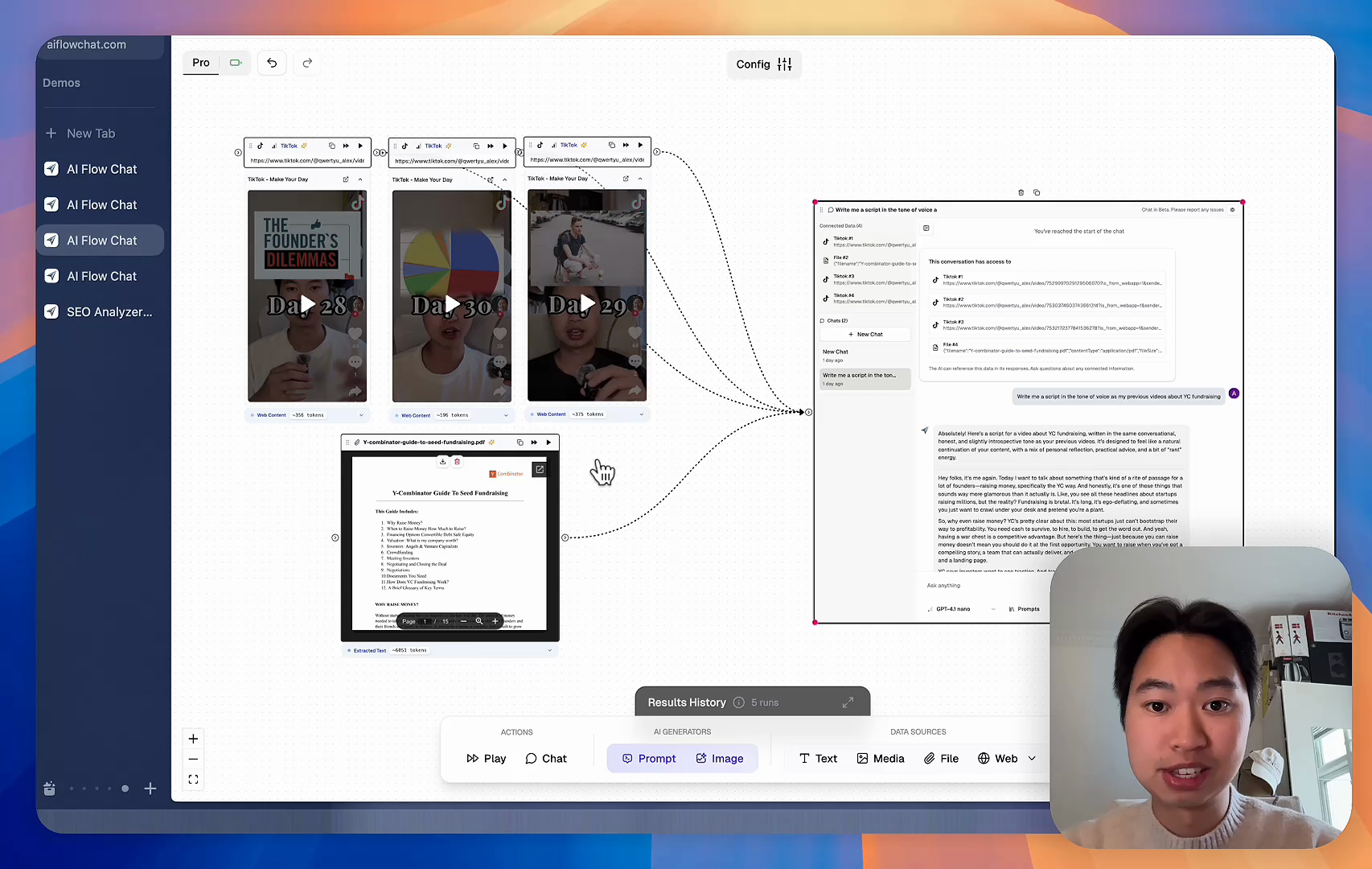
AI Flow Chat

Stop Losing Your AI Work

Tired of rewriting the same prompts, juggling ChatGPT and Claude in multiple tabs, and watching your best AI conversations disappear forever?

AI Flow Chat lets you save winning prompts to a reusable library, test all models in one workspace, and convert great chats into automated workflows that scale.
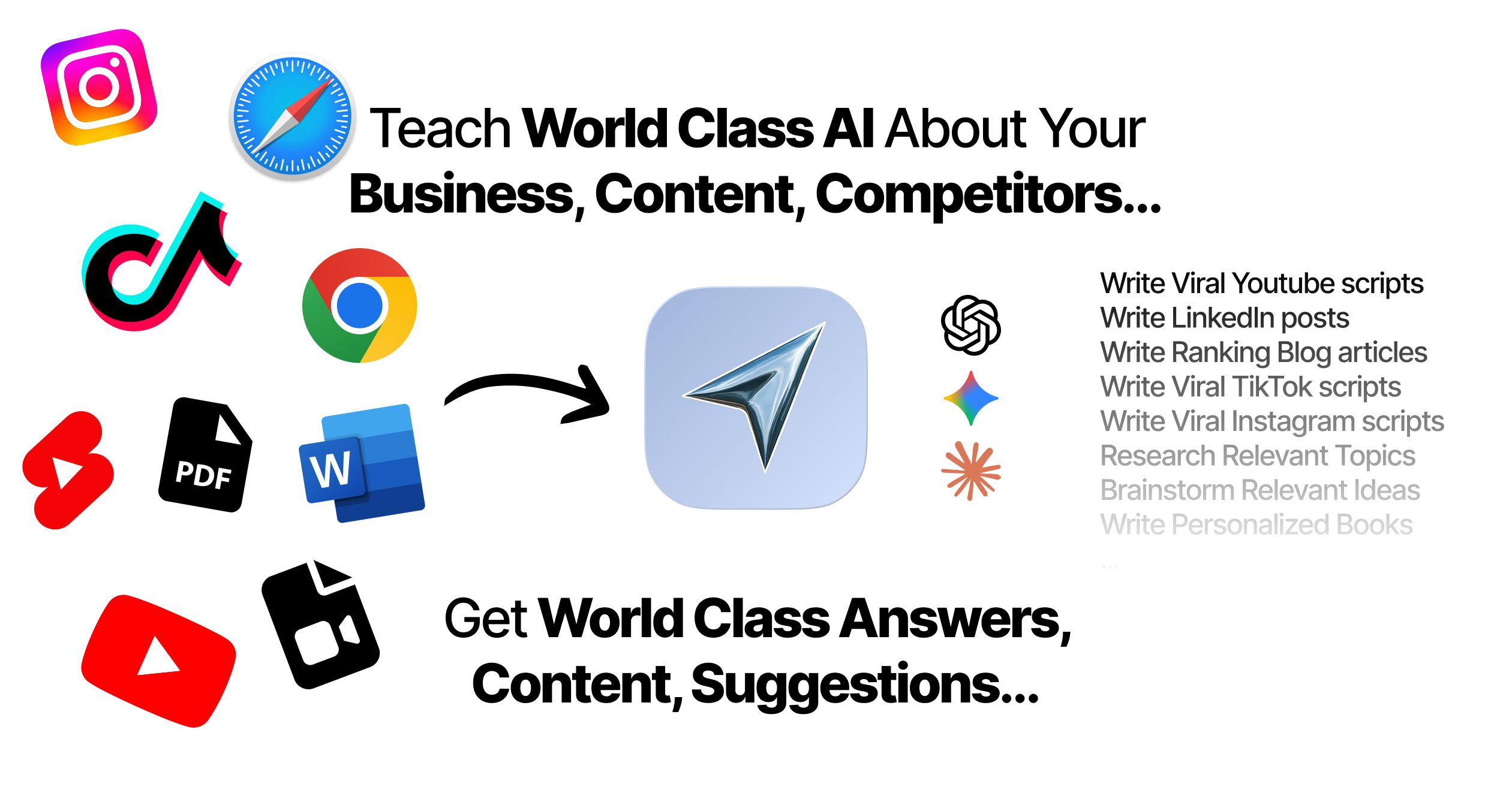

Teach World Class AI About Your Business, Content, Competitors… Get World Class Answers, Content, Suggestions...
AI Flow Chat powers our entire content strategy. We double down on what’s working, extract viral elements, and create stuff fast.
Video thumbnail

Reference Anything

Bring anything into context of AI and build content in seconds

YouTube

PDF

DOCX

TikTok

Web

Reels

Video Files

Twitter Videos

Facebook/Meta Ads

Tweets

Coming Soon

Audio Files

Coming Soon

Choose a plan to match your needs

Upgrade or cancel subscriptions anytime. All prices are in USD.

Basic

For normal daily use. Ideal for getting into AI automation and ideation.

$30/month
  • See what Basic gets you
  • 11,000 credits per month
  • Access to all AI models
  • 5 app schedules
  • Free optional onboarding call
  • 1,000 extra credits for $6
Get Started

No risk, cancel anytime.

ProRecommended

For power users with high-volume needs.

$100/month
  • See what Pro gets you
  • 33,000 credits per month
  • Access to all AI models
  • 10 app schedules
  • Remove AI Flow Chat branding from embedded apps
  • Free optional onboarding call
  • 2,000 extra credits for $6
Get Started

No risk, cancel anytime.

Frequently Asked Questions

Everything you need to know about AI Flow Chat. Still have questions? Contact us.