More Prompts:

Best prompts for Suno for mashups using AI-generated mashup techniques

13 practical, copy-ready Suno prompts for creating audio mashups. Each prompt includes a concise title, a short explanation, a realistic example you can paste and run, and recommended companion AIs for planning, arrangement, or lyric tweaks.


GPT-5
Claude Opus 4
Claude Sonnet 4
Gemini 2.5 Flash
Gemini 2.5 Pro
You've probably spent hours trying to get Suno to create the perfect mashup, only to end up with clashing keys, mismatched tempos, or vocals that sound like they're fighting each other. The frustration builds as you type vague prompts like "mix these two songs" and get results that sound more like audio chaos than creative fusion. What if you could skip the trial and error and get professional-quality mashups on your first try?
These 13 copy-ready Suno prompts transform your mashup game from guesswork to precision craftsmanship. From vocal-only combinations with automatic key matching to cross-cultural fusions that respect traditional elements, each prompt includes specific technical instructions that deliver consistent results. Instead of wasting time on prompts that don't work, you'll have a complete toolkit that handles everything from seamless BPM transitions to AI-generated bridges that perfectly glue incompatible tracks together.
1
Vocal-Only Two-Song Mashup (Key & BPM Match)
Create a 2:30 vocal-only mashup using the acapella of Song A (female lead, 100 BPM, key C major) and Song B (male lead, 118 BPM, key A minor). Auto-detect and match BPM and key; transpose Song B up to C major and time-stretch to 100 BPM. Structure: intro (8s solo A), verse overlap (30s: A verse + pitched B harmony), chorus blend (45s: A chorus on top, B doubles an octave lower), bridge (20s: alternating lines), outro (7s fade). Add a light pad under choruses and a -3 dB vocal reverb send. Output as stereo stem and a final mixed master.
Combine the acapellas of two songs, automatically matching key and BPM, with a seamless vocal crossfade and simple harmonic backing.
2
Instrumental Genre-Blend Mashup (EDM + Orchestral)
Produce a 3:00 instrumental mashup combining an EDM instrumental (128 BPM, four-on-the-floor) with an orchestral theme (sweeping strings, brass stabs). Keep EDM drums and bass as foundation. Layer legato strings for the verse and lush full orchestra for drops. Build: intro (16 bars ambient + strings), verse (32 bars: EDM groove + strings), pre-drop (8 bars with brass stabs), drop (16 bars full EDM + orchestral hits), breakdown (24s strings lead), final drop with a countermelody. Sidechain orchestra to kick; EQ low mids at -2 dB on strings to avoid masking bass. Provide stems: drums, bass, orchestra, synths, and final mix.
Fuse the groove and drop of an EDM instrumental with an orchestral arrangement; preserve EDM energy while adding dynamic strings and brass accents.
3
Key-Shifted Harmonic Overlay (Melody + Harmony Swap)
Create a 2:00 mashup where Track X's lead melody (key G major) becomes a three-part harmony under Track Y's chorus (key B major). Analyze and transpose Track X melody up to B major; arrange as SAT (soprano/alto/tenor) voices with light choir timbre. Keep Track Y chorus instrumentation intact but reduce chorus guitar by -4 dB to make space. Add a slow 6 dB stereo widen on the harmony section only. Output separated harmony stems and final mixed master.
Take the lead melody of one track and place it as the harmony under another track's chorus, using automatic harmonic analysis and tasteful voicing.
4
Tempo Morph Mashup (Gradual BPM Transition)
Generate a 3:30 mashup that starts with Song 1 at 85 BPM and transitions to Song 2 at 140 BPM over a 24-second morph. Use a tempo ramp from 85 -> 110 in first half of morph and 110 -> 140 in second half. During morph, apply rhythmic gating and reverb tails to smooth transients; keep beats quantized to the current tempo. Structure: full Song 1 (0:00-1:15), tempo morph (1:15-1:39), full Song 2 (1:39-3:30). Provide both mixed master and tempo-separated stems for each section.
Blend two songs with different tempos using a gradual BPM morph in the transition region to avoid audible artifacts.
5
Cross-Cultural Fusion Mashup
Create a 2:50 mashup melding a Western pop song (120 BPM, 4/4) with a traditional sitar + tabla recording (Bhairav mode, flexible tempo). Quantize the sitar performance to 120 BPM subtly while preserving microtonal ornamentation; map tabla hits to the pop groove with retained swing. Arrange verses with pop vocal over sitar drone and tabla pocket; chorus adds full pop instrumentation. Keep sitar microtonal bends audibly intact and pan tabla slightly left for space. Provide separate stems and a mastered export.
Fuse a Western pop track with a traditional instrumental from another culture; respect original rhythmic and modal characteristics.
6
Vocal Chop + Beat Flip Mashup
Produce a 1:20 high-energy mashup that uses a 2-bar vocal phrase from Source Vocal A. Chop it into 8 slices, create rhythmic patterns (A: 16th-8th-8th-16th), pitch-shift every alternate slice by +3 semitones, add formant preservation, and place over a flipped trap beat at 150 BPM. Add saturated 808 at -6 dB and transient shaper on chops. End with a 6-second reversed vocal tail. Provide chop stems and final loop-ready master.
Create a short, high-energy mashup that chops a vocal phrase into rhythmic stabs and recontextualizes it over a flipped beat.
7
Medley Builder with Seamless Segues
Construct a 4:00 medley from three songs: Song A (Intro, 100 BPM, key D minor), Song B (Main, 125 BPM, key F major), Song C (Outro, 90 BPM, key D minor). Arrange: 0:00-1:20 Song A trimmed to verse+prechorus, 1:20-2:50 Song B full chorus with tempo ramp 100->125 over 12s at transition, 2:50-4:00 Song C slowed to 100 BPM and key-matched to D minor, with crossfades of 6-10 seconds. Apply harmonic EQ and ducking to avoid clashes, produce stem exports for each segment and final continuous master suitable for DJ sets.
Automate creation of a medley from multiple songs with key-safe crossfades and tempo matching for live-set style transitions.
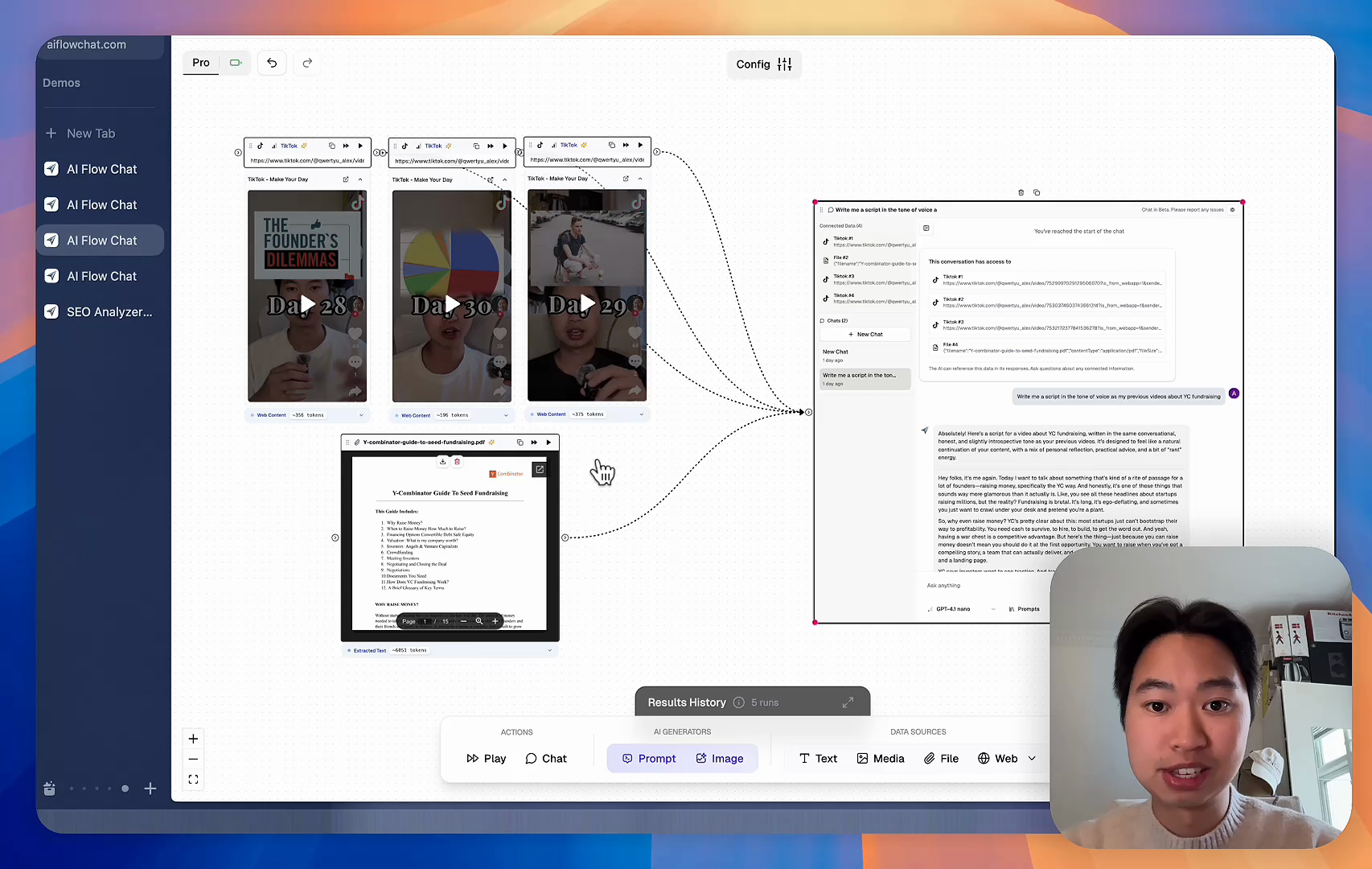
AI Flow Chat

Stop Losing Your AI Work

Tired of rewriting the same prompts, juggling ChatGPT and Claude in multiple tabs, and watching your best AI conversations disappear forever?

AI Flow Chat lets you save winning prompts to a reusable library, test all models in one workspace, and convert great chats into automated workflows that scale.
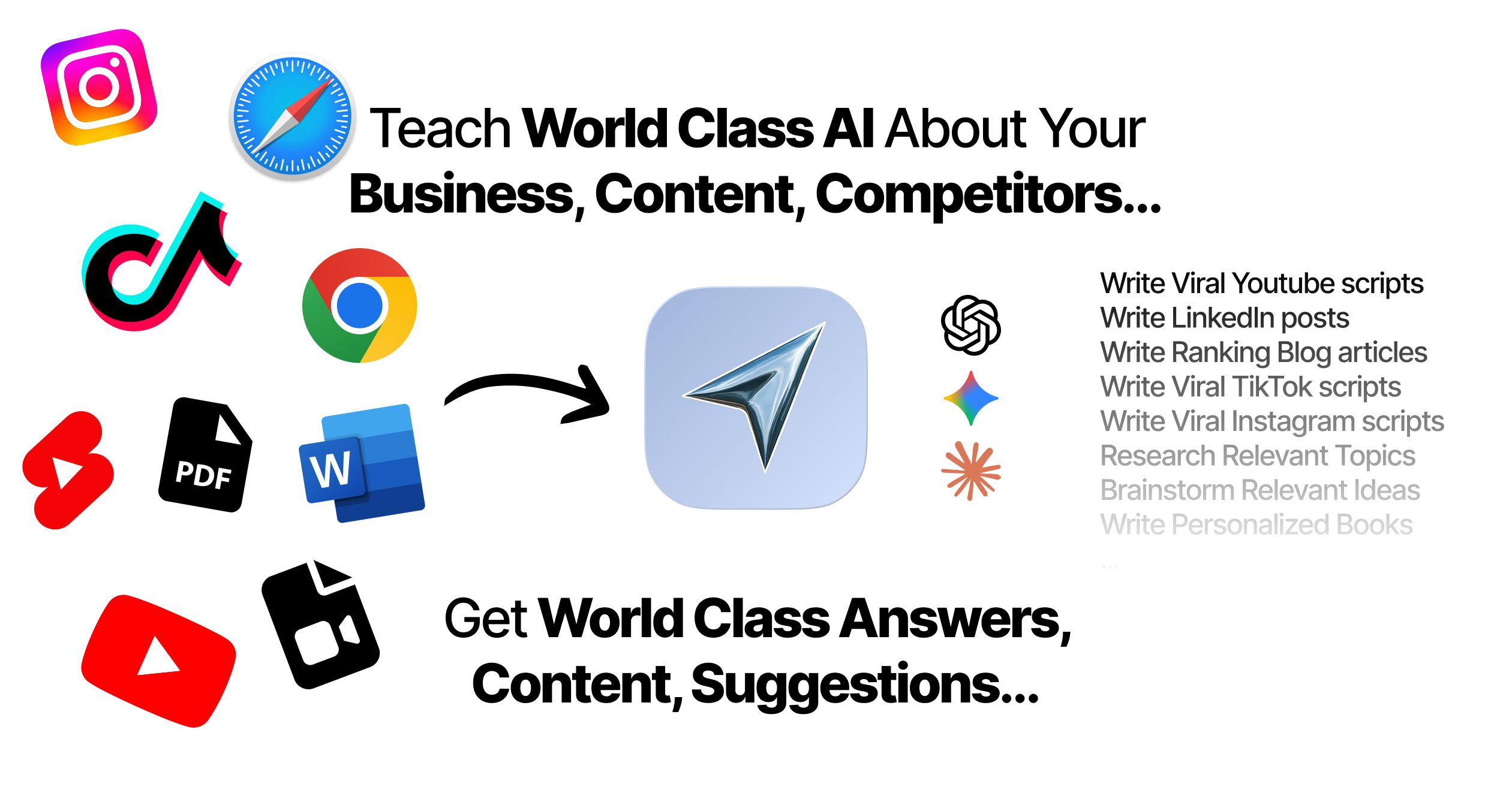

Teach World Class AI About Your Business, Content, Competitors… Get World Class Answers, Content, Suggestions...
AI Flow Chat powers our entire content strategy. We double down on what’s working, extract viral elements, and create stuff fast.
Video thumbnail

Reference Anything

Bring anything into context of AI and build content in seconds

YouTube

PDF

DOCX

TikTok

Web

Reels

Video Files

Twitter Videos

Facebook/Meta Ads

Tweets

Coming Soon

Audio Files

Coming Soon

Choose a plan to match your needs

Upgrade or cancel subscriptions anytime. All prices are in USD.

Basic

For normal daily use. Ideal for getting into AI automation and ideation.

$30/month
  • See what Basic gets you
  • 11,000 credits per month
  • Access to all AI models
  • 5 app schedules
  • Free optional onboarding call
  • 1,000 extra credits for $6
Get Started

No risk, cancel anytime.

ProRecommended

For power users with high-volume needs.

$100/month
  • See what Pro gets you
  • 33,000 credits per month
  • Access to all AI models
  • 10 app schedules
  • Remove AI Flow Chat branding from embedded apps
  • Free optional onboarding call
  • 2,000 extra credits for $6
Get Started

No risk, cancel anytime.

Frequently Asked Questions

Everything you need to know about AI Flow Chat. Still have questions? Contact us.