More Prompts:

Best prompts for ChatGPT using few-shot example templates

Thirteen copy-ready few-shot prompt templates for practical tasks (editing, code, extraction, translation, SQL, summarization, support, lesson plans, etc.). Each prompt includes concise instructions, 2–3 examples, a ready-to-use placeholder, and a realistic example. Use by replacing placeholders in <> with your content.


GPT-5
Claude Sonnet 4
Claude Opus 4
Gemini 2.5 Flash
Gemini 2.5 Pro
You've probably stared at a blank ChatGPT prompt box, knowing exactly what you want but having no idea how to ask for it. Maybe you've typed "write me an email" only to get something that sounds like a robot wrote it, or asked for code help and received a wall of text that somehow missed the point entirely. We've all been there, wrestling with AI that feels more like a stubborn genie than a helpful assistant.
This collection of 13 copy-ready few-shot prompt templates transforms your ChatGPT interactions from frustrating guesswork into precise, professional results. Whether you need to rewrite emails, debug Python code, extract data from receipts, create lesson plans, or handle any of the other practical tasks we tackle daily, these prompts give you the exact structure and examples ChatGPT needs to deliver exactly what you're looking for. Instead of spending 20 minutes refining vague prompts and getting mediocre outputs, you'll get professional-quality results on the first try by simply dropping your content into the ready-made templates.
1
Professional, concise email rewrite (few-shot)
Task: Rewrite the following email into a concise, professional message. Keep important details, remove filler, and provide an optional subject line. Example 1 Input: "hey team, sorry for the late reply — ive been swamped. can we push the meeting to next week? i have conflicts on wed and thursday but any other day is fine. also need the slide deck updated with the new figures if possible. thanks" Output: Subject: Request to Reschedule Meeting Hi team, Apologies for the late reply. Could we reschedule the meeting for next week? I’m unavailable Wednesday and Thursday but available any other day. Please also update the slide deck with the new figures. Thanks, <Name> Example 2 Input: "the report i sent had some mistakes—i forgot to include q4 numbers. i attached an updated file. please use that version for review. sorry for the confusion." Output: Subject: Updated Report with Q4 Numbers Hi, I sent an earlier report that omitted Q4 numbers. I’ve attached the corrected file—please use it for your review. Apologies for the confusion. Best, <Name> Template Input: "<paste original email here>" Output: Subject: <optional short subject> <professional, concise rewrite preserving key facts> Now rewrite the following email:
Rewrite informal/long emails into short, professional, polite messages. Preserve meaning and key facts; keep subject line optional.
2
Fix and explain a small Python bug (few-shot)
Task: Given a short Python function with a bug, return: 1) Corrected code only (delimited by triple backticks), 2) One-paragraph explanation of the bug and fix, 3) A simple assert-based test showing expected behavior. Example 1 Input: def add_items(lst, item): for i in item: lst.append(i) return lst Output: ```python def add_items(lst, item): if isinstance(item, (list, tuple, set)): for i in item: lst.append(i) else: lst.append(item) return lst ``` Explanation: The original code iterated over 'item' assuming it was iterable; if 'item' is a scalar (e.g., int or str) this misbehaves. The fix handles both iterables and single values. Test: assert add_items([1,2], 3) == [1,2,3] assert add_items([1], [2,3]) == [1,2,3] Example 2 Input: def mean(values): return sum(values) / len(values) Output: ```python def mean(values): values = list(values) if len(values) == 0: raise ValueError('mean() arg is an empty sequence') return sum(values) / len(values) ``` Explanation: The original fails on empty lists or non-reusable iterators. The fix converts to list and raises a clear error for empty input. Test: try: mean([]) except ValueError: pass Template Input: <insert buggy python function here> Now fix:
Provide a corrected version of a short Python function, a one-paragraph explanation of the bug, and a brief test demonstrating the fix.
3
Extract structured JSON from receipt text (few-shot)
Task: Parse the provided receipt text and output a JSON object with these fields: date (YYYY-MM-DD), vendor, currency, items (array of {name, qty, unit_price, total}), subtotal, tax, total. If a field is missing, set null. Example 1 Input: "Starbucks 07/14/2024 1x Latte $4.50 2x Cookie $3.00 Subtotal $7.50 Tax $0.68 Total $8.18" Output: { "date": "2024-07-14", "vendor": "Starbucks", "currency": "USD", "items": [ {"name":"Latte","qty":1,"unit_price":4.50,"total":4.50}, {"name":"Cookie","qty":2,"unit_price":1.50,"total":3.00} ], "subtotal": 7.50, "tax": 0.68, "total": 8.18 } Example 2 Input: "IKEA 2024-05-02 Receipt #12345 Chair x2 49.99each 99.98 VAT 19% Total 118.98" Output: { "date": "2024-05-02", "vendor": "IKEA", "currency": "USD", "items": [{"name":"Chair","qty":2,"unit_price":49.99,"total":99.98}], "subtotal": 99.98, "tax": 19.00, "total": 118.98 } Template Input: "<paste receipt text>" Now parse:
Convert noisy receipt text into normalized JSON fields: date, vendor, items (name, qty, unit_price, total), subtotal, tax, total, and currency.
4
Translate with tone and locale (few-shot)
Task: Translate the Input sentence to <language> using the <tone> tone and <locale>. Keep meaning identical and adapt idioms. Example 1 Input: "Can you send the report by Friday?" Language: Spanish Tone: Formal Locale: es-ES Output: "¿Podría enviar el informe antes del viernes, por favor?" Example 2 Input: "Hey, are we still on for tomorrow?" Language: Spanish Tone: Informal Locale: es-MX Output: "¿Todavía nos vemos mañana?" Template Input: Text: "<paste text>" Language: <language> Tone: <formal|informal> Locale: <locale code> Now translate:
Translate text to a target language, applying a specified tone (formal/informal) and locale variations (es-ES vs es-MX). Provide 2–3 examples then translate the user text.
5
Generate SQL from plain requirements (few-shot)
Task: Translate the requirement into SQL. If creating tables, include types, primary keys, indexes, and NOT NULL where appropriate. If selecting, return the query and a short comment explaining joins/filters. Example 1 Input: "Create a users table with id, email, name, signup_date, and is_active" Output: -- Assumptions: emails unique; id is serial primary key CREATE TABLE users ( id SERIAL PRIMARY KEY, email VARCHAR(255) NOT NULL UNIQUE, name VARCHAR(255) NOT NULL, signup_date DATE NOT NULL, is_active BOOLEAN NOT NULL DEFAULT TRUE ); Example 2 Input: "Find customers who purchased product_id 42 in last 30 days with total spent per customer" Output: -- Assumptions: tables orders(id, customer_id, order_date), order_items(order_id, product_id, price, qty) SELECT c.id AS customer_id, c.name, SUM(oi.price * oi.qty) AS total_spent FROM customers c JOIN orders o ON o.customer_id = c.id JOIN order_items oi ON oi.order_id = o.id WHERE oi.product_id = 42 AND o.order_date >= CURRENT_DATE - INTERVAL '30 days' GROUP BY c.id, c.name; Template Input: "<plain-English requirement>" Generate SQL:
Produce secure, correct SQL (DDL or SELECT) based on plain-English requirements. Include assumptions and sample output. Use examples as few-shot guidance.
6
Meeting transcript -> action items & decisions (few-shot)
Task: Read the transcript and output JSON with two arrays: actions [{owner, action, due}] and decisions [string]. Keep actions specific and assignable. Example 1 Input: "Anna: We should update the onboarding doc. Mike: I'll handle the first draft by next Tuesday. Sarah: Let's remove the deprecated steps." Output: { "actions": [ {"owner":"Mike","action":"Draft updated onboarding document","due":"next Tuesday"}, {"owner":"Sarah","action":"Identify deprecated steps to remove","due":null} ], "decisions": ["Update onboarding document to remove deprecated steps"] } Example 2 Input: "PM: Q3 campaign goes live Sept 1. Designer: I'll provide assets by Aug 20. Ops: Need budget sign-off by Aug 5." Output: { "actions": [ {"owner":"Designer","action":"Provide campaign assets","due":"2025-08-20"}, {"owner":"Ops","action":"Obtain budget sign-off","due":"2025-08-05"} ], "decisions": ["Q3 campaign launch date set to 2025-09-01"] } Template Input: "<paste transcript>" Now extract:
From a short meeting transcript, produce two lists: Action Items (owner, action, due date) and Decisions (concise phrase). Include 2–3 examples then process input.
7
Product listing: title, bullets, keywords (few-shot)
Task: Create a short product title (<=80 chars), three concise benefit bullets (max 140 chars each), and 10 relevant search keywords. Focus on benefits and customer intent. Example 1 Input: "Wireless noise-cancelling headphones, 30h battery, Bluetooth 5.2, foldable" Output: Title: "Wireless Noise-Cancelling Headphones — 30H Battery, Foldable" Bullets: - Active noise cancellation for immersive listening - 30-hour battery with fast-charge for all-day use - Foldable, lightweight design for travel comfort Keywords: "noise cancelling headphones, wireless headphones, 30h battery, Bluetooth 5.2, foldable headphones, travel headphones, ANC, long battery, comfortable, gift" Example 2 Input: "Ceramic nonstick frying pan, 10-inch, oven-safe to 450F, dishwasher-safe" Output: Title: "10" Ceramic Nonstick Frying Pan — Oven & Dishwasher Safe" Bullets: - Durable ceramic coating for easy, oil-free cooking - Oven-safe to 450°F for versatile recipes - Dishwasher-safe for quick cleanup Keywords: "ceramic pan, nonstick skillet, 10 inch frying pan, oven safe pan, dishwasher safe cookware, healthy cooking, no-stick, kitchen gift, durable pan, easy clean" Template Input: "<list main product features separated by commas>" Now produce title, bullets, keywords:
Given product features, produce: marketplace title (<=80 chars), 3 benefit-focused bullet points, and 10 search keywords. Use examples as pattern.
AI Flow Chat

Stop Losing Your AI Work

Tired of rewriting the same prompts, juggling ChatGPT and Claude in multiple tabs, and watching your best AI conversations disappear forever?

AI Flow Chat lets you save winning prompts to a reusable library, test all models in one workspace, and convert great chats into automated workflows that scale.
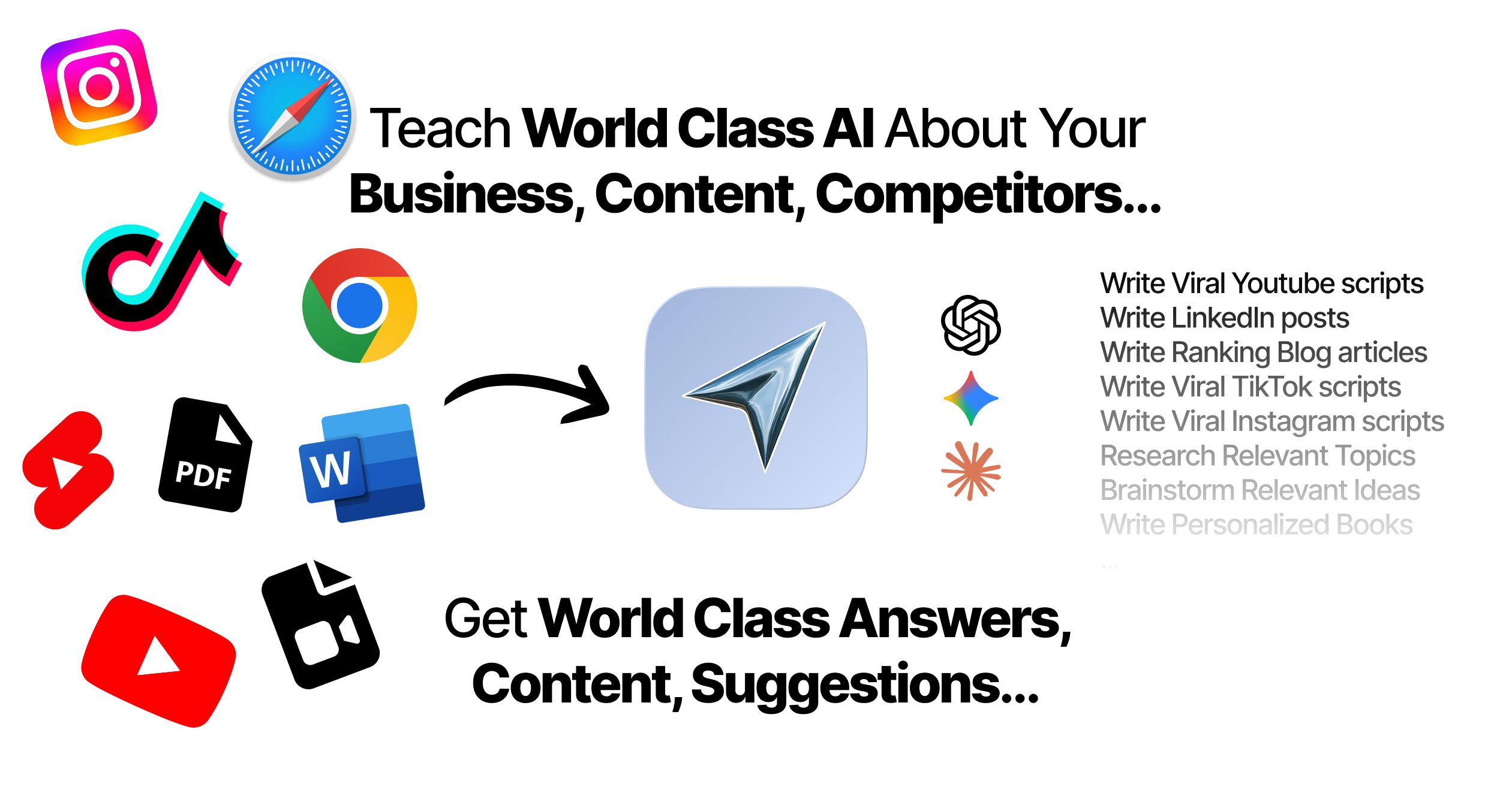

Teach World Class AI About Your Business, Content, Competitors… Get World Class Answers, Content, Suggestions...
AI Flow Chat powers our entire content strategy. We double down on what’s working, extract viral elements, and create stuff fast.
Video thumbnail

Reference Anything

Bring anything into context of AI and build content in seconds

YouTube

PDF

DOCX

TikTok

Web

Reels

Video Files

Twitter Videos

Facebook/Meta Ads

Tweets

Coming Soon

Audio Files

Coming Soon

Choose a plan to match your needs

Upgrade or cancel subscriptions anytime. All prices are in USD.

Basic

For normal daily use. Ideal for getting into AI automation and ideation.

$30/month
  • See what Basic gets you
  • 11,000 credits per month
  • Access to all AI models
  • 5 app schedules
  • Free optional onboarding call
  • 1,000 extra credits for $6
Get Started

No risk, cancel anytime.

ProRecommended

For power users with high-volume needs.

$100/month
  • See what Pro gets you
  • 33,000 credits per month
  • Access to all AI models
  • 10 app schedules
  • Remove AI Flow Chat branding from embedded apps
  • Free optional onboarding call
  • 2,000 extra credits for $6
Get Started

No risk, cancel anytime.

Frequently Asked Questions

Everything you need to know about AI Flow Chat. Still have questions? Contact us.