Google Opal Alternative: Opal vs. AI Flow Chat for Visual AI Workflows
At AI Flow Chat
Topics covered:
Contents
0%Google Opal is a visual, no-code builder for hosted AI mini-apps. It can turn a natural-language description into a multi-step app, and it also lets you edit the steps directly. If you are looking for a Google Opal alternative because your work starts with several source materials and ends in a repeatable content or research process, AI Flow Chat is worth evaluating as a visual workflow workspace.
That does not make either tool the universal winner. Opal is the clearer fit when the deliverable is a small hosted app that other people can run. AI Flow Chat is the more relevant candidate when a creator or small agency wants to arrange source material and connected AI steps on a canvas. The useful comparison is therefore not “Which product has more features?” but “Which product matches the workflow I need to repeat?”
What Google Opal is today
Google describes Opal as a way to build, edit, and share AI mini-apps using natural language. Its current product documentation says Opal chains prompts, model calls, and tools into multi-step flows and hosts the resulting app without requiring the builder to manage a web server.
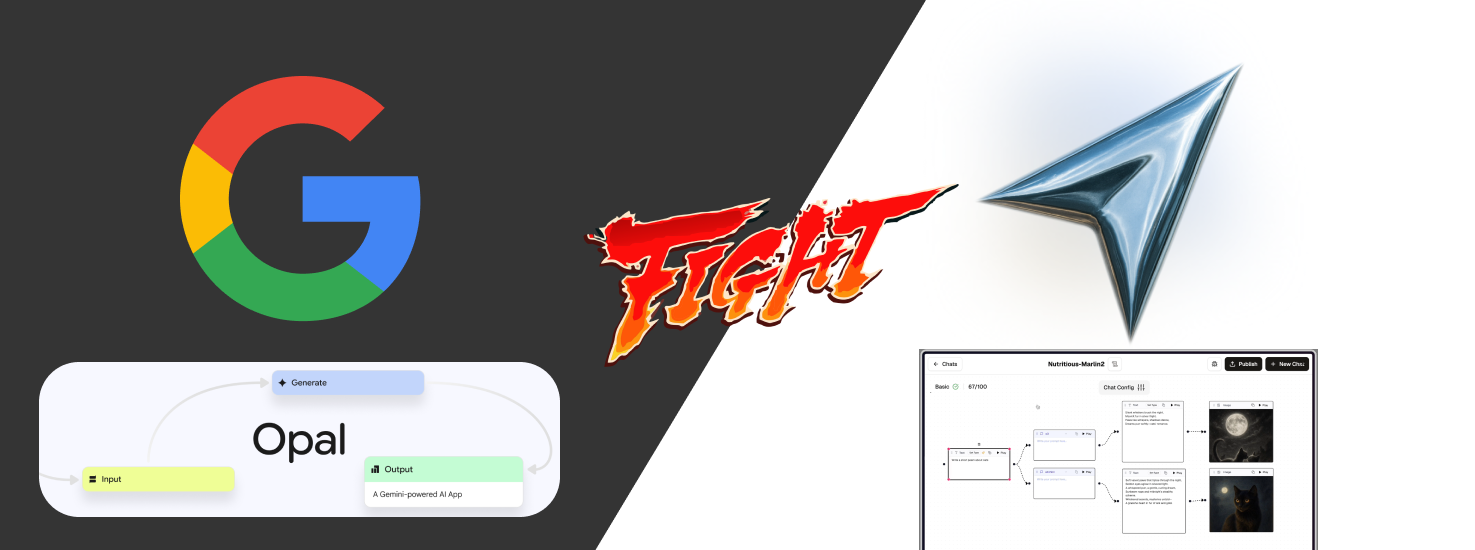
There are two ways to edit an Opal. You can describe changes in natural language, or work directly in its visual editor. The visual editor connects three core step types: user input, generation, and output. According to Google’s Opal overview, generation steps can reference earlier steps, built-in tools, and uploaded assets. Output can be presented as a generated webpage or exported to a Google Drive spreadsheet.
Opal has developed beyond the original US-only launch described in Google’s July 2025 announcement. Google’s current Opal FAQ lists availability across many countries. Because that list and product access can change, check the FAQ from your location instead of relying on an old “US-only” comparison.
Google also documents an Agent option for open-ended work that can use memory and external skills. The Agent Mode guide currently identifies Gemini 3 for reasoning, code execution, and Google Search or Maps grounding. That is more specific and more current than saying Opal is limited to a single generic model, but model availability remains a detail to verify inside the product when you test it.
Compare the tools around the job
The following comparison was checked against public product information on July 29, 2026. “Not stated” means the reviewed official pages did not provide enough evidence; it does not mean the feature is absent.
| Decision criterion | Google Opal | AI Flow Chat |
|---|---|---|
| Intended result | A hosted AI mini-app that collects input, runs AI steps, and presents an output | A visual AI workflow that connects source material, prompts, AI steps, and outputs |
| Building surface | Natural-language editor plus a visual step editor | Node-based visual canvas and AI whiteboard |
| Supported context | Text or image user input; uploaded reference files; YouTube links; built-in tools such as web search | Public product pages currently show videos, articles, images, PDFs, websites, and social content as reference material |
| AI steps | Generate steps can reference inputs, other steps, assets, and tools; Agent Mode is also documented | Connected prompt and AI nodes pass information through a visual flow; public pages currently name models from OpenAI, Anthropic, and Google |
| Reuse and review | Gallery apps can be remixed; the editor includes version history and an execution console | Workflows can be saved as reusable flowcharts and reviewed as connected nodes on the canvas |
| Sharing | Publish a link to an app or share access with selected people; Google warns that sharing may expose app details or prompts | Public product pages describe packaging workflows as shareable apps with public or private access |
| Availability | Public in the countries listed in Google’s current FAQ; desktop is recommended for editing | A public signup is available; the reviewed product pages do not publish a country-by-country access list |
| Setup | A builder can start from a gallery example, natural-language description, or blank visual flow | A builder creates an account, adds source or prompt nodes, connects the steps, and runs the flow |
| Published pricing | No standalone Opal price was stated on the official Opal pages reviewed | The AI Flow Chat homepage currently lists a seven-day Basic trial followed by paid credit-based plans |
The table deliberately avoids claims about scheduled runs, web scraping, reliability, production readiness, or long-term product support. Those claims were common in older comparisons but are not necessary to decide whether either tool fits a source-backed creator workflow.
A concrete workflow to build in both tools
Use the same small assignment in both products: turn three approved sources into a one-page content brief for a client newsletter. This is large enough to reveal how each tool handles context and handoffs, but small enough to rebuild without committing to a platform.
1. Prepare a controlled source pack
Choose one client brief and three current sources: for example, a product page, a research report, and a recorded interview. Write down the final deliverable, audience, required claims, and prohibited claims before opening either tool.
This step matters because no visual layout makes weak inputs trustworthy. Confirm that you have permission to use the material, and separate source facts from your own proposed angle.
2. Map four visible stages
Build the same sequence in each tool:
- Collect the brief and source material.
- Extract claims, evidence, audience language, and open questions.
- Draft a newsletter outline with each section tied to its supporting material.
- Review unsupported claims and produce the final brief.
In Opal, the natural mapping is user-input or asset steps followed by generate steps and an output step. Google’s visual-editor quickstart shows how to connect input, generation, and output nodes, reference earlier steps, and preview the resulting mini-app.
In AI Flow Chat, place the source materials on the AI whiteboard, connect them to the prompts that extract and organize the evidence, and then connect those outputs to the drafting and review steps. If you need more background on this structure, the guide to prompt chaining explains why smaller, inspectable handoffs are easier to revise than one large prompt.
3. Add a human review gate
Do not ask the final step to hide uncertainty. Require it to return three separate lists: supported claims, unsupported claims, and questions that need a person’s decision. Then compare each supported claim with the source pack before using the brief.
Google explicitly says in its FAQ that Opal can make mistakes and that builders should check prompts and test apps. The same caution is appropriate for any AI-generated research or content workflow, including AI Flow Chat. A connected graph makes the stages visible; it does not prove that an output is correct.
4. Reuse only after a clean test
Run a second topic through the same process without changing the structure. If the workflow still produces a useful, reviewable brief, save it for reuse. If the prompts require extensive repair, simplify the chain before adding more sources or AI steps.
This is where the product differences become practical. Opal can package the sequence as a mini-app with a controlled input and output experience. AI Flow Chat keeps the emphasis on the visual working canvas, where sources and intermediate steps remain part of the workflow you edit.
When Google Opal may be the better fit
Choose Opal for your trial when:
- The main deliverable is a mini-app that someone else should run through a simple interface.
- You want to describe the first version in natural language and then refine its input, generation, and output steps visually.
- Built-in Google-oriented tools, generated webpages, or Google Drive spreadsheet output match the process.
- Remixing a Google-provided gallery example is a useful starting point.
- The current country list and account access cover everyone who must build or use the app.
Opal is especially relevant for prototyping a guided utility, such as a content-brief intake app that asks a user for a topic and audience, runs several generation steps, and returns a formatted page.
When AI Flow Chat may be the better fit
Choose AI Flow Chat for your trial when:
- The work begins with multiple references that you want to arrange and inspect on a visual canvas.
- Creators or marketers need to see how source materials connect to prompts and outputs while developing the process.
- You want to try models from more than one provider within the workflow.
- The reusable asset is the source-backed workflow itself, not only the end-user app interface.
- Your next step is to extend the same research into a broader visual AI flowchart.
AI Flow Chat is most relevant to this comparison as a workspace for structuring AI-assisted content and research. That is narrower and more useful than claiming it replaces every function in Opal.
When neither tool is appropriate
Neither product should be the default when the task can be completed more clearly in one document or a normal AI chat. A visual workflow creates setup and maintenance work, so use it when the sequence, sources, or handoffs genuinely need to be inspected or reused.
Also choose a different system when the process requires capabilities you have not verified, such as a specific enterprise access policy, a guaranteed service level, a custom API, regulated-data handling, or an integration that must behave in a particular way. Verify those requirements in current documentation and contractual terms before placing sensitive or business-critical work into either product.
Evaluation checklist
Score both tools using the same source pack and the same expected brief. A simple 1-to-5 score for each criterion is enough:
- Setup effort: How long did it take to represent the four stages without workarounds?
- Context handling: Could you attach or reference every approved source in a form the workflow could use?
- Control: Could you inspect and revise each prompt, input, and handoff?
- Output usefulness: Did the final brief follow the requested structure and distinguish evidence from open questions?
- Reviewability: Could another person understand where each section came from?
- Repeatability: Did a second topic work without rebuilding the process?
- Sharing: Could the intended collaborator or end user access the result in an appropriate form?
- Cost clarity: Could you determine what ongoing use would cost from the pricing information available to you?
- Access fit: Could everyone involved use the editor and shared result from their location and device?
Record failures as well as scores. A missing required input, unclear pricing, or an unacceptable sharing permission can outweigh a polished demo. Recheck volatile details—country access, models, limits, and plan pricing—on the day you make a purchasing decision.
If a source-backed visual process is the better fit for your test, sign up for AI Flow Chat to structure your next content or research workflow on the canvas.
Continue Reading
Discover more insights and updates from our articles
Choose an AI model for scripts, marketing copy, coding, research, long documents, and quick everyday work using a practical quality, speed, and credit-cost framework.
Compare eight current Poppy AI alternatives for visual research, creator workflows, general AI work, grounded synthesis, automation, and reusable delivery.
A practical method for turning a scattered content process into a clear AI-assisted flowchart with source context, review checks, and a reusable output.