More Prompts:

Best prompts for VEO3 using stock market analysis

12 copy-ready, practical prompts for VEO3 focused on stock market analysis: signals, backtests, portfolio optimization, risk, sentiment, execution, factor models, volatility, anomaly detection, and scenario analysis. Each entry includes a concise explanation, a ready-to-run prompt, a realistic example, and recommended AIs.


Claude Sonnet 4
GPT-5
Claude Opus 4
Gemini 2.5 Flash
Gemini 2.5 Pro
You're staring at your screen at 2 AM, trying to get VEO3 to generate decent stock analysis, but all you're getting are generic responses that sound like they came from a textbook. The frustration is real when you know AI has the power to revolutionize your trading analysis, but you can't seem to unlock it with the right prompts. You're not alone in feeling like you're speaking a different language than your AI assistant.
These 12 battle-tested prompts transform VEO3 into your personal quantitative analyst, handling everything from daily signal generation and backtesting to portfolio optimization and risk management. Each prompt is crafted to deliver precise, actionable results whether you need intraday execution schedules, sentiment analysis correlations, or complex scenario simulations. Instead of wrestling with vague AI responses, you'll get professional-grade analysis with JSON outputs, statistical insights, and clear trading signals that actually move the needle on your investment decisions.
1
Daily signal generator (MA + RSI)
You are VEO3 analyzing daily OHLCV data. For each ticker in the provided CSV (columns: date, ticker, open, high, low, close, volume) compute: SMA_short (default 20), SMA_long (default 50), and RSI (14). Generate a signal per ticker: BUY if SMA_short > SMA_long AND RSI < 60, SELL if SMA_short < SMA_long AND RSI > 40, otherwise HOLD. Include current price, SMA_short, SMA_long, RSI, signal, and a one-sentence rationale. Output a JSON array of objects: {ticker, date, price, SMA_short, SMA_long, RSI, signal, rationale}. Use UTC dates and round numeric outputs to 4 decimals. If a ticker has less than 60 days of data, return "insufficient data" for that ticker.
Produce daily buy/hold/sell signals for a list of tickers using configurable moving averages and RSI thresholds; return JSON with signals, indicator values, and concise rationale.
2
Backtest with transaction costs and slippage
Backtest the provided trade rule on daily OHLC data (CSV: date,ticker,open,high,low,close,volume) for a single ticker over the given date range. Strategy: enter LONG at next open when signal column equals 'BUY', exit LONG at next open when signal = 'SELL'; ignore additional signals while in position. Parameters: initial capital = 1,000,000 USD, position sizing = entire capital per trade, transaction cost = 0.02% per side, slippage = 0.05% of execution price. Output JSON with: ticker, start_date, end_date, total_trades, win_rate, CAGR, annual_volatility, max_drawdown (peak-to-trough %), Sharpe_ratio (risk-free = 0%), total_return, and a time-series array equity_curve [{date, equity}]. Round numbers to 4 decimals. If no trades, return metrics with zeros and an empty equity_curve.
Backtest a rule-based strategy on historical price series including fixed transaction cost and slippage per trade; return performance metrics and equity curve data.
3
Walk-forward parameter optimization
Given historical daily price CSV for a single ticker and a strategy parameter grid, perform walk-forward optimization. Inputs: train_window_months (e.g., 24), test_window_months (e.g., 6), parameter_grid (JSON array, e.g., [{"SMA_short":10,"SMA_long":50},{"SMA_short":20,"SMA_long":100}]), transaction_cost_per_side (bps). For each rolling fold: (1) find best parameter set on train by CAGR; (2) apply that set to test period to compute test CAGR, volatility, and max_drawdown. Output JSON: folds array with {train_start,train_end,test_start,test_end,best_params,train_CAGR,test_CAGR,test_volatility,test_max_drawdown}, and aggregated metrics: average_test_CAGR, median_test_drawdown, percent_folds_positive. Use monthly alignment and round numbers to 4 decimals.
Perform walk-forward optimization across rolling windows for a strategy parameter grid; report best parameters per fold and aggregated out-of-sample performance.
4
Mean-variance portfolio optimizer with constraints
Optimize portfolio weights given input JSON: {tickers:[], expected_returns:{ticker:annual_return}, cov_matrix:{ticker:{ticker:cov}} , constraints:{max_weight:0.3,min_weight:0.0,turnover_limit:0.2, current_weights:{...}}}. Objective: maximize Sharpe ratio (risk-free = 0%) subject to constraints and weights sum to 1. If turnover_limit provided, minimize turnover while keeping Sharpe within 98% of unconstrained optimum. Output JSON: {optimized_weights:{ticker:weight}, expected_portfolio_return, portfolio_volatility, expected_sharpe, turnover}. Round weights to 4 decimals and metrics to 4 decimals. If optimization fails, return an error field with explanation.
Compute efficient portfolio weights given expected returns and covariance matrix with constraints (max weight, min weight, turnover cap) and output projected portfolio stats.
5
Portfolio risk report (VaR, CVaR, drawdown)
Given daily portfolio returns CSV or price series for each asset with current weights, compute: 1-day and 10-day historical VaR at 95% and 99% (historical simulation), corresponding CVaR (expected shortfall), maximum drawdown and top 5 drawdown events with dates and duration, and daily return volatility. Also compute P&L impact of two stress scenarios: -10% global equity shock and +200 bps rise in rates (apply given interest-rate sensitivity per asset if provided). Output JSON with sections: var_cvar, drawdowns, volatility, stress_results. Round to 4 decimals and express VaR/CVaR as portfolio % loss and absolute USD loss given portfolio_value input.
Produce a comprehensive risk report for a portfolio using historical simulation VaR/CVaR, drawdown table, and stress scenario P&L.
6
Event-driven alert rules from fundamentals and macro
Given an events table (columns: date,event_type,ticker,actual,consensus,prev) and macro calendar (date,indicator,actual,consensus,prev), produce alert rules that map: earnings surprise > +5% -> 'consider long' for ticker with confidence High; earnings surprise < -5% -> 'consider reduce' with confidence High; CPI MOM > consensus by >=0.2% -> 'reduce cyclical equities' with confidence Medium. For each observed event row, produce an alert object: {date,event_type,ticker_or_indicator,delta_pct,action,confidence,reason, suggested_size_pct_of_portfolio}. Use default suggested sizes: High=5-10%, Medium=2-5%, Low=1-2%. Output JSON array of alerts sorted by confidence then date.
Generate actionable alert rules mapping earnings/macro events to recommended pre-defined trade actions and confidence levels.
7
Intraday VWAP execution schedule
Given target order details {ticker, side (buy/sell), total_shares, start_time, end_time, max_participation_pct, max_child_order_size}, and intraday historical volume profile per minute for the last 60 trading days, output an execution schedule of child orders with fields {time, shares, expected_participation_pct, expected_slippage_estimate}. Aim to follow volume profile while keeping participation <= max_participation_pct and child order size <= max_child_order_size. Provide summary: total_shares_scheduled, avg_participation, estimated_implementation_shortfall (bps). If schedule cannot fit within constraints, return an error and suggested relaxation.
Create an intraday execution schedule to achieve a target participation rate while minimizing market impact using intraday volume profile and liquidity constraints.
AI Flow Chat

Stop Losing Your AI Work

Tired of rewriting the same prompts, juggling ChatGPT and Claude in multiple tabs, and watching your best AI conversations disappear forever?

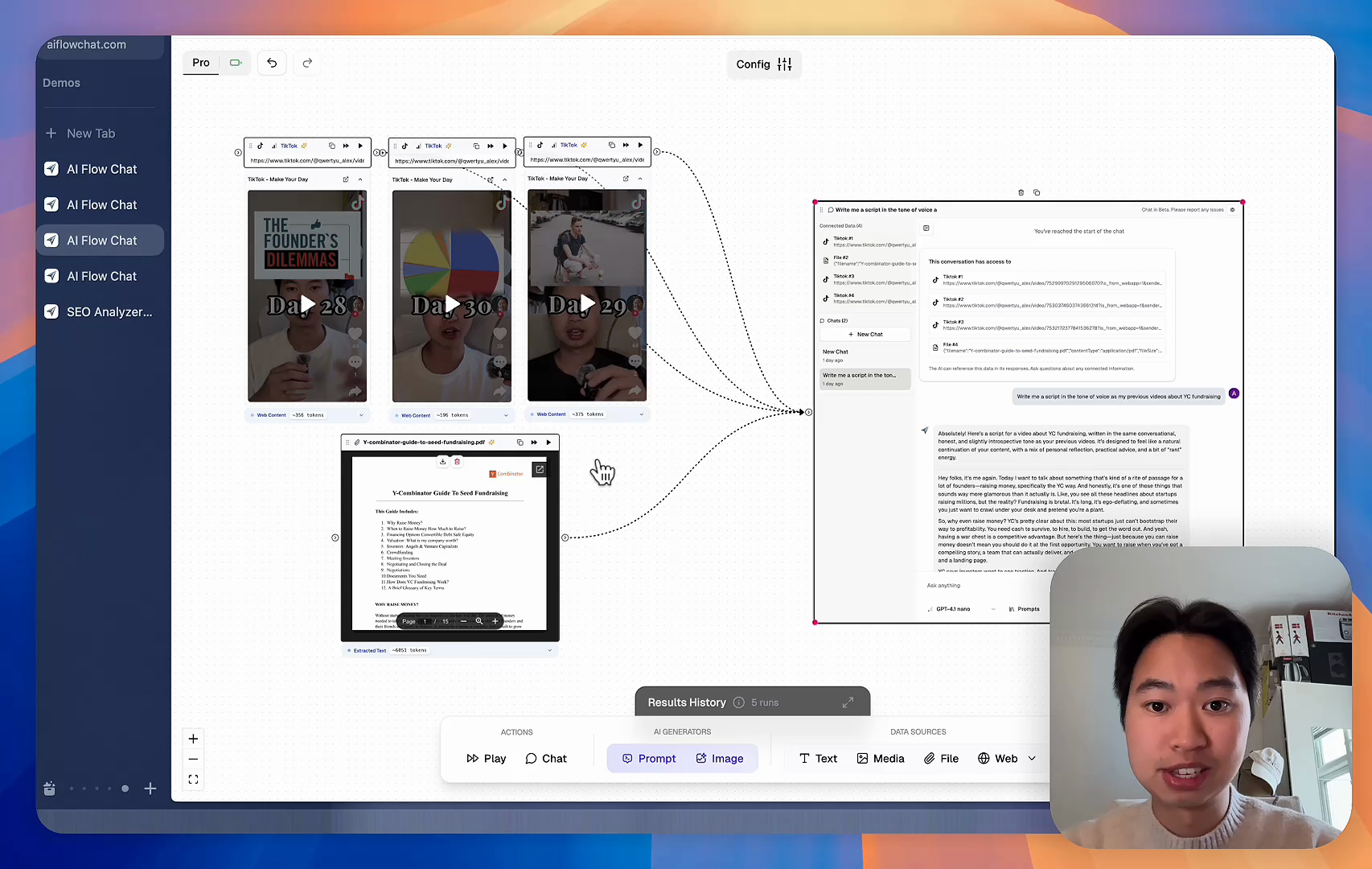
AI Flow Chat lets you save winning prompts to a reusable library, test all models in one workspace, and convert great chats into automated workflows that scale.


Teach World Class AI About Your Business, Content, Competitors… Get World Class Answers, Content, Suggestions...
AI Flow Chat powers our entire content strategy. We double down on what’s working, extract viral elements, and create stuff fast.
Video thumbnail

Reference Anything

Bring anything into context of AI and build content in seconds

YouTube

PDF

DOCX

TikTok

Web

Reels

Video Files

Twitter Videos

Facebook/Meta Ads

Tweets

Coming Soon

Audio Files

Coming Soon

Choose a plan to match your needs

Upgrade or cancel subscriptions anytime. All prices are in USD.

Basic

For normal daily use. Ideal for getting into AI automation and ideation.

$30/month
  • See what Basic gets you
  • 11,000 credits per month
  • Access to all AI models
  • 5 app schedules
  • Free optional onboarding call
  • 1,000 extra credits for $6
Get Started

No risk, cancel anytime.

ProRecommended

For power users with high-volume needs.

$100/month
  • See what Pro gets you
  • 33,000 credits per month
  • Access to all AI models
  • 10 app schedules
  • Remove AI Flow Chat branding from embedded apps
  • Free optional onboarding call
  • 2,000 extra credits for $6
Get Started

No risk, cancel anytime.

Frequently Asked Questions

Everything you need to know about AI Flow Chat. Still have questions? Contact us.